missing translation for 'onlineSavingsMsg'
Learn More
Learn More
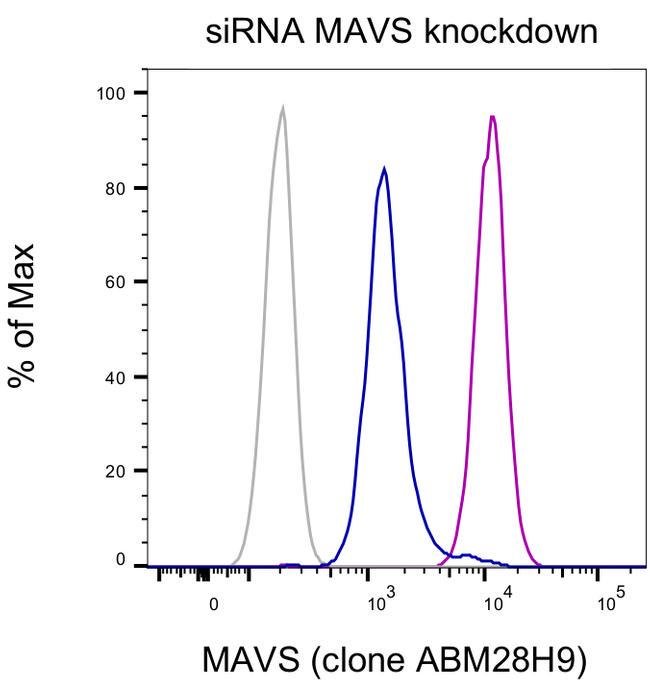
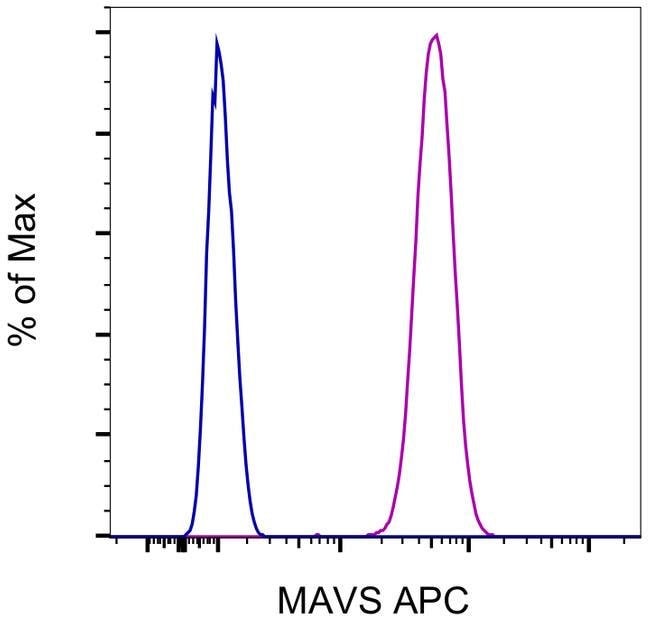
Invitrogen™ MAVS Monoclonal Antibody (ABM28H9), APC, eBioscience™, Invitrogen™

Mouse Monoclonal Antibody
£179.00 - £447.00
Specifications
| Antigen | MAVS |
|---|---|
| Clone | ABM28H9 |
| Concentration | 5 μL/Test |
| Applications | Flow Cytometry |
| Classification | Monoclonal |
| Code produit | Marque | Quantity | Prix | Quantité et disponibilité | |||||
|---|---|---|---|---|---|---|---|---|---|
| Code produit | Marque | Quantity | Prix | Quantité et disponibilité | |||||
|
17191672
|
Invitrogen™
17-9835-41 |
25 Tests | |||||||
|
17101682
|
Invitrogen™
17-9835-42 |
100 Tests |
£447.00
Pack of 100 |
Please sign in to purchase this item. Need a web account? Register with us today! | |||||
Description
Description: This ABM28H9 monoclonal antibody recognizes human MAVS, a mitochondrial membrane protein also known as VISA, CARDIF or IPS-1. Applications Reported: This ABM18H9 antibody has been reported for use in intracellular staining followed by flow cytometric analysis. Applications Tested: This ABM18H9 antibody has been pre-diluted and tested by intracellular staining followed by flow cytometric analysis of HEL cells using the Intracellular Fixation & Permeabilization Buffer Set (Product # 88-8824-00) and protocol. Please refer to Staining Intracellular Antigens for Flow Cytometry, Protocol A: Two step protocol for intracellular (cytoplasmic) proteins located at www.thermofisher.com/flowprotocols. This may be used at 5 μL (0.06 μg) per test. A test is defined as the amount (μg) of antibody that will stain a cell sample in a final volume of 100 μL. Cell number should be determined empirically but can range from 10^5 to 10^8 cells/test. Excitation: 633-647 nm; Emission: 660 nm; Laser: Red Laser
Two distinct signaling pathways activate the host innate immunity against viral infection. One pathway is reliant on members of the Toll-like receptor (TLR) family while the other uses the RNA helicase RIG-I as a receptor for intracellular viral double-stranded RNA as a trigger for the immune response. MAVS is a mitochondrial membrane protein that was identified as a critical component in the IFN beta signaling pathways that recruits IRF-3 to RIG-I, leading to its activation and that of NF-kappa-B. MAVS is also thought to interact with other components of the innate immune pathway such as the TLR adapter protein TRIF, TRAF2 and TRAF6. MAVS also interacts with the IKK-alpha, IKK-beta and IKK-iota kinases through its C-terminal region. Cleavage of this region by the Hepatitis C virus (HCV) protease allows HCV to escape the host immune system. Multiple isoforms of MAVS are known to exist.Spécification
| MAVS | |
| 5 μL/Test | |
| Monoclonal | |
| Liquid | |
| RUO | |
| PBS with BSA and 0.09% sodium azide; pH 7.2 | |
| CARD adapter inducing interferon beta; CARD adaptor inducing IFN-beta; Cardif; D430028G21Rik; IFN-B promoter stimulator 1; IFN-beta promoter stimulator-1; interferon beta promoter stimulator protein 1; interferon-beta promoter stimulator protein 1; IPS1; IPS-1; KIAA1271; MAVS; mitochondrial antiviral signaling protein; mitochondrial anti-viral signaling protein; mitochondrial antiviral-signaling protein; Putative NF-kappa-B-activating protein 031N; virus-induced signaling adapter; virus-induced signaling adaptor; virus-induced-signaling adapter; VISA | |
| MAVS | |
| IgG2b κ | |
| Affinity chromatography | |
| Antibody |
| ABM28H9 | |
| Flow Cytometry | |
| APC | |
| Mouse | |
| Human | |
| Q7Z434 | |
| 57506 | |
| Recombinant fragment of human MAVS (aa 72-296). | |
| Primary | |
| 4°C, store in dark, DO NOT FREEZE! | |
| MAVS |
Vous avez repéré une opportunité d'amélioration ?Partager une correction de contenu
Correction du contenu d'un produit
Veuillez fournir vos retours sur le contenu du produit en remplissant le formulaire ci-dessous.
Nom du produit