missing translation for 'onlineSavingsMsg'
Learn More
Learn More
-(CXCL8)-WB-20170216130641.jpg-650.jpg)
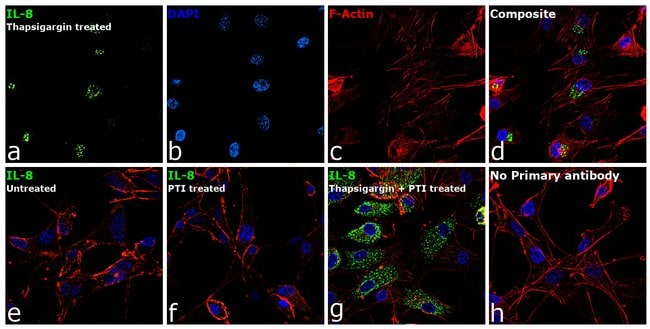
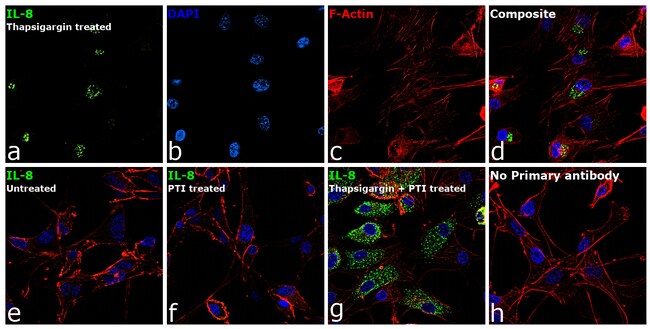
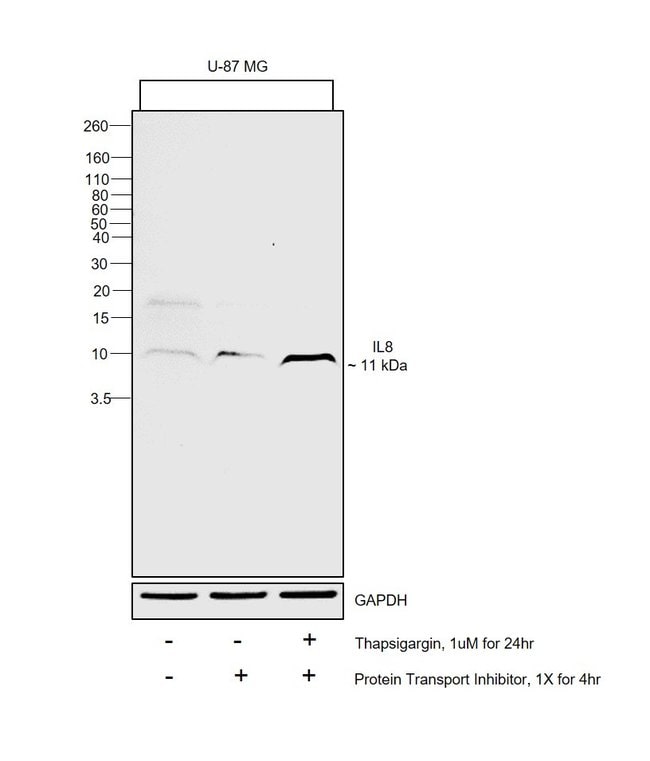
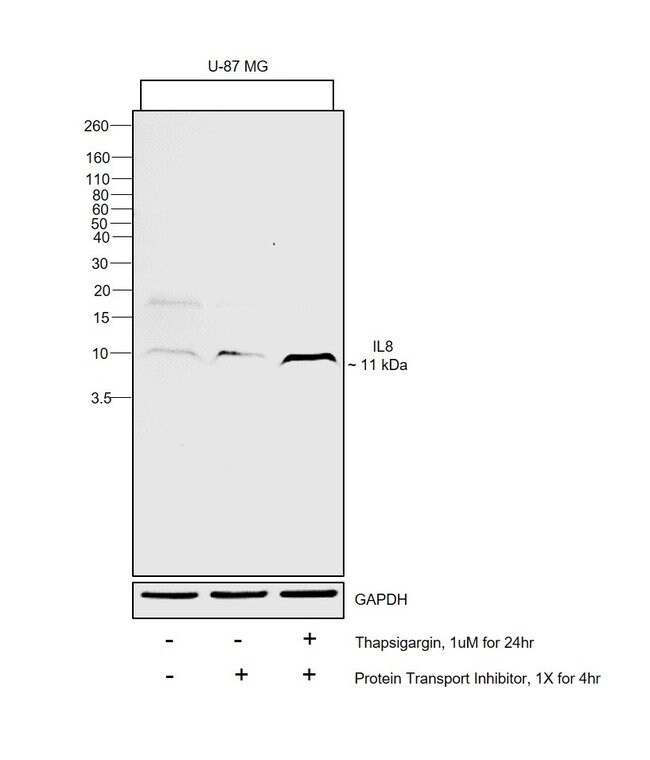
IL-8 (1-77) (CXCL8) Monoclonal Antibody (N11), eBioscience™, Invitrogen™

Mouse Monoclonal Antibody
£171.00 - £384.00
Specifications
| Antigen | IL-8 (1-77) (CXCL8) |
|---|---|
| Clone | N11 |
| Concentration | 0.5 mg/mL |
| Classification | Monoclonal |
| Conjugate | Unconjugated |
Description
Description: The monoclonal antibody N11 reacts specifically with the 77 amino acid form of IL-8 (IL-877, IL-8(1-77), CXCL877) and does not react with the more common 72 amino acid form. Frequently referred to as endothelial IL-8, the 77 amino acid form is secreted in cultured leukocytes. The 72 amino acid form is the result of efficient cleavage of an N-terminal pentamer from IL-877 after secretion. IL-8 is a C-X-C chemokine with potency in neutrophil chemotaxis and activation. IL-877 has decreased chemotactic activity when compared to IL-872, but has other specific pro-apoptotic and tumor cell chemotactic activities. IL-877 has recently been shown to be the major isoform present in premature neonates due to deficiency in serum protease activity that is not seen in term neonates. Applications Reported: This N11 antibody has been reported for use in immunoblotting (WB). Applications Tested: This N11 antibody has been tested by immunoblot of peripheral blood mononuclear cells stimulated with LPS for 4 hours. This can be used at 1-5 μg per mL. It is recommended that the antibody be carefully titrated for optimal performance in the assay of interest. Purity: Greater than 90%, as determined by SDS-PAGE. Aggregation: Less than 10%, as determined by HPLC. Filtration: 0.2 μm post-manufacturing filtered.
Interleukin 8 (IL-8, CXCL8) is a 72 amino acid pro-inflammatory factor which belongs to the CXC subfamily of chemokines, and are bound by the cell surface receptors IL-8RA and IL-8RB. IL-8 functions as a chemoattractant and potent angiogenic factor. The expression and secretion of IL-8 can be induced by diverse inflammatory stimuli in many cells, including macrophages and endothelial cells. In endothelial cells, IL-8 is present in storage vesicles called Weibel-Palade bodies. IL-8, first isolated from osteosarcoma cells, contains the ELR-motif (N-terminal Glu-Leu-Arg amino acid sequence) and signals through the CXCR1 and CXCR2 receptors. Previous nomenclature for IL-8 includes neutrophil activating protein 1 (NAP-1), granulocyte chemotactic protein 1 (GCP-1), monocyte-derived neutrophil-activating peptide (MONAP) and protein 3-10C. IL-8 and ten other members of the CXC chemokine gene family form a chemokine gene cluster in a region mapped to chromosome 4q. Cancer studies have demonstrated a role for IL-8 in the angiogenesis and growth of tumours, and IL-8 is believed to play a role in the pathogenesis of bronchiolitis, a common respiratory tract disease caused by viral infection.Specifications
| IL-8 (1-77) (CXCL8) | |
| 0.5 mg/mL | |
| Unconjugated | |
| Mouse | |
| Human | |
| 3576 | |
| IgG1 | |
| Affinity chromatography | |
| Antibody |
| N11 | |
| Monoclonal | |
| Liquid | |
| RUO | |
| P10145 | |
| CXCL8 | |
| Primary | |
| 4° C | |
| CXCL8 |
For Research Use Only.
Spot an opportunity for improvement?Share a Content Correction
Product Content Correction
Your input is important to us. Please complete this form to provide feedback related to the content on this product.
Product Title