missing translation for 'onlineSavingsMsg'
Learn More
Learn More
Invitrogen™ CD41a Monoclonal Antibody (HIP8), Super Bright™ 436, eBioscience™, Invitrogen™

Mouse Monoclonal Antibody
Brand: Invitrogen™ 62-0419-42
This item is not returnable.
View return policy
Description
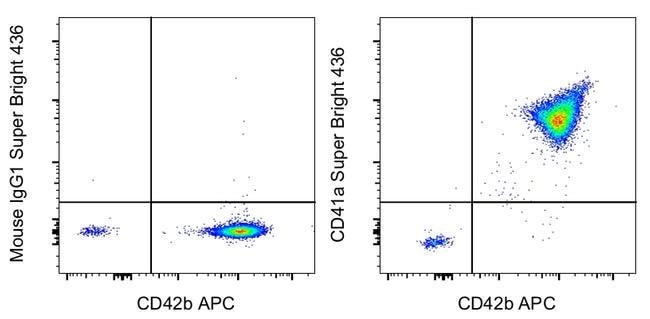
Description: The HIP8 monoclonal antibody reacts with the human CD41 molecule, the integrin alphaIIb also known as platelet GPIIb. CD41 non-covalently associates with integrin beta3 (GPIIIa, CD61) and is expressed by megakaryocytes and platelets. The CD41/CD61 complex is a receptor for fibronectin, fibrinogen, von Willebrand factor, vitronectin and thrombospondin and mediates platelets aggregation. HIP8 blocks platelet aggregation. Applications Reported: This HIP8 antibody has been reported for use in flow cytometric analysis. Applications Tested: This HIP8 antibody has been pre-diluted and tested by flow cytometric analysis of mouse splenocytes. This may be used at 5 μL (0.25 μg) per test. A test is defined as the amount (μg) of antibody that will stain a cell sample in a final volume of 100 μL. Cell number should be determined empirically but can range from 10^5 to 10^8 cells/test. Super Bright 436 can be excited with the violet laser line (405 nm) and emits at 436 nm. We recommend using a 450/50 bandpass filter, or equivalent. Please make sure that your instrument is capable of detecting this fluorochrome. When using two or more Super Bright dye-conjugated antibodies in a staining panel, it is recommended to use Super Bright Complete Staining Buffer (Product No. SB-4401) to minimize any non-specific polymer interactions. Please refer to the datasheet for Super Bright Staining Buffer for more information.
CD41, also known as platelet glycoprotein IIb or ITGA2B, is a protein composed of two subunits: a 120 kDa alpha subunit and a 23 kDa beta subunit. It interacts with CD61 (gpIIIa, integrin beta III) in the presence of calcium to form a functional adhesive protein receptor. Initially thought to be expressed exclusively on platelets and megakaryocytes, CD41 is also found on hematopoietic progenitors in the embryo, fetus, and adult, indicating its role in early stages of hematopoietic differentiation. CD41 plays a crucial role in platelet function and blood coagulation by mediating platelet aggregation. Upon blood vessel damage, CD41 binds to various adhesion molecules, including von Willebrand factor, fibrinogen, fibronectin, and vitronectin, facilitating platelet adhesion and aggregation. This receptor is essential for platelet function, contributing to the binding of several adhesion molecules and playing a significant role in hemostasis. Diseases associated with CD41 dysfunction include Glanzmann Thrombasthenia and Platelet type-16 bleeding disorder, highlighting its importance in normal platelet function and blood coagulation processes.
Specifications
| CD41a | |
| Monoclonal | |
| 5 μL/Test | |
| PBS with BSA and 0.09% sodium azide; pH 7.2 | |
| P08514 | |
| Itga2b | |
| Affinity chromatography | |
| RUO | |
| 3674 | |
| 4°C, store in dark, DO NOT FREEZE! | |
| Liquid |
| Flow Cytometry | |
| HIP8 | |
| Super Bright 436 | |
| Itga2b | |
| AI172977; alpha IIb; alphaIIb; alphaIIb protein; BDPLT16; BDPLT2; CD41; CD41B; form 1; form 2; GP IIb; GP2B; GPalpha IIb; GPIIb; GT; GTA; HPA3; integrin alpha 2b; integrin alpha 2b (Cd41b); integrin alpha-IIb; Integrin alpha-IIb heavy chain; Integrin alpha-IIb light chain; Integrin alpha-IIb light chain, form 1; Integrin alpha-IIb light chain, form 2; integrin subunit alpha 2b; integrin subunit alpha IIb; integrin, alpha 2B; integrin, alpha 2b (platelet glycoprotein IIb of IIb/IIIa complex, antigen CD41); ITGA2B; ITGAB; platelet fibrinogen receptor, alpha subunit; platelet glycoprotein IIb; platelet glycoprotein IIb of IIb/II Ia complex; platelet glycoprotein IIb of IIb/IIIa complex; platelet membrane glycoprotein IIb; platelet-specific antigen BAK; PPP1R93; protein phosphatase 1, regulatory subunit 93 | |
| Mouse | |
| 100 Tests | |
| Primary | |
| Human | |
| Antibody | |
| IgG1 κ |
Product Content Correction
Your input is important to us. Please complete this form to provide feedback related to the content on this product.
Product Title
Spot an opportunity for improvement?Share a Content Correction