Restriction Enzymes
Restriction enzymes are able to cleave DNA at or near specific recognition sequences (known as restriction sites). The resulting DNA fragments can then be bound together to create new sequences. Our product range includes various restriction enzymes, kits, buffers, and more.
Useful Links
Save Now - Exclusive Deals

Product Code 10304340

Product Code 7180331

Product Code 4521470

Product Code 11863933

Product Code 4521691

Product Code 4521759

Product Code 10384280

Product Code 10304240

Product Code 6543158

Product Code 15441933

Product Code 6543151

Product Code 6543149
Must Have

Product Code 4521909

Product Code 10715271

Product Code 4521717

Product Code 4521889

Product Code 4521817

Product Code 4521484

Product Code 4521901

Product Code 18416548
Complete Your Order - Great Deals

Product Code 10685273

Product Code 10578360

Product Code 11955331
FAQ
The primary action of a restriction enzyme is to cut DNA at specific sequences known as recognition sites. This process involves several key steps:
- Recognition: The enzyme binds to a specific DNA sequence. Each restriction enzyme recognizes a particular sequence of nucleotides that is typically palindromic (reads the same forwards and backwards on complementary strands)
- Binding: The enzyme binds to the DNA at the recognition site. This binding involves interactions between the enzyme and the specific nucleotide sequence
- Cleavage: The enzyme cleaves the DNA backbone at specific locations within or near the recognition site. This cleavage can result in "blunt ends" or "sticky ends"
- Blunt Ends: The DNA is cut straight across both strands, resulting in ends that are even
- Sticky Ends: The DNA is cut in a staggered manner, resulting in overhanging single-stranded ends that can easily pair with complementary sequences
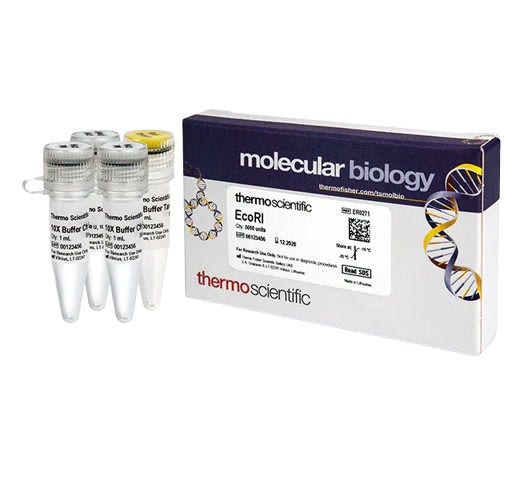
For example, the restriction enzyme EcoRI recognizes the palindromic sequence 5'-GAATTC-3' and cuts between the G and the A on each strand, producing sticky ends:
This results in:
5’-GAATTC-3’ 3’-CTTAA↑G-5’5’-GAATTC-3’ 3’-CTTAA↑G-5’
and
5’-G 3’-CTTAA AATTC-3’ G-5’5’-G 3’-CTTAA AATTC-3’ G-5’
Restriction enzymes are classified into four main types based on their structure, recognition sequence, cleavage site, and cofactor requirements. Here is an overview of each type:
- Type I Restriction Enzymes
These enzymes cut DNA at random sites that are far from their recognition sequences. They are complex, multi-subunit enzymes with both restriction and modification (methylation) activities. They recognize specific sequences but cleave the DNA at sites that can be hundreds to thousands of base pairs away from the recognition site. Require ATP and S-adenosyl methionine (SAM) for activity. - Type II Restriction Enzymes
These enzymes cut DNA at specific sites within or close to their recognition sequences. Generally simpler, usually consisting of a single subunit. They recognize specific palindromic sequences, typically 4-8 base pairs in length, and cleave the DNA at or near these sites. Require Mg²⁺ as a cofactor but do not need ATP. These are widely used in molecular biology for cloning, DNA mapping, and other genetic manipulations due to their predictable and precise cutting. - Type III Restriction Enzymes
These enzymes cut DNA at sites a short distance away from their recognition sequences. They are composed of two subunits: one for restriction and one for modification. Recognize specific sequences and cleave the DNA 20-30 base pairs away from the recognition site. Require ATP for restriction activity and SAM for modification activity. - Type IV Restriction Enzymes
These enzymes specifically recognize and cut modified DNA, such as methylated or hydroxymethylated DNA. Typically complex, but the exact structure can vary. Recognize modified bases within specific sequences. Usually require Mg²⁺ as a cofactor, but specifics can vary depending on the enzyme.
Type II enzymes are the most commonly used due to their precise and predictable cutting patterns.
When selecting restriction enzymes for a specific molecular biology application, consider these five key points to ensure successful and efficient DNA manipulation:
1. Recognition Sequence
Choose an enzyme that recognizes a specific sequence within your DNA of interest. Ensure that the recognition sequence is present at the desired location in the DNA and absent from other regions where cutting is not desired. Consider the length of the recognition sequence. Enzymes that recognize longer sequences (e.g., 8 base pairs) cut less frequently than those recognizing shorter sequences (e.g., 4 base pairs).
2. Cleavage Pattern
Determine whether you need blunt ends or sticky (cohesive) ends. Sticky ends are often preferred for cloning because they facilitate the ligation of DNA fragments. Ensure that the enzyme cuts at the desired position within or near the recognition site.
3. Reaction Conditions
Check the buffer requirements for the enzyme. If multiple enzymes are used in a single reaction, ensure that a compatible buffer exists or that buffer conditions can be adjusted without loss of activity. Verify the optimal temperature for enzyme activity. Most restriction enzymes work best at 37°C, but some require different temperatures. Some restriction enzymes are sensitive to DNA methylation. Ensure that the enzyme you select can cut methylated DNA if your DNA sample is likely to be methylated.
4. Star Activity
Be aware of "star activity", where an enzyme cuts at sites similar but not identical to its recognition sequence under non-optimal conditions (e.g., high glycerol concentration, low ionic strength, high pH). To minimize star activity, use the enzyme under optimal conditions as recommended by the manufacturer.
5. Commercial Availability and Cost
Ensure the enzyme is readily available from reliable suppliers. Consider the cost of the enzyme, especially if large amounts or multiple enzymes are required for your experiments. Select high-quality, highly purified enzymes to ensure consistent and reliable results.
Example Scenario
For instance, if you are cloning a gene into a plasmid vector, you might select an enzyme like EcoRI that produces sticky ends. You would ensure that the recognition sequence (5'-GAATTC-3') is present at the cloning site in both the gene and the vector. You would check that EcoRI is compatible with the buffer used in your reaction, operates optimally at 37°C, and is not inhibited by methylation if your DNA is methylated.
Resources and Related Information

Shop By Brand