
Introduction
Laboratory glassware—whether beakers, test tubes, vials, burettes, or cylinders—is fundamental to scientific workflows. But choosing the right type of glassware is about more than just function. It directly affects lab safety, accuracy, and regulatory compliance. This is especially true in pharmaceutical environments, where glassware must meet the highest standards for purity, durability, and reliability. This guide outlines key selection criteria with a focus on quality, performance, and sustainability and explains why DWK Life Sciences is a trusted partner for precision glassware.
1. Why Glass Type Matters: Not All Glass is Created Equal
Different glass types deliver different levels of performance. Selecting the appropriate material is essential to ensure compatibility with chemical processes, temperature demands, and regulatory frameworks.
Borosilicate Glass – A Laboratory Essential
Borosilicate glass is one of the most widely used materials in laboratories due to its excellent chemical resistance and ability to withstand the high temperatures commonly encountered in lab environments. Its low coefficient of thermal expansion allows the production of glassware with thicker walls, delivering greater mechanical strength and durability.
While not as pure as quartz glass, borosilicate is significantly easier and more cost-effective to manufacture, making it a practical and affordable choice for most lab applications. You’ll find borosilicate glass in a wide range of laboratory items, including beakers, vials, test tubes, and flasks, thanks to its versatility and thermal stability. However, it is not inert to every chemical. Special care is required when working with hydrofluoric acid, strong alkalis, or concentrated phosphoric acid. For applications involving these chemicals, alternative materials such as PTFE or quartz may be more appropriate.
Soda-Lime Glass – A Cost-Effective Choice for Routine Use
Soda-lime glass, composed of silica, soda ash, and lime, is the most common and economical glass type. It has a moderate coefficient of thermal expansion and is relatively inexpensive to produce. The key properties of this glass that it is transparent, chemically stable, inert, durable, easily moldable, and affordable making it suitable for a wide range of applications. Though not as durable as borosilicate or quartz glass, it remains a practical solution for disposable or routine-use laboratory items that are needed in large quantities.
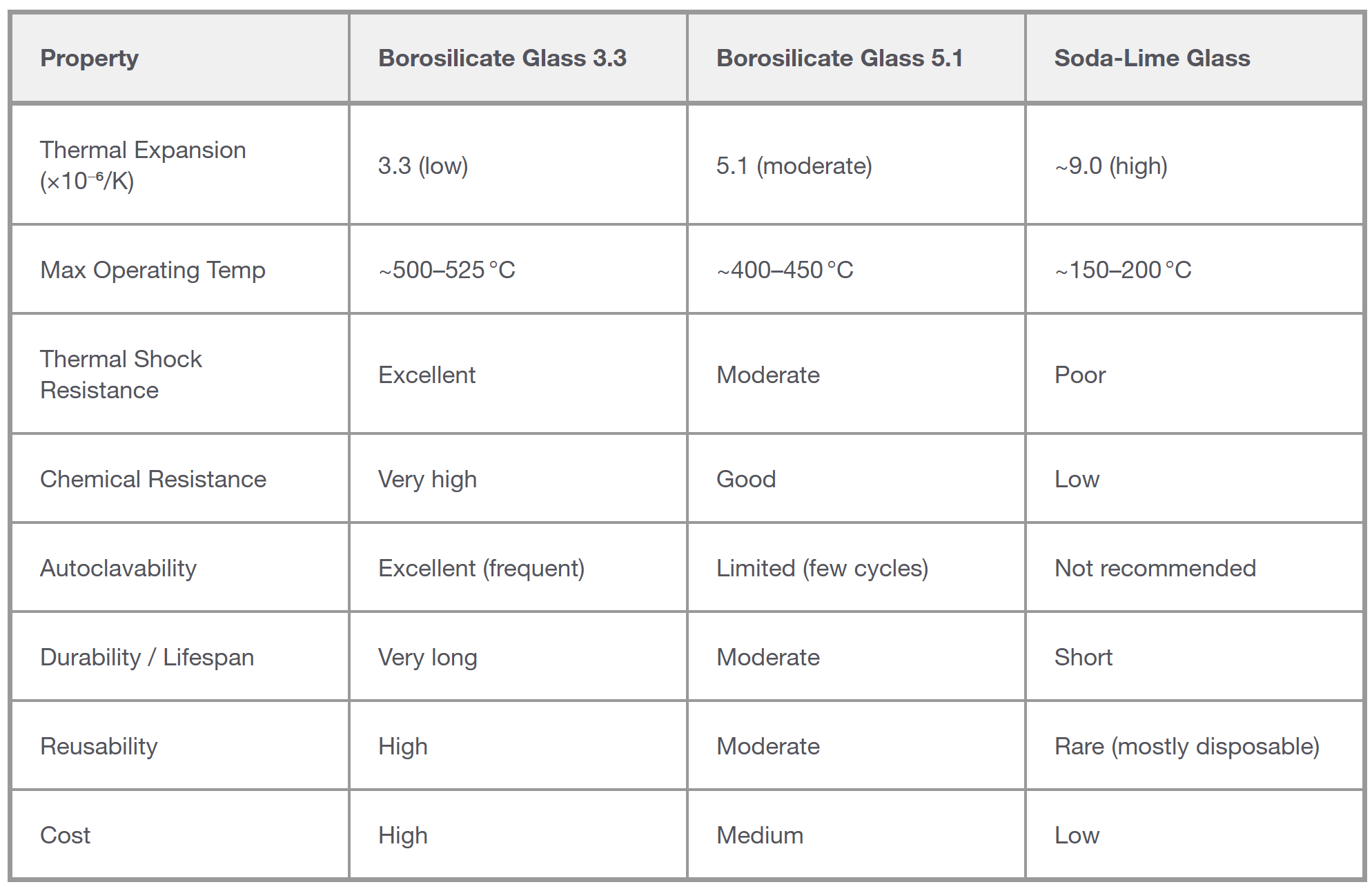
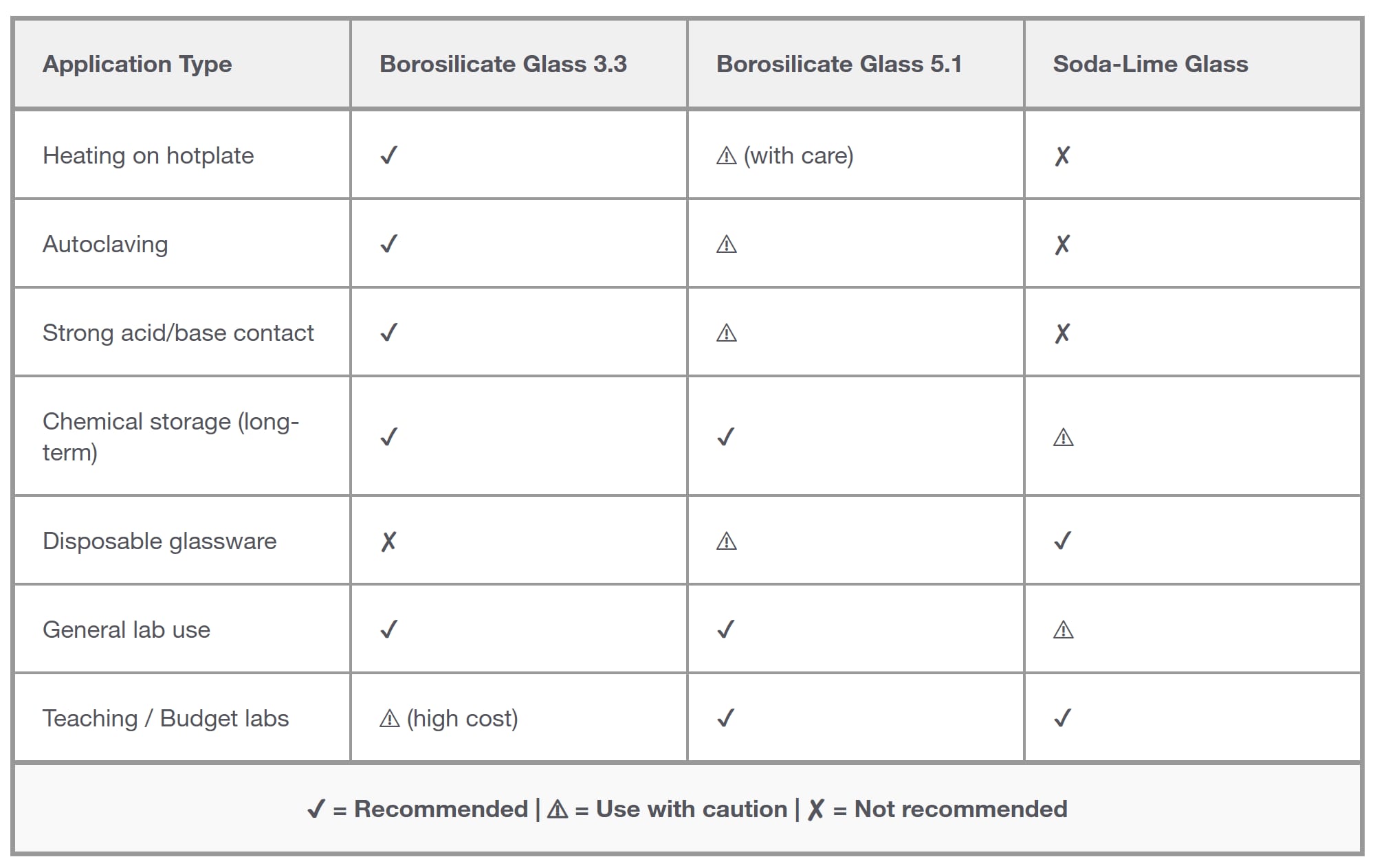
To support informed selection, the following tables compare key physical and chemical properties of common laboratory glass types—borosilicate 3.3, borosilicate 5.1, and soda-lime glass—as well as their suitability for typical lab applications. This side-by-side view helps identify the most appropriate material based on performance, durability, and intended use.
Quartz Glass – For Precision and Extreme and Conditions
Quartz glass (fused silica) contains nearly 100% silicon dioxide and is produced at very high temperatures (~2,000 °C). It delivers unmatched performance in demanding lab and industrial environments. With high optical clarity, low thermal expansion, and excellent resistance to heat, chemicals, and electrical conductivity, quartz is ideal for:
- Analytical chemistry (e.g., spectrophotometry, chromatography)
- High-purity and high-temperature sample preparation
- Semiconductor and microelectronics applications
- UV and IR light exposure (e.g., cuvettes, optical lenses)
- Handling of volatile or reactive substances
Due to its purity and production complexity, quartz is more expensive than other glasses but remains the material of choice for applications requiring high performance and precision.
2. Key Selection Criteria for Pharmaceutical Laboratories
Pharmaceutical laboratories operate under strict regulatory requirements and process demands. Glassware used in these settings must go beyond basic functionality to ensure consistency, compliance, and the protection of sensitive materials.
Chemical resistance is paramount. Pharmaceutical-grade glassware must withstand contact with strong acids, solvents, and aggressive reagents without leaching or structural degradation. This safeguards both sample and container integrity.
Sterilizability is essential for contamination control. Glassware must tolerate repeated autoclaving, dry heat sterilization, and chemical sterilant without compromising physical properties—ensuring sterility in aseptic processes.
Precision and optical clarity support accurate volume measurements and reliable visual inspections. This is particularly important in titrations, spectroscopy, and other analytical procedures where precision directly affects outcomes.
Regulatory compliance with international standards such as USP and EP is an essential requirement in pharmaceutical workflows. Conforming to these standards supports GMP documentation, process validation, and audit readiness.
Application-specific formats are also critical. Pharmaceutical workflows often require specialized containers such as ampoules, serum vials, HPLC sample vials, and cuvettes—all of which must meet stringent specifications for safety and compatibility.
Finally, sustainability has become a key consideration. Reusable, long-lasting glassware helps laboratories reduce waste and operating costs while aligning with broader environmental objectives.
By prioritizing these criteria, pharmaceutical laboratories can ensure optimal performance, compliance, and sustainability, even under the most demanding conditions.
3. The Comprehensive Benefits of DWK Glassware
DWK Life Sciences offers a complete range of glassware engineered to support pharmaceutical workflows by offering consistent high performance:
- Outstanding Chemical Resistance
Designed to withstand aggressive reagents and solvents without leaching or degradation - Thermal Shock Resistance
Reliably handles rapid temperature changes, enabling safe transition between heating and cooling steps - Exceptional Durability
Robust construction ensures long-term use, reducing breakage and replacement frequency - Superior Clarity and Precision
Enables accurate measurement and clear observation, critical in analytical and quality control applications - Compliance with USP and EP Standards
Ensures your lab stays aligned with global regulatory requirements for pharmaceutical manufacturing - Sustainable by Design
DWK’s reusable glassware contributes to waste reduction and aligns with broader sustainability goals in laboratory operations
Choosing the right glassware is more than a purchasing decision—it’s a strategic choice that affects lab safety, accuracy, and compliance. DWK Life Sciences delivers reliable, high-performance glassware tailored to the unique demands of pharmaceutical laboratories. By selecting DWK, you invest in quality, consistency, and sustainability.
Related Products
Formulation and Stability Testing
Use DWK reagent bottles and storage containers to monitor long-term stability under varied conditions.

Catalog Number 5195673

Catalog Number 11752282
Sterile Fill-Finish Processes
Precision vials ensure integrity in aseptic manufacturing workflows.

Catalog Number 17870525
Analytical QC and HPLC
Certified DWK vials provide consistent background profiles for chromatographic analysis.

Catalog Number 15849007

Catalog Number 16621076
Vaccine or Biologic Development
Borosilicate flasks and tubes ensure accurate sample preparation with minimal contamination risk.

Catalog Number 15210866

Catalog Number 11726278