missing translation for 'onlineSavingsMsg'
Learn More
Learn More
PeproTech WNT1 Polyclonal Antibody, Biotin, PeproTech®, Invitrogen™

Rabbit Polyclonal Antibody
Brand: PeproTech 500-P250BT-50UG
This item is not returnable.
View return policy
Description
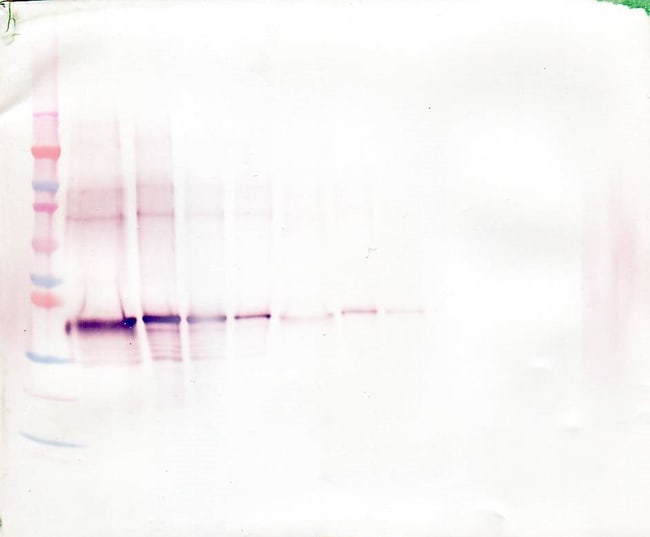
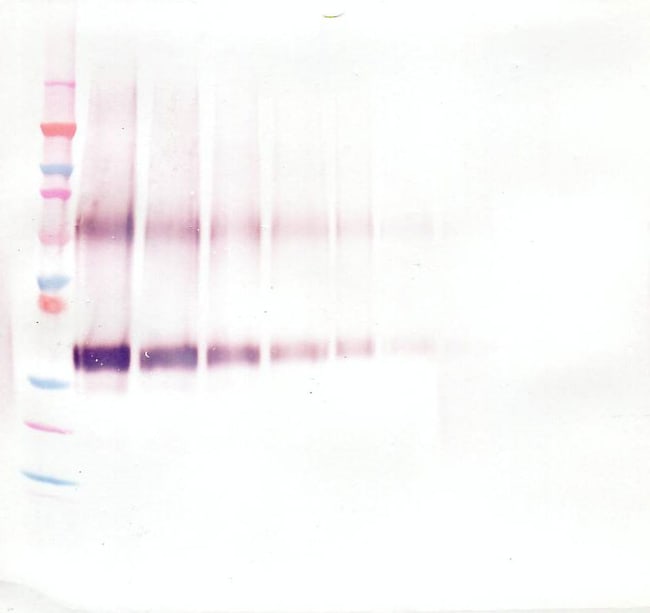
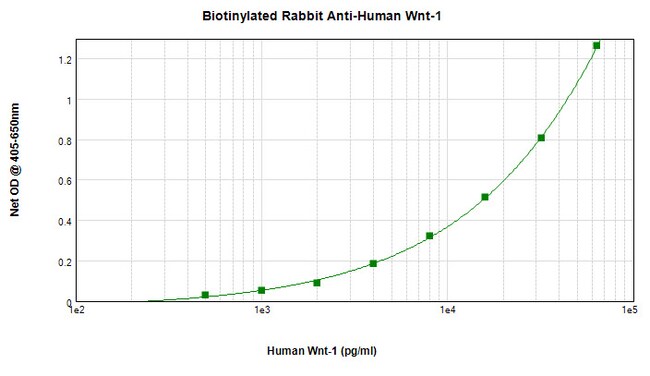
AA Sequence of recombinant protein: ANSSGRWWGI VNVASSTNLL TDSKSLQLVL EPSLQLLSRK QRRLIRQNPG ILHSVSGGLQ SAVRECKWQF RNRRWNCPTA PGPHLFGKIV NRGCRETAFI FAITSAGVTH SVARSCSEGS IESCTCDYRR RGPGGPDWHW GGCSDNIDFG RLFGREFVDS GEKGRDLRFL MNLHNNEAGR TTVFSEMRQE CKCHGMSGSC TVRTCWMRLP TLRAVGDVLR DRFDGASRVL YGNRGSNRAS RAELLRLEPE DPAHKPPSPH DLVYFEKSPN FCTYSGRLGT AGTAGRACNS SSPALDGCEL LCCGRGHRTR TQRVTERCNC TFHWCCHVSC RNCTHTRVLH ECL. Preparation: Produced from sera of rabbits immunized with highly pure Recombinant Human Wnt-1. Anti-Human Wnt-1-specific antibody was purified by affinity chromatography and then biotinylated. Sandwich ELISA: To detect hWNT-1 by sandwich ELISA (using 100 μL/well antibody solution) a concentration of 0.25-1.0 μg/mL of this antibody is required. This biotinylated polyclonal antibody, in conjunction with PeproTech Polyclonal Anti-Human WNT-1 (500-P250) as a capture antibody, allows the detection of at least 0.2-0.4 ng/well of Recombinant hWNT-1. Western Blot: To detect hWNT-1 by Western Blot analysis this antibody can be used at a concentration of 0.1-0.2 μg/mL. Used in conjunction with compatible secondary reagents the detection limit for Recombinant hWNT-1 is 1.5-3.0 ng/lane, under either reducing or non-reducing conditions. 500-P250BT-1MG will be provided as 2 x 500 μg
Wnt proteins constitute a family of secreted glyocoproteins that activate signal transduction pathways to mediate tissue homeostasis, cell fate, cell proliferation, and self-renewal. The canonical signaling pathway is initiated upon Wnt binding to a Frizzled family receptor and an LRP5/LRP6 coreceptor, which leads to activation of the beta-catenin cascade. Non-canonical Wnt signals are activated by binding to a Frizzled family receptor and ROR2 coreceptor. Extensive research has shown that deregulation of these pathways or its components can lead to cancer. Human Wnt-1 is encoded as a 370 amino acid precursor that, upon secretion, is cleaved into a 343 amino acid (42 kDa) mature form. At the amino acid level, mature human Wnt-1 is approximately 99% identical to mature mouse Wnt-1. Depending on the tissue, Wnt-1 can activate the canonical and non-canonical signaling pathways. Studies have demonstrated its involvement in a variety of functions, including embryonic development and carcinogenesis. Wnt-1 signaling can also induce the phosphorylation and subsequent degradation of c-Myb.
Specifications
| WNT1 | |
| Polyclonal | |
| Biotin | |
| WNT1 | |
| BMND16; INT1; Int-1; murine mammary tumor virus integration site; OI15; Proto-oncogene Int-1; proto-oncogene Int-1 homolog; proto-oncogene protein Wnt-1; proto-oncogene Wnt-1; sw; swaying; wingless-related MMTV integration site 1; Wingless-type MMTV integration site 1 homolog; Wingless-type MMTV integration site 1, homolog; wingless-type MMTV integration site family member 1; wingless-type MMTV integration site family, member 1; wingless-type MMTV integration site family, member 1 (oncogene INT1); Wnt family member 1; Wnt1; Wnt-1 | |
| Rabbit | |
| Antigen affinity chromatography | |
| RUO | |
| 7471 | |
| -20°C | |
| Lyophilized |
| ELISA, Western Blot | |
| 0.1-1.0 mg/mL | |
| PBS with no preservative | |
| P04628 | |
| WNT1 | |
| E.coli-derived, 38.4 kDa Recombinant Human Wnt-1. | |
| 50 μg | |
| Primary | |
| Human | |
| Antibody |
Product Content Correction
Your input is important to us. Please complete this form to provide feedback related to the content on this product.
Product Title
Spot an opportunity for improvement?Share a Content Correction