missing translation for 'onlineSavingsMsg'
Learn More
Learn More
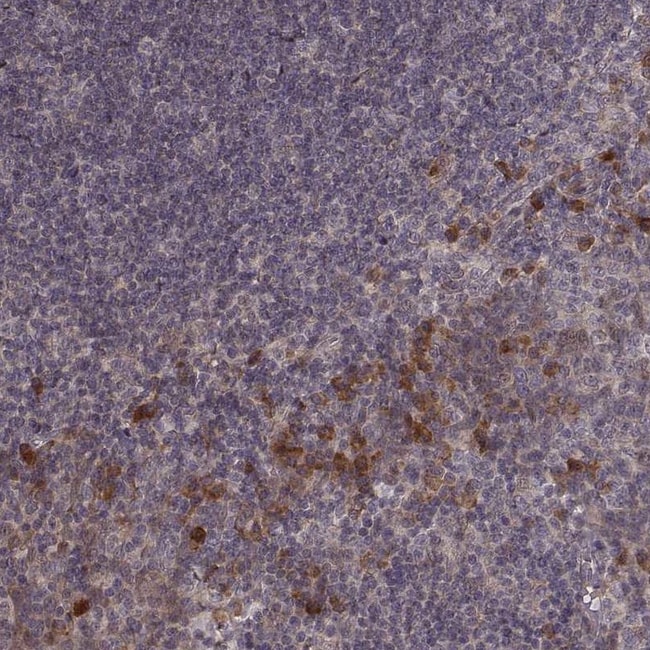
Invitrogen™ USP15 Polyclonal Antibody

Rabbit Polyclonal Antibody
£550.00
Specifications
| Antigen | USP15 |
|---|---|
| Concentration | 0.05 mg/mL |
| Content And Storage | Store at 4°C short term. For long term storage, store at -20°C, avoiding freeze/thaw cycles. |
| Applications | Immunohistochemistry (Paraffin) |
| Classification | Polyclonal |
| Product Code | Brand | Quantity | Price | Quantity & Availability | |||||
|---|---|---|---|---|---|---|---|---|---|
| Product Code | Brand | Quantity | Price | Quantity & Availability | |||||
|
17118633
|
Invitrogen™
PA5110706 |
100 μL |
£550.00
100µL |
Please sign in to purchase this item. Need a web account? Register with us today! | |||||
|
17169583
|
Invitrogen™
PA5111668 |
100 μL |
£550.00
100µL |
Please sign in to purchase this item. Need a web account? Register with us today! | |||||
Description
Immunogen sequence: IFAMDENLSS IMERDDIYVF EININRTEDT EHVIIPVCLR EKFRHSSYTH HTGSSLFGQP FLMAVPRNNT EDKLYNLLLL RMCRYVKIST ETEETEGSLH CCKDQNINGN GPNGIHEEGS PSEMETD Highest antigen sequence indentity to the following orthologs: Rat - 95%, Mouse - 92%.
Modification of target proteins by ubiquitin participates in a wide array of biological functions. Proteins destined for degradation or processing via the 26 S proteasome are coupled to multiple copies of ubiquitin. However, attachment of ubiquitin or ubiquitin-related molecules may also result in changes in subcellular distribution or modification of protein activity. An additional level of ubiquitin regulation, deubiquitination, is catalyzed by proteases called deubiquitinating enzymes, which fall into four distinct families. Ubiquitin C-terminal hydrolases, ubiquitin-specific processing proteases (USPs),1 OTU-domain ubiquitin-aldehyde-binding proteins, and Jab1/Pad1/MPN-domain-containing metallo-enzymes. Among these four families, USPs represent the most widespread and represented deubiquitinating enzymes across evolution. USPs tend to release ubiquitin from a conjugated protein. They display similar catalytic domains containing conserved Cys and His boxes but divergent N-terminal and occasionally C-terminal extensions, which are thought to function in substrate recognition, subcellular localization, and protein-protein interactions.Specifications
| USP15 | |
| Store at 4°C short term. For long term storage, store at -20°C, avoiding freeze/thaw cycles. | |
| Polyclonal | |
| Liquid | |
| IgG | |
| Human | |
| USP15 | |
| 4921514G19Rik; AI327321; deubiquitinating enzyme 15; deubiquitinating enzyme Ubp109; E430033I05Rik; Gcap18; granule cell antiserum positive 18; Kiaa0529; MGC131982; MGC149838; MGC74854; Ubiquitin carboxyl-terminal hydrolase 15; ubiquitin carboxyl-terminal hydrolase of 109 kDa; ubiquitin specific peptidase 15; ubiquitin specific protease 15; ubiquitin thioesterase 15; ubiquitin thiolesterase 15; ubiquitin-specific-processing protease 15; ubp109; UNPH-2; Unph4; Usp15 | |
| USP15 | |
| Primary | |
| Antigen affinity chromatography |
| 0.05 mg/mL | |
| Immunohistochemistry (Paraffin) | |
| Unconjugated | |
| Rabbit | |
| RUO | |
| PBS with 40% glycerol and 0.02% sodium azide; pH 7.2 | |
| Q9Y4E8 | |
| 9958 | |
| Recombinant Protein corresonding to Human USP15. Recombinant protein control fragment (Product #RP-89264). | |
| Antibody |
Spot an opportunity for improvement?Share a Content Correction
Product Content Correction
Your input is important to us. Please complete this form to provide feedback related to the content on this product.
Product Title