missing translation for 'onlineSavingsMsg'
Learn More

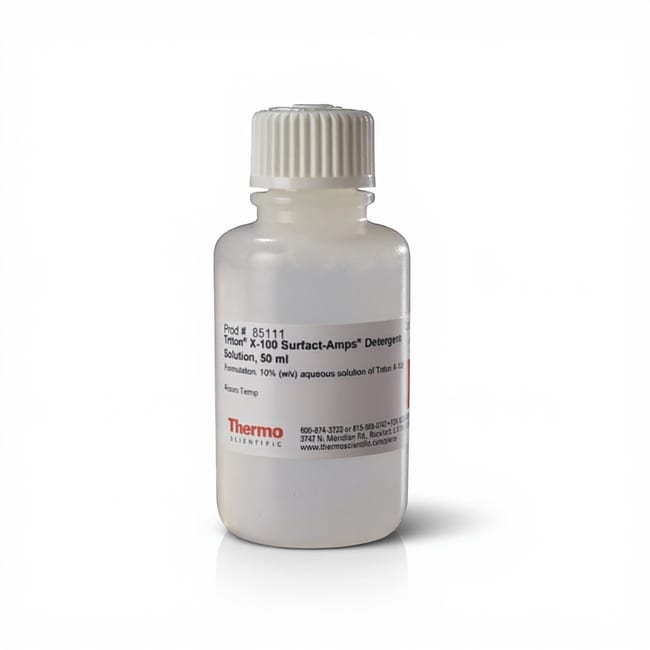
Thermo Scientific™ Triton™ X-100 Surfact-Amps™ Detergent Solution

Product Code. 13444259 Shop All Thermo Scientific Products
Change view
Click to view available options
Quantity:
50 mL
250 mL
6 x 10 mL
1 L
Unit Size:
1000mL
250mL
50mL
Pack of 6
4 product options available for selection
Product selection table with 4 available options. Use arrow keys to navigate and Enter or Space to select.
Product Code. Quantity unitSize
13444259 50 mL 50mL
11891445 6 x 10 mL Pack of 6
13454259 250 mL 250mL
11358311 1 L 1000mL
Use arrow keys to navigate between rows. Press Enter or Space to select a product option. 4 options available.
4 options
This item is not returnable. View return policy
Regulatory: This product contains a substance listed in Annex XIV to REACH Regulation (EC) No 1907/2006, all customers must complete a declaration before delivery.
Product Code. 13444259 Supplier Thermo Scientific™ Supplier No. 85111

Please to purchase this item. Need a web account? Register with us today!

This item is not returnable. View return policy
Regulatory: This product contains a substance listed in Annex XIV to REACH Regulation (EC) No 1907/2006, all customers must complete a declaration before delivery.

Thermo Scientific Triton X-100 Surfact-Amps Detergent Solution is a highly-purified Triton™ X-100 detergent stabilized as a 10% solution (w/v) in variable sizes packaged under nitrogen in 10 mL glass ampules or three sizes of non-leaching HDPE bottles, ensuring their stability and eliminating the accumulation of peroxides and degradation products.

Features of Triton X-100 Surfact-Amps Detergent Solution:

  • Triton X-100—a nonionic detergent for use in various protein methods
  • Accurate—precise 10% detergent solution in ultrapure water
  • Easy-to-use—solution is simple to dispense and dilute for use
  • Exceptionally pure—less than 1.0μeq/mL peroxides and carbonyls
  • Stable—packaged under inert nitrogen gas in glass ampules or HDPE bottles

Specifications for Triton X-100 Surfact-Amps Detergent Solution:

  • Visual: Clear to slightly hazy, colorless solution, free of particulate matter.
  • Concentration: 10.0±1.0%
  • Oxidants: ≤1.0μeq/mL
  • Carbonyls: ≤1.0μeq/mL
  • Suspended Solids: Residue present must not exceed Residue Reference.

Properties of Triton X-100:

  • Molecular Weight: 647 g
  • Detergent Class: Nonionic polyoxyethylene surfactant
  • Aggregation Number: 140
  • Micelle Molecular Weight: 90,000 g
  • Critical Micelle Concentration (CMC): 0.24 mM (0.0155% w/v)
  • Cloud Point: 64°C
  • Dialyzable: No

Triton X-100 is most frequently used as a component of cell lysis buffers or other solutions intended to extract and solubilize proteins.

Related Products

  • Surfact-Amps™ Detergent Sampler (Cat. No. 28340)

TRUSTED_SUSTAINABILITY

Specifications

Product Type Detergent
Content And Storage Store between 20°C and 25°C
Form Liquid
Product Line Surfact-Amps, Triton
Reagent Type Detergent Solution
Quantity 50 mL
I need to do immunolabeling of a thick cryosection, around 60 µm thick. What should I do to ensure good labeling with my antibody?

One thing you should do is to permeabilize well, by including 0.1% to 0.2% Triton X-100 in all washes and incubations. Another recommendation is to extend the labeling times to overnight at 4oC for both primary antibody and secondary antibody. Finally, label the section free-floating, rather than adhered to a slide, to gain penetration for the antibody from both sides.

What are the storage conditions for Triton X-100 Surfact-Amps Detergent Solution (Cat. No. 85111)?

After opening, we recommend storing the unused solution sealed in an air-tight vial containing minimal air space or from which the air has been purged with nitrogen gas. Frequent opening should be avoided because Triton X-100 is susceptible to autoxidation upon exposure to air.

Can you provide the shelf life for Triton X-100 Surfact-Amps Detergent Solution (Cat. No. 85111)?

Triton X-100 Surfact-Amps Detergent Solution is covered under our general 1-year warranty and is guaranteed to be fully functional for 12 months from the date of shipment, if stored as recommended (20-25 degrees C). Please see section 8.1 of our Terms & Conditions of Sale (https://www.thermofisher.com/content/dam/LifeTech/Documents/PDFs/Terms-and-Conditions-of-Sale.pdf).

What are the main advantages of using Thermo Scientific Pierce Surfact-Amps detergents?

Thermo Scientific Pierce Surfact-Amps detergents are highly purified, precisely diluted (10%) formulations that are ideal for applications or assays that are sensitive to contaminants that are present in unpurified detergents. We test every batch to insure that our detergents contain less than 1.0 µeq/mL peroxides and carbonyls and package them under nitrogen, to prevent oxidization during storage.

Superior quality - lower measurable contaminant levels than other leading vendors
Accurate -precise 10% detergent solution in ultrapure water
Easy-to-use - solution is simple to dispense and dilute for use
Exceptionally pure - less than 1.0 µeq/mL peroxides and carbonyls

Are detergents denaturing or non-denaturing with respect to protein structure?

Ionic detergents, or those that carry a charge, are the most likely to be denaturing to proteins. Denaturing detergents can be anionic such as sodium dodecyl sulfate (SDS) or cationic such as ethyl trimethyl ammonium bromide. These detergents totally disrupt membranes and denature proteins by breaking protein-protein interactions through changes in the three-dimensional structure of the proteins. Nondenaturing detergents can be divided into nonionic detergents (i.e., Triton X-100), bile salts (i.e., cholate), and zwitterionic detergents (i.e., CHAPS).

What are detergents?

Detergents are amphipathic molecules containing both a nonpolar “tail” having aliphatic or aromatic character, and a polar “head”. The ionic character of the polar head group forms the basis for broad classification of detergents as ionic, nonionic, or zwitterionic.

How does detergent-based cell lysis work?

Detergents are amphipathic molecules, meaning they contain both a nonpolar “tail” having aliphatic or aromatic character and a polar “head”. Like the components of biological membranes, detergents have hydrophobic-associating properties as a result of their nonpolar tail groups. Nevertheless, detergents are themselves water soluble.

Consequently, detergent molecules allow the dispersion (miscibility) of water-insoluble, hydrophobic compounds into aqueous media, including the extraction and solubilization of membrane proteins. Detergent monomers solubilize membrane proteins by partitioning into the membrane bilayer. With increasing amounts of detergents, membranes undergo various stages of solubilization.

What types of detergents are available for cell lysis?

Detergents can be denaturing or non-denaturing with respect to protein structure. Denaturing detergents can be anionic such as sodium dodecyl sulfate (SDS) or cationic such as ethyl trimethyl ammonium bromide. These detergents totally disrupt membranes and denature proteins by breaking proteinprotein interaction. These detergents are considered harsh. Non-denaturing detergents can be divided into nonionic detergents (i.e., Triton X-100), bile salts (i.e., cholate), and zwitterionic detergents (i.e., CHAPS). These detergents do not denature proteins and do not break protein-protein interactions. These detergents are considered mild.

Why does the method of cell lysis matter?

Cell lysis is the first step in cell fractionation, organelle isolation, and protein extraction and purification. As such, cell lysis opens the door to a myriad of proteomics research methods. Many techniques have been developed and used to obtain the best possible yield and purity for different species of organisms, sample types (cells or tissue), and target molecule or subcellular structure. Subcellular fractionation and protein enrichment are important methods in the rapidly growing field of proteomics. Isolation of subcellular fractions and concentration of proteins in low abundance allow for more efficient identification and study of proteins of interest. Examples are the isolation of integral membrane proteins and nuclear proteins.

What methods of cell lysis are available?

Historically, physical lysis was the method of choice for cell disruption and extraction of cellular contents; however, it often requires expensive, cumbersome equipment and involves protocols that can be difficult to repeat due to variability in the apparatus (such as loose-fitting compared with tight-fitting homogenization pestles). Also, traditional physical disruption methods are not conducive for high-throughput and smaller volumes typical of modern laboratory research.
In recent years, detergent-based cell lysis methods have become the norm. Through empirical testing by trial and error, different detergent-based solutions composed of particular types and concentrations of detergents, buffers, salts and reducing agents have been developed to provide the best possible results for particular species and types of cells. Detergents have both lysing and solubilizing effects.


compliance-icons
Product Identifier
  • Triton X-100 Surfact-Amps Detergent Solution, 50 mL.
Signal Word
  • Warning
Hazard Category
  • Serious eye damage/eye irritation Category 2
  • ACUTE AQUATIC Acute 1
Hazard Statement
  • H319-Causes serious eye irritation.
  • H412-Harmful to aquatic life with long lasting effects.
Precautionary Statement
  • P280-Wear protective gloves/protective clothing/eye protection/face protection.
  • P273-Avoid release to the environment.
  • P264-Wash thoroughly after handling.
  • P305+P351+P338-IF IN EYES: Rinse cautiously with water for several minutes. Remove contact lenses, if present and easy to do. Continue rinsing.
  • P337+P313-If eye irritation persists: Get medical advice/attention.
Supplemental information
  • MIXTURE LIST-Contain: Octylphenol ethoxylate

For Research Use Only. Not for use in diagnostic procedures.

Product Title
Select an issue

By clicking Submit, you acknowledge that you may be contacted by Fisher Scientific in regards to the feedback you have provided in this form. We will not share your information for any other purposes. All contact information provided shall also be maintained in accordance with our Privacy Policy.