missing translation for 'onlineSavingsMsg'
Learn More
Learn More
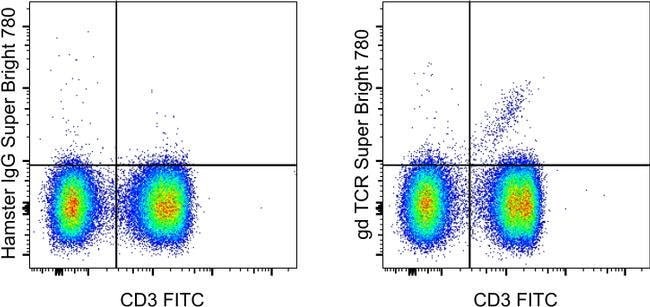
Invitrogen™ TCR gamma/delta Monoclonal Antibody (eBioGL3 (GL-3, GL3)), Super Bright™ 780, eBioscience™, Invitrogen™
Armenian Hamster Monoclonal Antibody
Brand: Invitrogen™ 78-5711-80
This item is not returnable.
View return policy
Description
Description: This DS5MMER monoclonal antibody recognizes mouse MerTK, a 170-210 kDa member of the TAM family of tyrosine kinase receptors that also includes Axl and Tyro3. MerTK is expressed on tissue macrophages and is involved in the removal of apoptotic cells. This process relies on two soluble ligands of MerTK, Protein S and Gas6 that bind to phosphatidylserine found on the outer leaflet of the plasma membrane of cells undergoing apoptosis. Upon binding these ligands, MerTK undergoes autophosphorylation at multiple tyrosine residues that activate the PI3K and Akt pathways. This results in the phagocytosis of apoptotic cells and also results in the direct inhibition of TLR-induced production of pro-inflammatory cytokines. In addition, MerTK may function as a putative entry receptor for filoviruses. Deficiency of MerTK causes general autoimmunity, inflammation and accumulation of apoptotic bodies. MerTK is constitutively released from the cell surface by metalloproteinases and thus is present in the serum and culture medium. This process can be enhanced by stimulation with LPS. MerTK can be used to help discriminate macrophages from dendritic cells. MerTK is often expressed on maligt cells and may be implicated in immune evasion. The DS5MMER antibody will work on paraformaldehyde-fixed cells. Applications Reported: This DS5MMER antibody has been reported for use in flow cytometric analysis.
TCR gamma/delta (T-cell receptor gamma/delta) are specialized T-cells in the immune system. The ability of T cell receptors (TCR) to discriminate foreign from self-peptides presented by major histocompatibility complex (MHC) class II molecules is essential for an effective adaptive immune response. TCR recognition of self-peptides has been linked to autoimmune disease. Mutant self-peptides have been associated with tumors. Engagement of TCRs by a family of bacterial toxins know as superantigens has been responsible for toxic shock syndrome. Autoantibodies to V beta segments of T cell receptors have been isolated from patients with rheumatoid arthritis (RA) and systemic lupus erythematosus (SLE). The autoantibodies block TH1-mediated inflammatory auto-destructive reactions and are believed to be a method by which the immune system compensates for disease. Most human T cells express the TCR alpha-beta and either CD4 or CD8 molecule (single positive, SP). However, a small number of T cells lack both CD4 and CD8 (double negative, DN). Increased percentages of alpha-beta DN T cells have been identified in some autoimmune and immunodeficiency disorders. Gamma-delta T cells are primarily found within the epithelium. They show less TCR diversity and recognize antigens differently than alpha-beta T cells. Subsets of gamma-delta T cells have shown antitumor and immunoregulatory activity.
Specifications
| TCR gamma/delta | |
| Monoclonal | |
| 0.2 mg/mL | |
| PBS with BSA and 0.09% sodium azide; pH 7.2 | |
| 0 | |
| Tcrd, Tcrg | |
| Affinity chromatography | |
| RUO | |
| 110066, 110067 | |
| 4°C, store in dark, DO NOT FREEZE! | |
| Liquid |
| Flow Cytometry | |
| eBioGL3 (GL-3, GL3), GL3) | |
| Super Bright 780 | |
| Tcrg | |
| RGD1311300; similar to T cell receptor V delta 6; T cell receptor gamma locus; T3/TCR complex; TCR delta gamma; TCR gamma/delta; TCR-CD3 complex; Tcrg; Trg; Trg@ | |
| Armenian Hamster | |
| 25 μg | |
| Primary | |
| Mouse | |
| Antibody | |
| IgG |
Product Content Correction
Your input is important to us. Please complete this form to provide feedback related to the content on this product.
Product Title
Spot an opportunity for improvement?Share a Content Correction