missing translation for 'onlineSavingsMsg'
Learn More

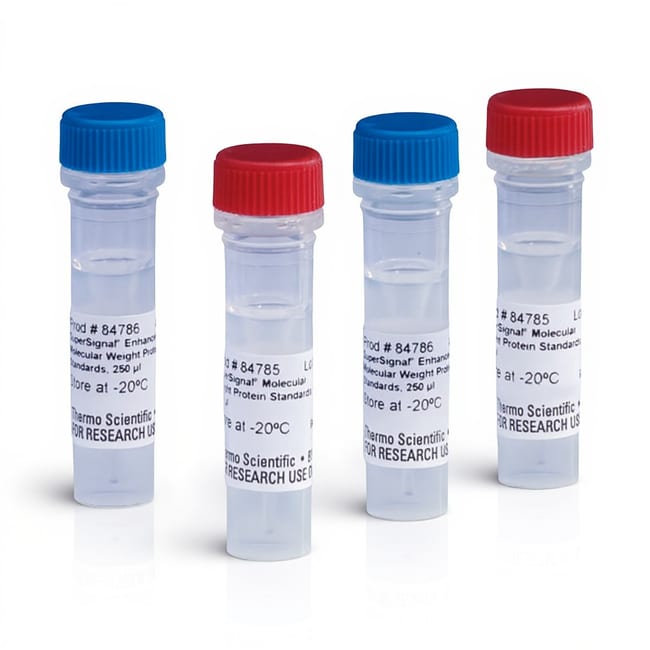
Thermo Scientific™ SuperSignal™ Molecular Weight Protein Ladder

Product Code. 10755869 Shop All Thermo Scientific Products
Change view
Click to view available options
Quantity:
250 μL
Unit Size:
250µL
1 product options available for selection
Product selection table with 1 available options. Use arrow keys to navigate and Enter or Space to select.
Product Code. Quantity unitSize
10755869 250 μL 250µL
Use arrow keys to navigate between rows. Press Enter or Space to select a product option. 1 options available.
1 options
This item is not returnable. View return policy
Product Code. 10755869 Supplier Thermo Scientific™ Supplier No. 84785

Please to purchase this item. Need a web account? Register with us today!

This item is not returnable. View return policy

Ready-to-use mix of recombinant proteins (20 to 150K) with IgG-binding sites for chemiluminescent, fluorescent, chromogenic or other detection methods.

Thermo Scientific™ SuperSignal Molecular Weight Protein Ladders (20 to 150KDa) are a ready-to-use mix of recombinant proteins with IgG-binding sites that provide reliable and proportional band intensities in stained gels and immunoblots developed with chemiluminescent, fluorescent, chromogenic or other detection systems.

The SuperSignal Molecular Weight Protein Ladders and SuperSignal Enhanced Molecular Weight Protein Ladders contain a ready-to-use stabilized mixture of eight recombinant proteins ranging in size from 20 to 150kDa. These recombinant proteins bind antibodies used in the Western blot through an IgG binding site. The protein markers can then be visualized either using appropriate substrates for enzyme-labeled antibodies or via fluorescent dye-labeled antibodies. The molecular weight marker mix also contains a special pink tracking dye to monitor the electrophoresis run and membrane transfer without the need for additional colored markers. The standards are compatible with nitrocellulose and PVDF membranes, multiple blocking buffers and many other detection methods.

Two versions of the standard are offered. The regular formulation is appropriate for use with most rabbit and other non-mouse polyclonal antibodies. The enhanced standard is formulated specifically for applications requiring mouse monoclonal antibodies and experiments where very dilute antibody concentrations are used.

Highlights:

  • Ready-to-use – liquid format is ready to load and requires no boiling

  • Direct visualization – see marker bands with gel stains and blotting detection reagents

  • Consistent – even band intensity regardless of detection method

  • Compatible – enhanced version for compatibility with mouse monoclonal primary antibodies

  • Simple marker sizes – band molecular weights are divisible by 10K, making them easy to remember

  • Stable – store long term at -20°C, three months at 4°C or one month at ambient temperature

Additional Features:

  • The molecular masses included in these standards are 20, 30, 40, 50, 60, 80, 100 and 150kDa.

TRUSTED_SUSTAINABILITY

Specifications

Content And Storage Contents: one vial of 250 μL

Storage buffer: 62.5 mM Tris-H3PO4 (pH 7.5 at 25°C), 1 mM EDTA, 2% SDS, 10 mM DTT, 1 mM NaN3 and 33% glycerol

Storage: Upon receipt store at -20°C for long term storage, or three months at 4°C or one month at ambient

Detection Method User defined detection system
Number of Markers 8
Ready to Load Yes
Size Range 20 to 150 kDa
Gel Compatibility Bolt™ Bis-Tris Plus Gels, Novex™ Tricine Gels, Novex™ Tris-Glycine Gels, NuPAGE™ Bis-Tris Gels, NuPAGE™ Tris-Acetate Gels, SDS-PAGE Gels
Molecular Weight (g/mol) 150, 100, 80, 60, 50, 40, 30, 20 kDa
Quantity 250 μL
Shipping Condition Wet Ice
Product Line SuperSignal
Product Type Protein Ladder
Stain Type Unstained
System Type Western Blotting, SDS-PAGE
Show More Show Less
With your SuperSignal Molecular Weight Protein Ladder/ SuperSignal Enhanced MW Protein Ladder, I see dye front interference in fluorescent applications. What should I do?

This is likely due to the dye-front not run off the gel or removed from the blot. We recommend running the dye front off of the gel or removing it from the blot.

I used your SuperSignal Molecular Weight Protein Ladder and did not see any bands after western detection. What could have happened?

Here are possible causes and solutions:

- Not enough volume loaded: Load more volume onto the gel
- Incomplete or poor transfer: Optimize transfer conditions
- Secondary antibody does not recognize marker proteins: Ensure appropriate secondary is used that binds to marker proteins
- Secondary antibody not enzyme-conjugated: Ensure appropriate secondary antibody used in system
- A mouse monoclonal primary antibody was used: Use a greater volume of the ladder or use SuperSignal Enhanced Molecular Weight Protein Ladder (Cat. No. 84786) for mouse primary antibodies

With your SuperSignal Molecular Weight Protein Ladder and SuperSignal Enhanced MW Protein Ladder, I did not get visible band separation after western detection. What could have happened?

Here are possible causes and solutions:

- Ladder was boiled: Discard boiled aliquot.
- Too much volume of ladder used: Load less volume of the ladder.
- Concentration of antibody is too high: Optimize antibody concentration

I used one of your protein standards for a western transfer and noticed that some of the lower-molecular weight protein bands passed through the membrane. How can I resolve this issue?

- Decrease voltage, current or length of transfer time
- Make sure that the methanol concentration in the transfer buffer is proper; use a methanol concentration of 10-20% methanol removes the SDS from SDS-protein complexes and improves the binding of protein to the membrane.
- Make sure that the SDS concentration (if added) in the transfer buffer is proper, don't use more than 0.02-0.04% SDS. Using too much SDS can prevent binding of proteins to the membrane.
- Check the pore size of the membrane and the size of the target protein. Proteins smaller than 10 kDa will easily pass through a 0.45 µm pore size membrane. If proteins smaller than 10 kDa are of interest, it would be better to use a 0.2 µm pore size membrane.

I used one of your protein standards for a western transfer and noticed that some of the higher-molecular weight bands transferred very poorly to the membrane. Can you offer some tips?

- Increase voltage, current or length of time for transfer
- SDS in the gel and in the SDS-protein complexes promotes elution of the protein from the gels but inhibits binding of the protein to membranes. This inhibition is higher for nitrocellulose than for PVDF. For proteins that are difficult to elute from the gel such as large molecular weight proteins, a small amount of SDS may be added to the transfer buffer to improve transfer. We recommend pre-equilibrating the gel in 2X Transfer buffer (without methanol) containing 0.02-0.04% SDS for 10 minutes before assembling the sandwich and then transferring using 1X transfer buffer containing 10% methanol and 0.01%SDS.
- Methanol removes the SDS from SDS-protein complexes and improves the binding of protein to the membrane, but has some negative effects on the gel itself, leading to a decrease in transfer efficiency. It may cause a reduction in pore size, precipitation of some proteins, and some basic proteins to become positively charged or neutral. Make sure that the methanol concentration in the transfer buffer is not more than 10-20% and that high-quality, analytical grade methanol is used.

I used one of your pre-stained standards on a Tris-Glycine gel and noticed that the molecular weights of the proteins were different than on a NuPAGE Bis-Tris gel. What is the reason for this?

Pre-stained standards have a dye that is covalently bound to each protein that will result in the standard migrating differently in different buffer systems (i.e., different gels). As a result, using a pre-stained standard for molecular weight estimation will only give the apparent molecular weight of the protein. Pre-stained standards may be used for molecular weight approximation, confirming gel migration and estimating blotting efficiency but for accurate molecular weight estimation, an unstained standard should be used.

I used one of your protein standards and am seeing some extra bands in the lane. Can you offer some suggestions?

- While loading, take care to make sure that there is no cross-contamination from adjacent sample lanes.
- Make sure that the correct amount of standard is loaded per lane. Loading too much protein can result in extra bands and this is a problem especially with silver-stained gels.
- Improper storage of the standard or repeated freeze/thawing can result in protein degradation.

I used one of your protein standards and the bands look non-distinct and smeary. What should I do?

Here are some suggestions:

- Make sure that the correct amount of standard is loaded per lane. Loading too much protein can cause smearing and this is a problem especially with silver stained gels.
- Bands will not be as well resolved in low percentage gels. Try using a higher percentage gel.
- If the bands look smeary and non-distinct after a western transfer/detection, this may be due to the antibody being too concentrated. Follow the manufacturer's recommended dilution or determine the optimal antibody concentration by dot-blotting.

A couple of bands in my protein standard are missing on the gel. Can you help me troubleshoot?

Here are some suggestions:

- Check the gel type/percentage of the gel that was used. Depending on the gel type and/or percentage, all the bands may not be seen. For example, the smallest bands of the protein standard may not resolve on a very low percentage gel whereas the higher molecular weight bands may not resolve on a high percentage gel.
- Check the expiration date on the protein standard. Expired lots may result in faded or missing bands due to protein degradation.
- Check the storage conditions for the protein standard. Improper storage conditions will compromise the stability of the proteins in the standard.
- Make sure that the protein standard was not heated/boiled prior to loading on the gel. Our protein standards are ready to load and we do not recommend heating/boiling them as this may cause degradation of proteins in the standard.

When should I choose the SuperSignal Enhanced Molecular Weight Protein Ladder over the SuperSignal Molecular Weight Protein Ladder?

We would recommend using the SuperSignal Molecular Weight Protein Ladder for most applications. Use the SuperSignal Enhanced Molecular Weight Protein Ladder when low concentrations of antibody are used or when mouse primary antibody is used.

What is the composition of the SuperSignal Molecular Weight Protein Ladder?

The SuperSignal Molecular Weight Protein Ladder is a mixture of eight recombinant proteins ranging from 20 kDa to 150 kDa. Each protein in the mixture contains an IgG-binding site and is proportioned to yield comparable gel electrophoresis and western blotting band intensities. The ladder contains a pink tracking dye in the buffer for monitoring electrophoresis and transfer. The ladder can be used with chemiluminescent, fluorescent, chromogenic and other detection types.

What are the storage conditions and shelf life for the SuperSignal Molecular Weight Protein Ladder and SuperSignal Enhanced Molecular Weight Protein Ladder?

We recommend storing these ladders at -20 degrees C where they are stable for a year. They are stable for up to one month at room temperature and for up to three months at 4 degrees C.

Do protein standards run differently on a Zymogram gel compared to a regular Tris-Glycine gel?

Zymogram gels are essentially Tris-Glycine gels containing the substrate. Protein standards run based solely on the percentage of acrylamide and hence should run the same in both kinds of gels. It is quite possible though that if the standard is prestained, the proteins will appear a different color because of the staining (or pre-staining) of the Zymogram gels.

Can I use any of your protein standards for estimation of protein quantity (protein quantitation)?

Our protein standards are not designed for protein quantitation.

What is the recommended gel loading volume for your protein standards?

Please find this information in the respective manuals for the individual protein standards.

Do I need to boil your protein standards before loading on the gel?

Our protein standards are ready to load. We do not recommend heating them as this may cause protein degradation.

Do I have to add reducing agent to your protein standards?

Except for our NativeMark Unstained Protein Standard (designed for native electrophoresis), all of the other unstained and prestained standards we offer (Invitrogen Sharp, SeeBlue, SeeBlue Plus2, BenchMark, HiMark) have been pre-reduced (by a proprietary method). Hence, you do not need to add reducing agent.


For Research Use Only. Not for use in diagnostic procedures.

Product Title
Select an issue

By clicking Submit, you acknowledge that you may be contacted by Fisher Scientific in regards to the feedback you have provided in this form. We will not share your information for any other purposes. All contact information provided shall also be maintained in accordance with our Privacy Policy.