missing translation for 'onlineSavingsMsg'
Learn More
Learn More
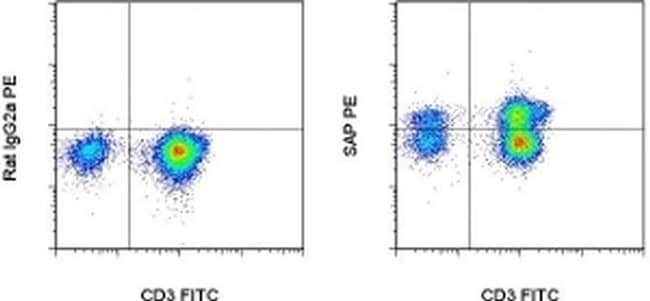
SAP (SLAM-Associated Protein) Monoclonal Antibody (XLP-1D12), PE, eBioscience™, Invitrogen™
Rat Monoclonal Antibody
Brand: Invitrogen 12-9787-41
This item is not returnable.
View return policy
Description
Description: The monoclonal antibody XLP-1D12 reacts with human SLAM-associated protein (SAP), which is also known as SH2D1A. SAP is a 15-kDa SH2 domain-containing adaptor protein. Upon CD150/SLAM family receptor ligation, SAP recruits Fyn tyrosine kinase, which phosphorylates the receptor to activate downstream signaling events. SAP is expressed in thymocytes, T cells, NK cells, and NKT cells. Studies have demonstrated a role for SAP in promoting follicular T helper cell differentiation during germinal center formation. In addition, this protein is involved in NKT cell development, Th1/Th2 differentiation, development of innate T cells, and regulation of NK cell and CD8+ T cell cytotoxicity. Mutations of the gene encoding SAP results in X-linked lymphoproliferative (XLP) syndrome, which is characterized by impaired humoral immunity leading to increased susceptibility to Epstein-Barr virus infection and/or lymphoma. SAP has also been linked to automimmune diseases such as systemic lupus erythematosus. Applications Reported: This XLP-1D12 antibody has been reported for use in intracellular staining followed by flow cytometric analysis. Applications Tested: This XLP-1D12 antibody has been pre-titrated and tested by intracellular staining and flow cytometric analysis of normal human peripheral blood cells using the Foxp3/Transicription Factor Staining Buffer Set (cat. 00-5523) and protocol.
Please refer to Best Protocols: Protocol B: One step protocol for (nuclear) intracellular proteins located under the Resources tab online. This can be used at 5 μL (0.5 μg) per test. A test is defined as the amount (μg) of antibody that will stain a cell sample in a final volume of 100 μL. Cell number should be determined empirically but can range from 10^5 to 10^8 cells/test. Excitation: 488-561 nm; Emission: 578 nm; Laser: Blue Laser, Green Laser, Yellow-Green Laser. Filtration: 0.2 μm post-manufacturing filtered. This gene encodes a protein that plays a major role in the bidirectional stimulation of T and B cells. This protein contains an SH2 domain and a short tail. It associates with the signaling lymphocyte-activation molecule, thereby acting as an inhibitor of this transmembrane protein by blocking the recruitment of the SH2-domain-containing signal-transduction molecule SHP-2 to its docking site. This protein can also bind to other related surface molecules that are expressed on activated T, B and NK cells, thereby modifying signal transduction pathways in these cells. Mutations in this gene cause lymphoproliferative syndrome X-linked type 1 or Duncan disease, a rare immunodeficiency characterized by extreme susceptibility to infection with Epstein-Barr virus, with symptoms including severe mononucleosis and maligt lymphoma. Multiple transcript variants encoding different isoforms have been found for this gene.
Specifications
| SAP (SLAM-Associated Protein) | |
| Monoclonal | |
| 5 μL/Test | |
| PBS with 0.1% gelatin, 0.2% BSA and 0.09% sodium azide; pH 7.2 | |
| O60880 | |
| SH2D1A | |
| Affinity chromatography | |
| RUO | |
| 4068 | |
| 4° C, store in dark, DO NOT FREEZE! | |
| Liquid |
| Flow Cytometry | |
| XLP-1D12 | |
| PE | |
| SH2D1A | |
| DSHP, EBVS, IMD5, LYP, MTCP1, SH2D1A, XLP, XLPD | |
| Rat | |
| 25 Tests | |
| Primary | |
| Human | |
| Antibody | |
| IgG2a κ |
Product Content Correction
Your input is important to us. Please complete this form to provide feedback related to the content on this product.
Product Title
For Research Use Only.
Spot an opportunity for improvement?Share a Content Correction