missing translation for 'onlineSavingsMsg'
Learn More

Invitrogen™ phospho-Tyrosine Monoclonal Antibody (pY20), eFluor™ 660, eBioscience™
GREENER_CHOICE

Product Code. 15589966
Change view
Click to view available options
Quantity:
100 Tests
Unit Size:
100 tests
1 product options available for selection
Product selection table with 1 available options. Use arrow keys to navigate and Enter or Space to select.
Product Code. Quantity unitSize
15589966 100 Tests 100 tests
Use arrow keys to navigate between rows. Press Enter or Space to select a product option. 1 options available.
1 options
This item is not returnable. View return policy
Product Code. 15589966 Supplier Invitrogen™ Supplier No. 50500142

Please to purchase this item. Need a web account? Register with us today!

This item is not returnable. View return policy

Mouse Monoclonal Antibody

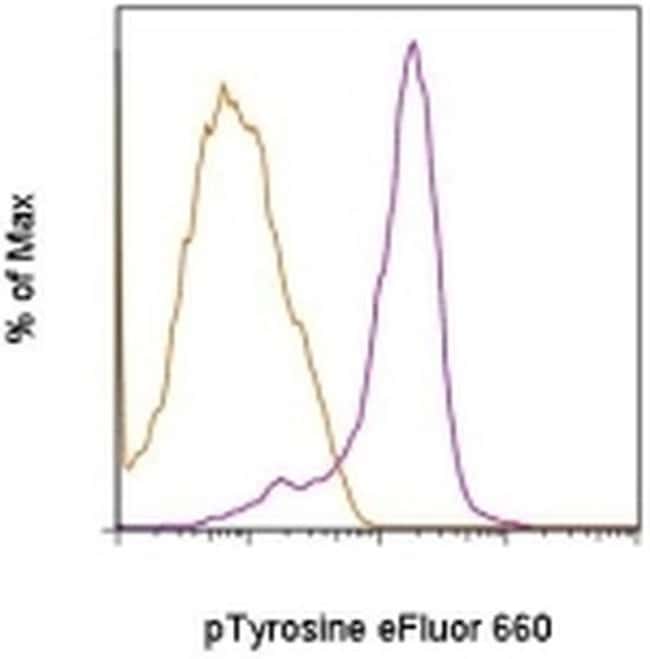
The pY20 monoclonal antibody recognizes phosphorylated tyrosine residues (p-Tyr) on proteins. Numerous intracellular signaling cascades are propagated via phosphorylation of specific tyrosine on signaling proteins. The detection of p-Tyr residues is valuable for the characterization and purification of phosphorylated proteins and the biochemical pathways that they are involved in. Applications Reported:This pY20 antibody has been reported for use in intracellular staining followed by flow cytometric analysis. Applications Tested: This pY20 antibody has been pre-titrated and tested by intracellular staining followed by flow cytometric analysis of normal human peripheral blood cells. This can be used at 5 μL (0.06 μg) per test. A test is defined as the amount (μg) of antibody that will stain a cell sample in a final volume of 100 μL. Cell number should be determined empirically but can range from 10^5 to 10^8 cells/test. Staining Protocol: All protocols work well for this monoclonal antibody. Use of Protocol A: Two-step protocol: intracellular (cytoplasmic) proteins allows for the greatest flexibility for detection of surface and intracellular (cytoplasmic) proteins. Use of Protocol B: One-step protocol: intracellular (nuclear) proteins is recommended for staining of transcription factors in conjunction with surface and phosphorylated intracellular (cytoplasmic) protein(s). Protocol C: Two-step protocol: Fixation/Methanol allows for the greatest disc...

The role of tyrosine phosphorylation in transduction of the mitogenic signal from transmembrane receptors and in transformation by oncogene tyrosine kinases has been the subject of intense investigation for several years. While the phosphorylation of specific tyrosine residues has been shown to be a primary mechanism of signal transduction during normal mitogenesis, cell cycle progression and oncogenic transformation, its role in other areas such as differentiation and gap junction communication, is a matter of active and ongoing research. Antibodies that specifically recognize phosphorylated tyrosine residues have proved to be invaluable to the study of tyrosine -phosphorylated proteins and the biochemical pathways in which they function. The fluorescein (FITC) conjugate of clone PY20 anti-phosphotyrosine is especially useful for the detection of these P-Tyr proteins in immunohistochemical and immunocytochemical protocols in situations wherein the use of a secondary antibody would complicate detection of the protein(s) of interest.
TRUSTED_SUSTAINABILITY

Specifications

Antigen phospho-Tyrosine
Applications Flow Cytometry
Classification Monoclonal
Clone pY20
Concentration 5 μL/Test
Conjugate eFluor 660
Formulation PBS with BSA and 0.09% sodium azide; pH 7.2
Gene Alias Phosphotyrosine; pTyr; pY
Host Species Mouse
Purification Method Affinity chromatography
Quantity 100 Tests
Regulatory Status RUO
Primary or Secondary Primary
Target Species Chemical
Content And Storage 4°C, store in dark, DO NOT FREEZE!
Product Type Antibody
Form Liquid
Isotype IgG2b κ
Target Molecule Chemical
Show More Show Less
I am unable to analyze my cells stained with eFluor Organic Dyes today. What options do I have?

Our options will depend on the samples you are analyzing.

If cell viability is not critical, you can store your stained samples at 4 degrees C or on ice overnight in the dark and analyze the following day.

For samples stained with eFluor organic fluorochromes, we recommend that cells be suspended in 100 uL of Flow Cytometry Staining Buffer (Cat. No. 00-4222) and 100 uL of eBioscience IC Fixation Buffer (Cat. No. 00-8222); samples can be incubated for up to 3 days at 4 degrees C in the dark. Alternatively, the 1-step Fix/Lyse Solution (Cat. No. 00-5333) can be used. This is a great option when working with whole blood but also works for other cell types.

Can the eFluor Organic fluorochromes be used for intracellular staining?

Yes, the eFluor Organic fluorochromes can be used for intracellular staining. The eFluor organic fluorochromes maintain bright signal and require minimal changes in compensation when fixed with eBioscience IC Fixation Buffer (Cat. No. 00-8222-49) and Permeabilization Buffer (Cat. No. 00-8333-56) or 1-step Fix/Lyse Solution (Cat. No. 00-5333-54, 00-5333-57) (as compared to live cells).

How does eBioscience determine the specificity of their phosphorylation-specific antibodies?

Antibodies are tested and validated in a variety of ways. First, we verify that in a panel of cells in which different pathways have been induced, we see phosphorylation specific staining only in the cells in which the specific pathway of interest has been activated. Second, we verify that phosphorylation specific staining is observed only in cell types in which the protein is expressed and not in cell types in which the protein is not expressed. Third, whenever possible, western immunoblotting is used to confirm the presence of a band(s) of the appropriate size(s) in stimulated/treated cells (and not in unstimulated/untreated cells, as appropriate).

Is the eFluor 660 fluorochrome compatible with Anti-Cy5/Alexa Fluor 647 beads?

Yes, in-house studies have demonstrated that the eFluor 660 fluorochrome is recognized by Anti-Cy5/Alexa Fluor 647 beads. Side by side studies with Alexa Fluor 647 versus eFluor 660 conjugated antibodies have demonstrated comparable results.

What buffers are compatible with the eFluor Organic fluorochromes and eVolve QDots?

The eFluor Organic fluorochromes and eVolve QDots can be used with flow staining buffers containing PBS and protein.

What is the difference between eFluor Organic Dyes and eVolve Qdots?

The eFluor Organic Dyes (eFluor 450, APC-eFluor 780, PerCP-eFluor 710, eFluor 710) are conventional fluorochromes. In contrast, the eVolve line of products are Quantum dots.

How long can cells that have been fixed and placed in methanol be stored for use with eBioscience antibodies? What is the recommended storage temperature? How about storage of fixed cells in eBioscience fixation buffers?

We have data demonstrating that fixed cells stored in methanol are stable at -20 degrees C or at -80 degrees C for several weeks. We do not recommend storing fixed cells in eBioscience Foxp3/Transcription Factor Buffer. However, cells fixed with eBioscience Foxp3/Transcription Factor Buffer or eBioscience Intracellular (IC) fixation buffer can be stored in eBioscience IC fixation buffer for up to 3 days at 4 degrees C in the dark.
Note: Please be aware that higher compensation values may be seen with tandem dyes if any other fixative is used apart from eBioscience IC fixation buffer, for 3-day storage.

What is the optimal protocol for eBioscience phosphorylation-specific antibodies?

Each antibody has been tested in three different buffer systems: IC fixation and permeabilization, Foxp3/Transcription Factor Buffer, and IC fixation Buffer/Methanol. The recommended buffer system(s) will be noted on the Technical Data Sheet for the specific antibody.

What is the best way to maintain surface staining when using the methanol-based protocol?

Because methanol can destroy the epitope recognized by some antibodies, ideally surface staining would be performed at the beginning of the protocol with a methanol-resistant fluorochrome (like eFluor 450, FITC, and eFluor 660).
Please recognize that surface staining before stimulation can have undesired effects due to activation of the cell caused by antibody binding. We recommend staining after stimulation/treatment, fixation, and methanol treatment.

Can I use other buffer systems from other companies when using eBioscience phosphorylation-specific antibodies?

In general, you can use other companies' buffer systems provided that their buffers are of a similar composition as the buffers recommended. Be aware that results will vary depending upon the buffer system used. eBioscience antibodies have been optimized for use in eBioscience buffers and we have not tested all of our antibodies in other buffer systems. Thus, we highly recommend using our optimized protocol and buffer systems.

What are the appropriate controls to run when using eBioscience phosphorylation-specific antibodies?

It is important to understand whether the stimulation/treatment results in an upregulation or a down regulation of the phosphorylation event. Thus, it is recommended that changes in phosphorylation levels in stimulated/treated versus unstimulated/untreated cells be compared. A histogram or density plot overlay these two treatments will provide a better assessment of a change in phosphorylation event than using isotype controls.

Can I perform phosphorylation specific staining and stain for intracellular cytokines at the same time when using eBioscience phosphorylation-specific antibodies?

In theory, if the buffer systems are compatible for the antibodies of interest, this can be done. In practice, cytokine translation and phosphorylation events do not typically occur in the same timeframe, therefore, it may be difficult to detect both events in the same sample. The results will be depended on the kinetics and should be determined for each system and protein of interest.

When using eBioscience phosphorylation-specific antibodies, can I perform phosphorylation specific staining together with transcription factor staining at the same time? If so, what buffer and protocol do I use?

In theory, this can be done if the antibodies against both the transcription factor and the phosphorylated protein work in the same buffer system. For example, Anti-Human/Mouse phsopho-H2AX and all transcription factor eBioscience antibodies offered will work in the Foxp3/Transcription Factor Buffer System (Cat. No. 00-5523-00).

For eBioscience phosphorylation-specific antibodies, can total and phosphorylated protein be analyzed in parallel?

In theory, this can be done if the antibodies to both proteins work in the same buffer system and if the antibodies recognize different epitopes. Please refer to the individual Technical Data Sheets for information about buffer compatibility. Also, consider using eBioscience InstantOne ELISA Kits for immunoassay quantitation of both total and phosphorylated proteins such as AKT1/2/3, JNK1/2/3, NFκB, STAT3, and STAT5.

Are the eFluor Organic Dyes photo-labile?

As with other fluorochromes, we recommend minimal exposure to light to maintain optimal signal.


Product Title
Select an issue

By clicking Submit, you acknowledge that you may be contacted by Fisher Scientific in regards to the feedback you have provided in this form. We will not share your information for any other purposes. All contact information provided shall also be maintained in accordance with our Privacy Policy.