missing translation for 'onlineSavingsMsg'
Learn More
Learn More
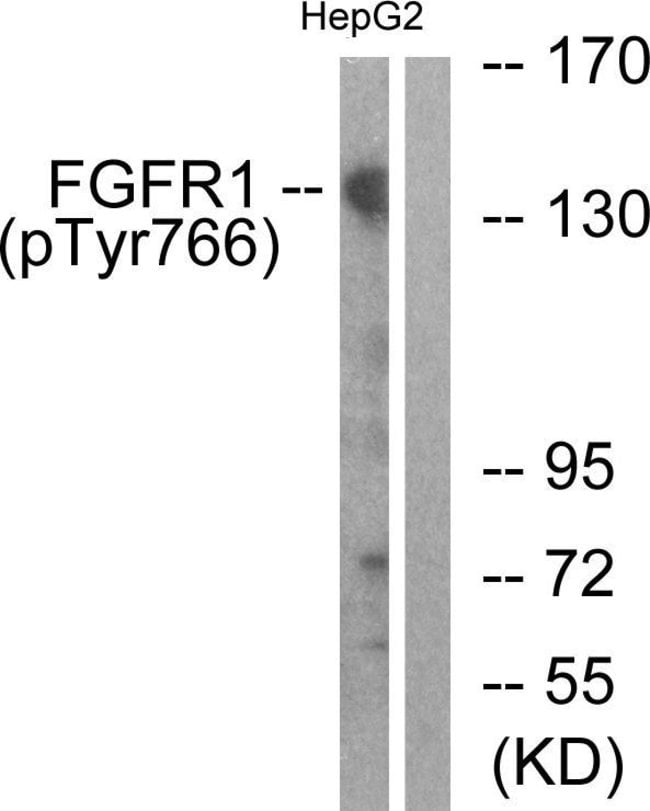
Phospho-FGFR1 (Tyr766) Polyclonal Antibody, Invitrogen™
Rabbit Polyclonal Antibody
Brand: Invitrogen PA538271
This item is not returnable.
View return policy
Description
FGFR1 (fibroblast growth factor receptor 1) is a member of the fibroblast growth factor receptor family containing an Ig-like domain and a tyrosine kinase domain. FGFR1 has multiple isoforms and is a Type I membrane protein. FGFR family members differ from one another in their ligand affinities and tissue distribution. A full-length representative protein consists of an extracellular region, composed of three immunoglobulin-like domains, a single hydrophobic membrane-spanning segment and a cytoplasmic tyrosine kinase domain. The extracellular portion of FGFR1 interacts with fibroblast growth factors, setting in motion a cascade of downstream signals, ultimately influencing mitogenesis and differentiation. FGFR1 binds both acidic and basic fibroblast growth factors and is involved in limb induction. FGFR1 can be modified by phosphorylation and can bind basic/acidic fibroblast factor depending on the receptor isoform. FGFR1 has been shown to interact with N-cadherin and NCAM. Four genes encoding for high affinity cell surface FGF receptors (FGFRs) have been identified: FGFR-1, FGFR-2, FGFR-3 and FGFR-4. FGFRs are members of the tyrosine kinase family of growth factor receptors. At the mRNA level, FGFR1 is highly expressed in developing human tissues including the brain, vascular basement membrane and skin. Defects in FGFR1 result in Pfeiffer syndrome associated with craniosynostosis. Other defects in FGFR1 are responsible for several diseases which include Pfeiffer syndrome (PS), idiopathic hypogonadotropic hypogonadism (IHH), Kallmann syndrome type 2 (KAL2), osteoglophonic dysplasia (OGD), non-syndromic trigonocephaly, Jackson-Weiss syndrome, Antley-Bixler syndrome. Chromosomal aberrations involving this gene are associated with stem cell myeloproliferative disorder and stem cell leukemia lymphoma syndrome.
Specifications
| Phospho-FGFR1 (Tyr766) | |
| Polyclonal | |
| Unconjugated | |
| FGFR1 | |
| Fibroblast growth factor receptor 1, FGFR-1, 2.7.10.1, Basic fibroblast growth factor receptor 1, BFGFR, bFGF-R-1, Fms-like tyrosine kinase 2, FLT-2, N-sam, Proto-oncogene c-Fgr, CD331, BFGFR, CEK, FGFBR, FLG, FLT2, HBGFR, FGFR1 | |
| Rabbit | |
| Antigen affinity chromatography | |
| RUO | |
| 14182, 2260, 79114 | |
| -20°C | |
| Liquid |
| Immunohistochemistry (Paraffin), Western Blot | |
| 1 mg/mL | |
| Dulbecco′s PBS with 150mM NaCl, 50% glycerol and 0.02% sodium azide; pH 7.4 | |
| P11362, P16092, Q04589 | |
| FGFR1 | |
| A synthetic phosphopeptide derived from human FGFR1 around the phosphorylation site of Tyr766 (Q-E-YP-L-D) | |
| 100 μg | |
| Primary | |
| Human, Mouse, Rat | |
| Antibody | |
| IgG |
Product Content Correction
Your input is important to us. Please complete this form to provide feedback related to the content on this product.
Product Title
Spot an opportunity for improvement?Share a Content Correction