missing translation for 'onlineSavingsMsg'
Learn More
Learn More
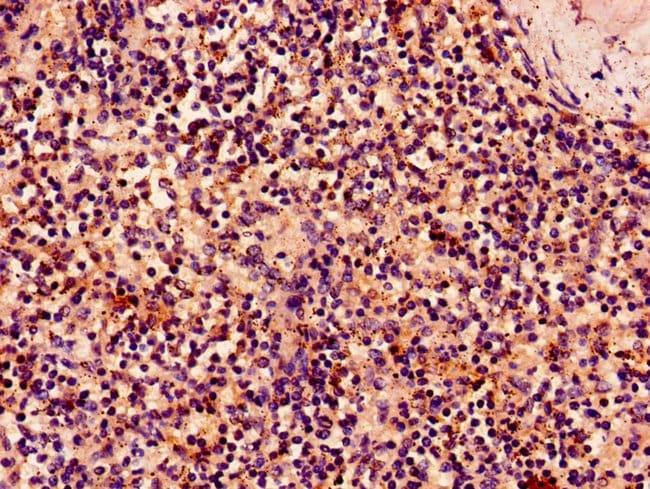

Invitrogen™ NKG2D Polyclonal Antibody

Description
NKG2D Polyclonal Antibody for Western Blot, IHC (P), ELISA
Natural killer (NK) cells are lymphocytes that can mediate lysis of certain tumor cells and virus-infected cells without previous activation. NK cells can regulate specific humoral and cell-mediated immunity, and preferentially express several calcium-dependent (C-type) lectins, which have been implicated in the regulation of NK cell function. The NK gene encodes a member of the NKG2 family, and the encoded transmembrane protein is characterized by a type II membrane orientation (extracellular C terminus) and the presence of a C-type lectin domain. The NKG2 gene family is located within the NK complex, a region that contains several C-type lectin genes preferentially expressed in NK cells.

Specifications
Specifications
| Antigen | NKG2D |
| Applications | ELISA, Immunohistochemistry (Paraffin), Western Blot |
| Classification | Polyclonal |
| Concentration | 0.6 mg/mL |
| Conjugate | Unconjugated |
| Formulation | PBS with 40% glycerol and 0.05% sodium azide; pH 7.4 |
| Gene | Klrk1 |
| Gene Accession No. | P26718 |
| Gene Alias | CD314; D12S2489E; D6H12S2489E; killer cell lectin like receptor K1; Killer cell lectin-like receptor subfamily K member 1; killer cell lectin-like receptor subfamily K, member 1; KLR; Klrk1; natural killer cell group 2D; natural killer cell receptor; NK cell receptor D; NK lectin-like receptor; Nkg2d; NKG2-D; NKG2-D type II integral membrane protein; NKG2-D-activating NK receptor; NKLLR; Nkrp2; NKR-P2; NKR-P2, ortholog of human NKG2D |
| Gene Symbols | Klrk1 |
| Show More |
Product Title
By clicking Submit, you acknowledge that you may be contacted by Fisher Scientific in regards to the feedback you have provided in this form. We will not share your information for any other purposes. All contact information provided shall also be maintained in accordance with our Privacy Policy.
Spot an opportunity for improvement?