missing translation for 'onlineSavingsMsg'
Learn More
Learn More
Invitrogen™ NKG2A/C/E Monoclonal Antibody (20d5), FITC, eBioscience™, Invitrogen™

Rat Monoclonal Antibody
£108.00 - £266.00
Specifications
| Antigen | NKG2A/C/E |
|---|---|
| Clone | 20d5 |
| Concentration | 0.5 mg/mL |
| Applications | Flow Cytometry |
| Classification | Monoclonal |
| Product Code | Brand | Quantity | Price | Quantity & Availability | |||||
|---|---|---|---|---|---|---|---|---|---|
| Product Code | Brand | Quantity | Price | Quantity & Availability | |||||
|
15238289
|
Invitrogen™
11-5896-82 |
100 μg |
£108.00
100µg |
Please sign in to purchase this item. Need a web account? Register with us today! | |||||
|
15248289
|
Invitrogen™
11-5896-85 |
500 μg |
£266.00
500µg |
Please sign in to purchase this item. Need a web account? Register with us today! | |||||
Description
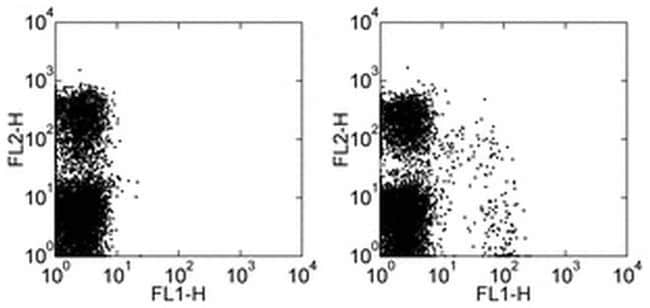
Description: The 20d5 monoclonal antibody reacts with the mouse NKG2A, C, and E. NKG2 molecules belong to a C-type lectin-like family of cell surface receptors expressed by mouse NK and NKT cell lineages. NKG2 molecules form heterodimeric complexes with CD94 and are responsible for recognition of non-classical MHC class I antigen Qa-1. When co-staining with NKG2A^B6 clone 16a11, it is important to stain for NKG2A-B6 first then subsequently with NKG2A/C/E, as steric hindrance has been observed if co-stained concurrently. Applications Reported: 20d5 has been reported for use in flow cytometric analysis. Applications Tested: The 20d5 antibody has been tested by flow cytometric analysis of mouse splenocytes and can be used at less than or equal to 0.125 μg per test. A test is defined as the amount (μg) of antibody that will stain a cell sample in a final volume of 100 μL. Cell number should be determined empirically but can range from 10^5 to 10^8 cells/test. It is recommended that the antibody be carefully titrated for optimal performance in the assay of interest. Excitation: 488 nm; Emission: 520 nm; Laser: Blue Laser. Filtration: 0.2 μm post-manufacturing filtered.
Natural killer (NK) cells are lymphocytes that can mediate lysis of certain tumor cells and virus-infected cells without previous activation. They can also regulate specific humoral and cell-mediated immunity. The protein encoded by this gene belongs to the killer cell lectin-like receptor family, also called NKG2 family, which is a group of transmembrane proteins preferentially expressed in NK cells. This family of proteins is characterized by the type II membrane orientation and the presence of a C-type lectin domain. This protein forms a complex with another family member, KLRD1/CD94, and has been implicated in the recognition of the MHC class I HLA-E molecules in NK cells. The genes of NKG2 family members form a killer cell lectin-like receptor gene cluster on chromosome 12. Four alternatively spliced transcript variants encoding two distinct isoforms have been observed.Specifications
| NKG2A/C/E | |
| 0.5 mg/mL | |
| Monoclonal | |
| Liquid | |
| RUO | |
| PBS with 0.09% sodium azide; pH 7.2 | |
| CD159a; cd159c; cd159e; Cluster of Differentiation 159a; killer cell lectin-like receptor subfamily C, member 1; killer cell lectin-like receptor subfamily C, member 2; killer cell lectin-like receptor subfamily C, member 3; Klrc1; Klrc2; Klrc3; natural killer cell group 2E cell receptor; NKG2; NKG2A; NKG2-A/NKG2-B type II integral membrane protein; NKG2B; NKG2C; Nkg2e | |
| Klrc1, Klrc2, Klrc3 | |
| Primary | |
| 4°C, store in dark, DO NOT FREEZE! |
| 20d5 | |
| Flow Cytometry | |
| FITC | |
| Rat | |
| Mouse | |
| 0 | |
| 16641, 16642, 58179 | |
| IgG2a κ | |
| Affinity chromatography | |
| Antibody |
For Research Use Only.
Spot an opportunity for improvement?Share a Content Correction
Product Content Correction
Your input is important to us. Please complete this form to provide feedback related to the content on this product.
Product Title