missing translation for 'onlineSavingsMsg'
Learn More

Invitrogen™ Nanog Monoclonal Antibody (eBioMLC-51), eBioscience™, Invitrogen™

Rat Monoclonal Antibody

£1388.00 - £3115.00

Specifications

Antigen Nanog
Clone eBioMLC-51
Concentration 0.5 mg/mL
Classification Monoclonal
Conjugate Unconjugated
View More Specs

Products 2
Product Code Brand Quantity Price Quantity & Availability  
17120682
View Documents
Invitrogen™
14-5761-37
2 mg
£1388.00
2mg
View alternative products
Save Up to 
»
Please to purchase this item. Need a web account? Register with us today!
17130682
View Documents
Affymetrix eBioscience
14-5761-95
10 mg This item is currently unavailable or has been discontinued.
View the product page for possible alternatives.
N/A View alternative products
Save Up to 
»
Description

Description

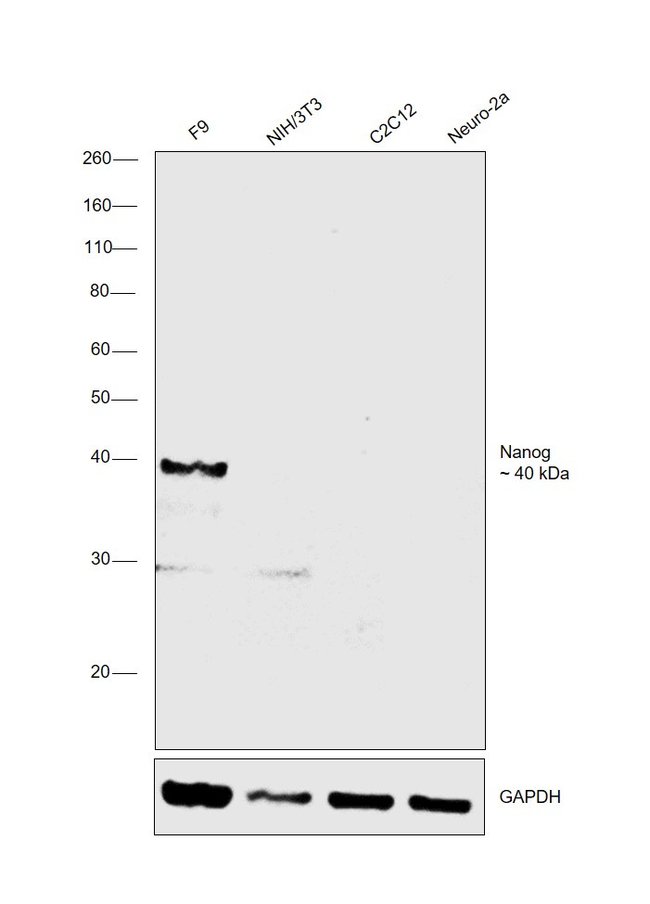
The eBioMLC51 MAb recognizes mouse Nanog. Nanog is a multidomain homeobox transcription factor that has been shown to maintain pluripotency of embryonic stem cells, independent of LIF/Stat3. Expression of Nanog in the mouse is specific to early embryos, the ICM of the blastocyst, embryonic stem (ES) cells, and embryonic germ (EG) cells. Nanog expression often overlaps, but is not identical to, that of Oct4. Nanog is downregulated upon cellular differentiation and loss of pluripotency, making it a suitable marker in determining the undifferentiated state of stem cells. Nanog acts as a transcriptional activator and has two activation domains in the C-terminus, called CD2 and WR, and one activation domain in the N terminus. The CD2 domain is unique to Nanog, whereas the NK2 DNA binding domain is well conserved. Immunoblotting using eBioMLC51 reveals a band at ∽ 45 kDa in F9 (an embryonal carcinoma cell line) lysate, but not in lysate from the NIH3T3 cell line or mouse spleen. Preliminary data using fluorochrome-conjugated eBioMLC51 suggests that it is essential to use the eBioscience Foxp3 Staining Buffer Set, Cat. 00-5523, for intracellular staining of mouse Nanog.

NANOG (Nanog homeobox) is a divergent homeodomain protein that directs pluripotency and differentiation of undifferentiated embryonic stem cells. NANOG mRNA is present in pluripotent mouse and human cell lines, and absent from differentiated cells. Human NANOG protein shares 52% overall amino acid identity with the mouse protein, and 85% identity in the homeodomain. Human NANOG maps to gene locus 12p13.31, while the mouse NANOG maps to gene loci 6 F2. Murine embryonic NANOG expression is detected in the inner cell mass of the blastocyst. Research studies have shown that high levels of human NANOG expression in the undifferentiated N-Tera embryonal carcinoma cell line. Further, NANOG is a transcription regulator involved in inner cell mass and embryonic stem (ES) cells proliferation and self-renewal. The role of NANOG in embryonic development suggested that it might be useful in the creation of stem cells that might be useful in cell replacement therapies in the treatment of several degenerative diseases. Artificial stem cells, termed induced pluripotent stem (iPS) cells, can be created by expressing POU5F1 (also known as Oct-4), another germline-specific transcription factor, and the transcription factors Sox2, Klf4 and Lin28 along with c-Myc in mouse fibroblasts. Experiments have demonstrated that iPS cells could be generated using expression plasmids expressing NANOG, Sox2, KlfF4 and c-Myc, eliminating the need for virus introduction, thereby addressing a safety concern for potential use of iPS cells in regenerative medicine. When overexpressed, NANOG promotes cells to enter into S phase and proliferation. Diseases associated with dysfunction in the NANOG protein include tetracarcinoma and germ cell/embryonal cancer.
Specifications

Specifications

Nanog
0.5 mg/mL
Unconjugated
Rat
Mouse
Q80Z64
IgG2a κ
Affinity chromatography
Antibody
eBioMLC-51
Monoclonal
Liquid
RUO
PBS with 0.09% sodium azide; pH 7.2
71950
Primary
4°C
NANOG
Videos
SDS
Documents

Documents

Product Certifications
Product Content Correction

Your input is important to us. Please complete this form to provide feedback related to the content on this product.

Product Title

By clicking Submit, you acknowledge that you may be contacted by Fisher Scientific in regards to the feedback you have provided in this form. We will not share your information for any other purposes. All contact information provided shall also be maintained in accordance with our Privacy Policy.

Thank You! Your feedback has been submitted. Fisher Scientific is always working to improve our content for you. We appreciate your feedback.