missing translation for 'onlineSavingsMsg'
Learn More
Learn More


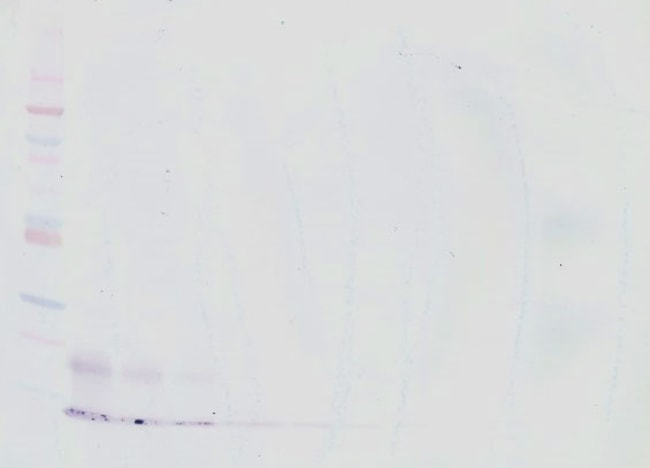
PeproTech MCP-3 Polyclonal Antibody, PeproTech®, Invitrogen™
Goat Polyclonal Antibody
£177.00 - £1468.00
Specifications
| Antigen | MCP-3 |
|---|---|
| Concentration | 0.1-1.0 mg/mL |
| Applications | ELISA, Western Blot |
| Classification | Polyclonal |
| Conjugate | Unconjugated |
| Product Code | Brand | Quantity | Price | Quantity & Availability | |||||
|---|---|---|---|---|---|---|---|---|---|
| Product Code | Brand | Quantity | Price | Quantity & Availability | |||||
|
17894203
|
PeproTech
500-P116G-50UG |
50 μg |
£177.00
50µg |
Please sign in to purchase this item. Need a web account? Register with us today! | |||||
|
17843943
|
PeproTech
500-P116G-100UG |
100 μg |
£228.00
100µg |
Please sign in to purchase this item. Need a web account? Register with us today! | |||||
|
17814383
|
PeproTech
500-P116G-1MG |
1 mg |
£1468.00
1mg |
Please sign in to purchase this item. Need a web account? Register with us today! | |||||
Description
AA Sequence of recombinant protein: QPDGPNASTC CYVKKQKIPK RNLKSYRRIT SSRCPWEAVI FKTKKGMEVC AEAHQKWVEE AIAYLDMKTP TPKP. Preparation: Produced from sera of goats immunized with highly pure Recombinant Murine MCP-3 (CCL7). Anti-Murine MCP-3 (CCL7)-specific antibody was purified by affinity chromatography employing an immobilized Muine MCP-3 (CCL7) matrix. Sandwich ELISA: To detect Murine MCP-3 (CCL7) by sandwich ELISA (using 100 μL/well antibody solution) a concentration of 0.5-2.0 μg/mL of this antibody is required. This antigen affinity purified antibody, in conjunction with PeproTech Biotinylated Anti-Murine MCP-3 (CCL7) (500-P116GBt) as a detection antibody, allows the detection of at least 0.2-0.4 ng/well of Recombinant Murine MCP-3 (CCL7). Western Blot: To detect Murine MCP-3 (CCL7) by Western Blot analysis this antibody can be used at a concentration of 0.1-0.2 μg/mL. Used in conjunction with compatible secondary reagents the detection limit for Recombinant Murine MCP-3 (CCL7) is 1.5-3.0 ng/lane, under either reducing or non-reducing conditions.
This is a secreted chemokine which attracts macrophages during inflammation and metastasis. It is a member of the C-C subfamily of chemokines which are characterized by having two adjacent cysteine residues. The protein is an in vivo substrate of matrix metalloproteinase 2, an enzyme which degrades components of the extracellular matrix.Specifications
| MCP-3 | |
| ELISA, Western Blot | |
| Unconjugated | |
| Goat | |
| Mouse | |
| Q03366 | |
| 20306 | |
| E.coli-derived Recombinant Murine MCP-3 (CCL7). | |
| Antigen affinity chromatography | |
| CCL7 |
| 0.1-1.0 mg/mL | |
| Polyclonal | |
| Lyophilized | |
| RUO | |
| PBS with no preservative | |
| C-C motif chemokine 7; C-C motif chemokine ligand 7; CCL7; chemokine (C-C motif) ligand 7; chemotactic protein-3; Fic; H-MCP-3; Intercrine/chemokine MARC; marc; Mcp3; MCP-3; MGC138463; MGC138465; Monocyte chemoattractant protein 3; monocyte chemotactic protein 3; NC28; Protein FIC; RANTES/sis homolog; RP23-350G1.4; SCYA6; Scya7; small inducible cytokine A7; small inducible cytokine A7 (monocyte chemotactic protein 3); small-inducible cytokine A7 | |
| CCL7 | |
| Primary | |
| -20°C |
Spot an opportunity for improvement?Share a Content Correction
Product Content Correction
Your input is important to us. Please complete this form to provide feedback related to the content on this product.
Product Title