missing translation for 'onlineSavingsMsg'
Learn More
Learn More
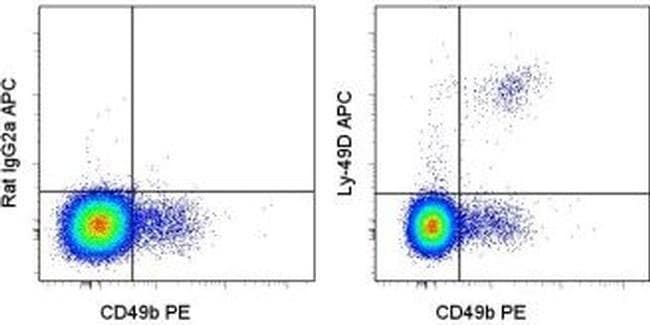
Invitrogen™ Ly-49D Monoclonal Antibody (eBio4E5 (4E5)), APC, eBioscience™

Rat Monoclonal Antibody
Brand: Invitrogen™ 17-5782-82
This item is not returnable.
View return policy
Description
Description: The monoclonal antibody eBio4E5 (4E5) reacts with Ly-49D, an activating member of the Ly-49 family of NK cell receptors. This family of receptors form homodimers that recognize MHC Class I molecules. The activating Ly-49 receptors (Ly-49D and Ly-49H) do not contain immune receptor tyrosine-based inhibitory motifs (ITIM) in their cytoplasmic domains, distinguishing them from the inhibitory Ly-49 family members. Instead, activating Ly-49 molecules have been shown to associate with DAP12 which contains an immunoreceptor tyrosine-based activation motif (ITAM) that is required for positive signaling. Expression of different Ly-49 family members is not linked, therefore, several Ly-49 proteins can be expressed on the same cells. Expression of Ly-49D on subsets of NK cells is strain-dependent and is found in C57BL/6, CB6F1 and SJL mice, while BALB/c, DBA/2, AKR and CBA/J mice are negative for Ly-49D. In 129/J mice, eBio4E5 also recognizes Ly-49O, Ly-49V and Ly-49R. eBio4E5 is reported to have functional (activating) activity. Applications Reported: This eBio4E5 (4E5) antibody has been reported for use in flow cytometric analysis. Applications Tested: This eBio4E5 (4E5) antibody has been tested by flow cytometric analysis of mouse splenocytes. This can be used at less than or equal to 0.5 μg per test. A test is defined as the amount (μg) of antibody that will stain a cell sample in a final volume of 100 μL. Cell number should be determined empirically but can...
Ly-49D, an activating member of the Ly-49 family of NK cell receptors. This family of receptors form homodimers that recognize MHC Class I molecules. The activating Ly-49 receptors (Ly-49D and Ly-49H) do not contain immune receptor tyrosine-based inhibitory motifs (ITIM) in their cytoplasmic domains, distinguishing them from the inhibitory Ly-49 family members. Instead, activating Ly-49 molecules have been shown to associate with DAP12 which contains an immunoreceptor tyrosine-based activation motif (ITAM) that is required for positive signaling. Expression of different Ly-49 family members is not linked, therefore, several Ly-49 proteins can be expressed on the same cells. Expression of Ly-49D on subsets of NK cells is strain-dependent and is found in C57BL/6, CB6F1 and SJL mice, while BALB/c, DBA/2, AKR and CBA/J mice are negative for Ly-49D. In 129/J mice, eBio4E5 also recognizes Ly-49O, Ly-49V and Ly-49R.
Specifications
| Ly-49D | |
| Monoclonal | |
| 0.2 mg/mL | |
| PBS with 0.09% sodium azide; pH 7.2 | |
| Q60651 | |
| Klra4 | |
| Affinity chromatography | |
| RUO | |
| 16635 | |
| 4°C, store in dark, DO NOT FREEZE! | |
| Liquid |
| Flow Cytometry | |
| eBio4E5 (4E5) | |
| APC | |
| Klra4 | |
| Chok; killer cell lectin-like receptor 4; killer cell lectin-like receptor subfamily A member 32; killer cell lectin-like receptor subfamily A member 33; killer cell lectin-like receptor, subfamily A, member 4; Klra32; Klra33; Klra4; Ly49d; Ly-49d; Ly49-d; ly49r>129>; Lymphocyte antigen 49d; T-cell surface glycoprotein Ly-49D | |
| Rat | |
| 100 μg | |
| Primary | |
| Mouse | |
| Antibody | |
| IgG2a κ |
Product Content Correction
Your input is important to us. Please complete this form to provide feedback related to the content on this product.
Product Title
Spot an opportunity for improvement?Share a Content Correction