missing translation for 'onlineSavingsMsg'
Learn More
Learn More
Invitrogen™ LAP (Latency Associated peptide) Monoclonal Antibody (TW7-16B4), PE, eBioscience™

Mouse Monoclonal Antibody
£230.00
Specifications
| Antigen | LAP (Latency Associated peptide) |
|---|---|
| Clone | TW7-16B4 |
| Concentration | 0.2 mg/mL |
| Content And Storage | 4°C, store in dark, DO NOT FREEZE! |
| Applications | Flow Cytometry |
Description
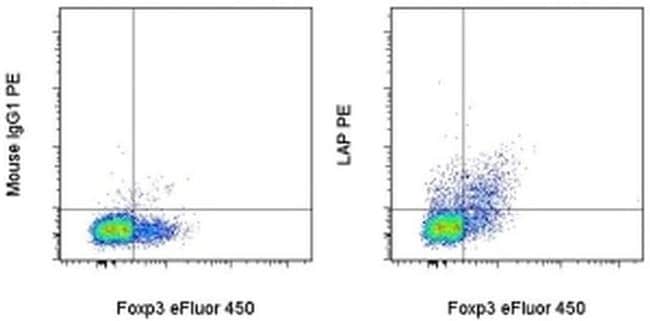
Description: The TW7-16B4 monoclonal antibody reacts with mouse latency associated peptide (LAP, pro-TGF beta 1, LAP/TGF beta 1). Many different cells produce TGF beta and it mediates effects on the proliferation, differentiation and function of many cell types. TGF beta is synthesized as a precursor that contains LAP at the N-terminus and mature TGF beta at the C-terminus. Processing and cleavage of the precursor protein between amino acids 278 and 279 results in the formation of LAP dimers and TGF beta dimers that then non-covalently associate with each other to form the small latent TGF beta complex. LAP is secreted and can be found in the extracellular matrix. In addition, LAP can also be expressed on platelets and activated regulatory T cells. It is believed that this surface-expressed LAP is due to the binding of LAP to GARP (LRRC32), which is a transmembrane protein that is also found at high levels on platelets and activated regulatory T cells. Applications Reported: This TW7-16B4 antibody has been reported for use in flow cytometric analysis. Applications Tested: This TW7-16B4 antibody has been tested by flow cytometric analysis of stimulated mouse splenocytes. This can be used at less than or equal to 0.25 μg per test. A test is defined as the amount (μg) of antibody that will stain a cell sample in a final volume of 100 μL. Cell number should be determined empirically but can range from 10^5 to 10^8 cells/test. It is recommended that the antibo...
TGF beta-1 is a polypeptide member of the transforming growth factor beta superfamily of cytokines, found almost ubiquitously in tissues. Transforming growth factor (TGF)-b is stored in the extracellular matrix as a latent complex with its prodomain. Activation of TGF-b1 requires the binding of aV integrin to an RGD sequence in the prodomain and exertion of force on this domain, which is held in the extracellular matrix by latent TGF-b binding proteins. Latent forms are complexes of TGF-beta, an aminoterminal portion of the TGF-beta precursor, designated TGF-LAP (TGF-latency associated peptide), and a specific binding protein, known as LTBP.Specifications
| LAP (Latency Associated peptide) | |
| 0.2 mg/mL | |
| Flow Cytometry | |
| PE | |
| Mouse | |
| RUO | |
| PBS with 0.09% sodium azide; pH 7.2 | |
| P04202 | |
| 21803 | |
| Primary | |
| Affinity chromatography |
| TW7-16B4 | |
| 4°C, store in dark, DO NOT FREEZE! | |
| Monoclonal | |
| Liquid | |
| IgG1 κ | |
| Mouse | |
| TGFB1 | |
| CED; DPD1; LAP; latency-associated peptide; prepro-transforming growth factor beta-1; regulatory protein; TGFB; Tgfb1; Tgfb-1; TGFbeta; TGF-beta 1; TGFbeta1; TGF-beta1; TGF-beta-1; transforming growth factor beta 1; transforming growth factor beta-1; Transforming growth factor beta-1 proprotein; transforming growth factor, beta 1; transforming growth factor-beta 1 | |
| TGFB1 | |
| Antibody |
Spot an opportunity for improvement?Share a Content Correction
Product Content Correction
Your input is important to us. Please complete this form to provide feedback related to the content on this product.
Product Title