missing translation for 'onlineSavingsMsg'
Learn More
Learn More
KIR2DL1/CD158a Antibody (2F9) - BSA Free, Novus Biologicals™
Mouse Monoclonal Antibody
Brand: Novus Biologicals NBP1-04315
This item is not returnable.
View return policy
Description
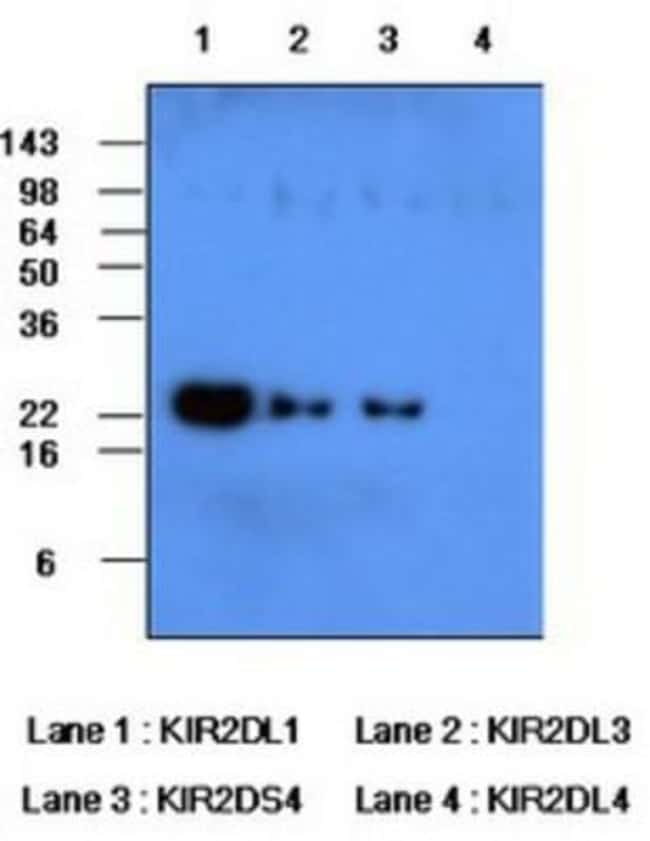
KIR2DL1/CD158a Monoclonal specifically detects KIR2DL1/CD158a in Human samples. It is validated for Western Blot, Flow Cytometry, ELISA, Immunocytochemistry/Immunofluorescence, Immunoprecipitation.
Specifications
| KIR2DL1/CD158a | |
| Monoclonal | |
| 1.0 mg/mL | |
| Western Blot 1:500, Flow Cytometry, ELISA 1:100-1:2000, Immunocytochemistry/Immunofluorescence | |
| CD158 antigen-like family member A, CD158a antigen, CD158Ankat1, cl-42, killer cell immunoglobulin-like receptor 2DL1, killer cell immunoglobulin-like receptor, two domains, long cytoplasmic tail, 1, killer Ig receptor, killer inhibitory receptor 2-2-1, KIR221, MHC class I NK cell receptor, Natural killer-associated transcript 1, NKAT, NKAT-1, NKAT1KIR-K64, p58 killer cell inhibitory receptor KIR-K64, p58 natural killer cell receptor clones CL-42/47.11, p58 NK cell inhibitory receptor NKR-K6,47.11, p58 NK receptor CL-42/47.11, p58.1, p58.1 MHC class-I-specific NK receptor | |
| Mouse | |
| Protein G purified | |
| RUO | |
| Primary | |
| Anti-human KIR2DL1 mAb, clone 2F9, is derived from hybridization of mouse SP2/O myeloma cells with spleen cells from BALB/c mice immunized with a recombinant human KIR2DL1 protein. | |
| Store at 4C short term. Aliquot and store at -20C long term. Avoid freeze-thaw cycles. | |
| IgG2a κ |
| Western Blot, Flow Cytometry, ELISA, Immunocytochemistry, Immunofluorescence, Immunoprecipitation | |
| 2F9 | |
| Unconjugated | |
| NP_055033 | |
| KIR2DL1 | |
| Recombinant human KIR2DL1 (23-223 aa) purified from E. coli | |
| 0.1 mL | |
| Immunology, Innate Immunity, Signal Transduction | |
| 3802 | |
| Human | |
| Purified |
Product Content Correction
Your input is important to us. Please complete this form to provide feedback related to the content on this product.
Product Title
For Research Use Only
Spot an opportunity for improvement?Share a Content Correction