missing translation for 'onlineSavingsMsg'
Learn More
Learn More
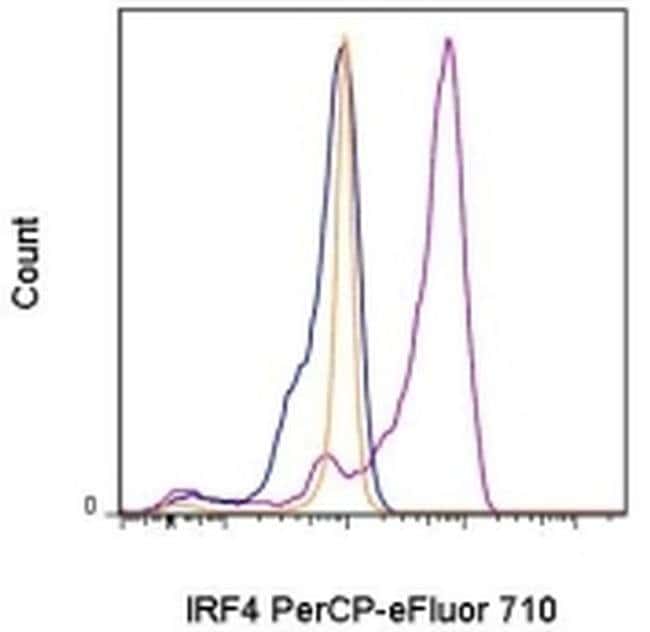
Invitrogen™ IRF4 Monoclonal Antibody (3E4), PerCP-eFluor™ 710, eBioscience™

Rat Monoclonal Antibody
£127.00 - £306.00
Specifications
| Antigen | IRF4 |
|---|---|
| Clone | 3E4 |
| Concentration | 0.2 mg/mL |
| Content And Storage | 4°C, store in dark, DO NOT FREEZE! |
| Applications | Flow Cytometry |
| Product Code | Brand | Quantity | Price | Quantity & Availability | |||||
|---|---|---|---|---|---|---|---|---|---|
| Product Code | Brand | Quantity | Price | Quantity & Availability | |||||
|
15569446
|
Invitrogen™
46-9858-80 |
25 μg |
£127.00
25µg |
Please sign in to purchase this item. Need a web account? Register with us today! | |||||
|
15579446
|
Invitrogen™
46-9858-82 |
100 μg |
£306.00
100µg |
Please sign in to purchase this item. Need a web account? Register with us today! | |||||
Description
Description: The monoclonal antibody 3E4 reacts with human and mouse interferon regulatory factor 4 (IRF4). IRF4 is a 52 kDa transcription factor with roles in B cell, T cell and macrophage function. In B cells, IRF4 is highly expressed in mature plasma cells and plays a crucial role in their differentiation. IRF4 has been shown to interact with PU.1 and control the transcription of many B cell-specific genes including Prdm1, which encodes Blimp1. In T cells, IRF4 has been implicated in regulatory T (Treg), Th2, Th9 and Th17 cell development and function. This transcription factor is upregulated upon T cell activation and is expressed in mature T cells. Studies have shown that IRF4 directly induces Blimp1 expression in Tregs, leading to IL-10 expression. IRF4 has also been demonstrated to be involved in macrophage polarization and regulation. Lastly, in addition to its roles in normal immune function, IRF4 expression has been reported to be upregulated in many blood-related cancers. Applications Reported: This 3E4 antibody has been reported for use in intracellular staining followed by flow cytometric analysis. Applications Tested: This 3E4 antibody has been tested by intracellular staining and flow cytometric analysis of stimulated normal human peripheral blood cells using the Foxp3/Transcription Factor Buffer Set (Product # 00-5523-00) and protocol. Please see BestProtocols® Section (Staining intracellular Antigens for Flow Cytometry) for staining protocol (refer to...
The IRF (interferon regulatory factor) family of transcription factors are characterized by an unique tryptophan pentad repeat DNA-binding domain. The IRFs are important in the regulation of interferons in response to infection by virus, and in the regulation of interferon-inducible genes. IRF4 is lymphocyte specific and negatively regulates toll-like-receptor (TLR) signaling that is central to the activation of innate and adaptive immune systems. A chromosomal translocation involving this gene and the IgH locus, t(6;14)(p25;q32), may be a cause of multiple myeloma. Alternatively spliced transcript variants have been found.Specifications
| IRF4 | |
| 0.2 mg/mL | |
| Flow Cytometry | |
| PerCP-eFluor 710 | |
| Rat | |
| RUO | |
| PBS with 0.09% sodium azide; pH 7.2 | |
| Q15306, Q64287 | |
| 16364, 3662 | |
| Primary | |
| Affinity chromatography |
| 3E4 | |
| 4°C, store in dark, DO NOT FREEZE! | |
| Monoclonal | |
| Liquid | |
| IgG1 κ | |
| Human, Mouse | |
| IRF4 | |
| AI385587; interferon regulatory factor 4; Irf4; IRF-4; LSIRF; Lymphocyte-specific interferon regulatory factor; multiple myeloma oncogene 1; MUM1; NF-EM5; PU.1 interaction partner; Sfpi1/PU.1 interaction partner; SHEP8; Spip; Transcriptional activator PIP | |
| IRF4 | |
| Antibody |
Spot an opportunity for improvement?Share a Content Correction
Product Content Correction
Your input is important to us. Please complete this form to provide feedback related to the content on this product.
Product Title