missing translation for 'onlineSavingsMsg'
Learn More
Learn More
Invitrogen™ IL-33R (ST2) Monoclonal Antibody (hIL33Rcap), APC, eBioscience™, Invitrogen™

Mouse Monoclonal Antibody
Brand: Invitrogen™ 17-9338-42
This item is not returnable.
View return policy
Description
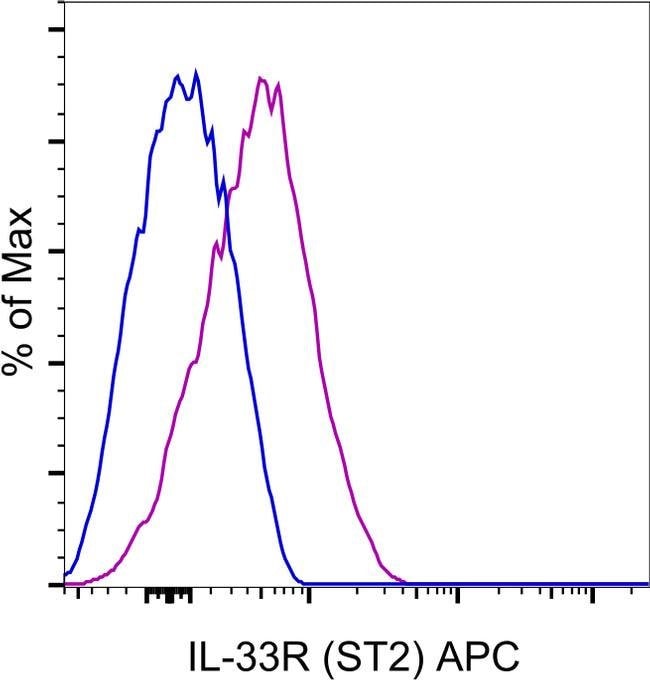
Description: This hIL33Rcap monoclonal antibody recognizes human IL-33R, also known as ST2. This antibody binds both, the membrane bound form (ST2L) and the soluble form (ST2S). This antibody is suitable for both surface and intracellular staining. This hIL33Rcap clone is also used as a capture antibody in the IL-33R (ST2) Human ProcartaPlex™ Simplex Kit (Product # EPX010-12231-901) Applications Reported: This hIL33Rcap antibody has been reported for use in flow cytometric analysis. Applications Tested: This hIL33Rcap antibody has been pre-diluted and tested by flow cytometric analysis of LAD2 cells. This may be used at 5 μL (0.125 μg) per test. A test is defined as the amount (μg) of antibody that will stain a cell sample in a final volume of 100 μL. Cell number should be determined empirically but can range from 10^5 to 10^8 cells/test. Excitation: 633-647 nm; Emission: 660 nm; Laser: Red Laser
IL-33R, also known as ST2, is a receptor for IL-33. It is a member of the IL-1 receptor family of innate receptors. Its extracellular domain consists of 3 Ig-like domains that directly interact with its co-receptor IL-1RAcP, and the ligand alarmin, IL-33. IL-33 ligation results in the association of IL-33R complex with its adaptor proteins MyD88, IRAK1, IRAK4 and TRAF6, and activation of the NF-kB, and MAPK pathways. This, in turn, instigates the release of chemokines and cytokines such as IL-5, IL-6, IL-8, and IL-13. Two most common isoforms of IL-33R that result from alternative splicing are ST2L - the membrane bound form, and ST2S - the soluble form. The membrane bound form can be released from the cell surface by proteolytic cleavage. The soluble forms have been suggested to act as decoys dampening the IL-33 signaling. IL-33R is primarily expressed by mast cells, basophils, and eosinophils. In mouse, IL-33R expression has been shown on ILC2 and Th2 cells. IL-33R signaling has been implicated in the number of immune conditions, including allergies, arthritis, atherosclerosis and sepsis.
Specifications
| IL-33R (ST2) | |
| Monoclonal | |
| 5 μL/Test | |
| PBS with BSA and 0.09% sodium azide; pH 7.2 | |
| Q01638 | |
| IL1RL1 | |
| Extracellular domain of human IL-33R protein. | |
| 100 Tests | |
| Primary | |
| Human | |
| Antibody | |
| IgG1 κ |
| Flow Cytometry | |
| hIL33Rcap | |
| APC | |
| IL1RL1 | |
| DER4; Fit1; Fit-1; Fos-responsive gene 1 protein; growth stimulation-expressed; homolog of mouse growth stimulation-expressed; IL-1 R4; IL1RL1; IL-1RL1; IL33R; IL-33R; interleukin 1 receptor like 1; interleukin 1 receptor-like 1; interleukin 1 receptor-related protein; Interleukin1 receptor like 1; interleukin-1 receptor-like 1; Interleukin-33 receptor alpha chain; Ly84; lymphocyte antigen 84; Protein ST2; Protein T1; sIL 33R; soluble IL 33 Receptor; soluble IL 33R; St2; ST2L; St2-rs1; ST2V; Ste2; T1; T1/ST2 | |
| Mouse | |
| Affinity chromatography | |
| RUO | |
| 9173 | |
| 4°C, store in dark, DO NOT FREEZE! | |
| Liquid |
Product Content Correction
Your input is important to us. Please complete this form to provide feedback related to the content on this product.
Product Title
Spot an opportunity for improvement?Share a Content Correction