missing translation for 'onlineSavingsMsg'
Learn More
Learn More
PeproTech IL-33 Polyclonal Antibody, PeproTech®, Invitrogen™

Rabbit Polyclonal Antibody
Brand: PeproTech 500-P261-50UG
This item is not returnable.
View return policy
Description
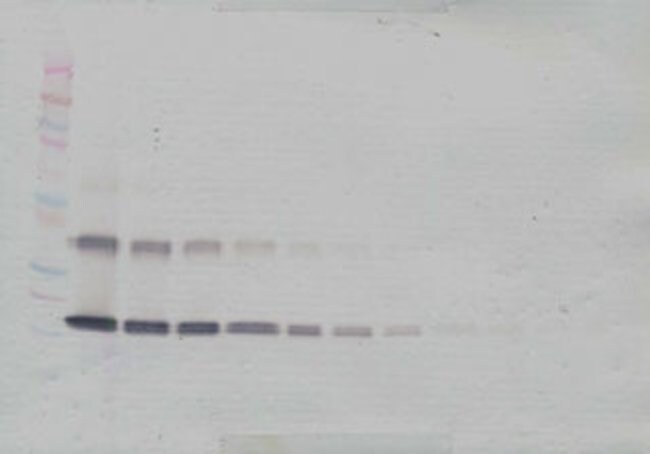
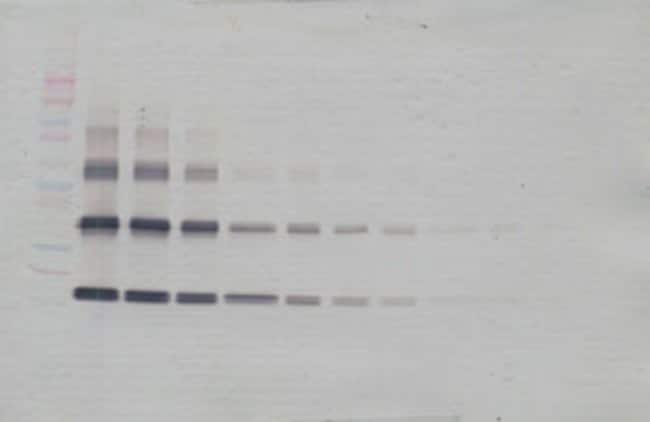
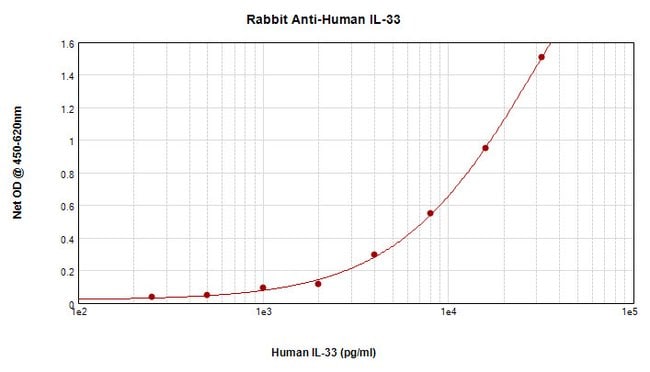
AA Sequence of recombinant protein: SITGISPITE YLASLSTYND QSITFALEDE SYEIYVEDLK KDEKKDKVLL SYYESQHPSN ESGDGVDGKM LMVTLSPTKD FWLHANNKEH SVELHKCEKP LPDQAFFVLH NMHSNCVSFE CKTDPGVFIG VKDNHLALIK VDSSENLCTE NILFKLSET. Preparation: Produced from sera of rabbits immunized with highly pure Recombinant Human IL-33. Anti-Human IL-33-specific antibody was purified by affinity chromatography employing an immobilized Human IL-33 matrix. Sandwich ELISA: To detect Human IL-33 by sandwich ELISA (using 100 μL/well antibody solution) a concentration of 0.5-2.0 μg/mL of this antibody is required. This antigen affinity purified antibody, in conjunction with PeproTech Biotinylated Anti-Human IL-33 (500-P261Bt) as a detection antibody, allows the detection of at least 0.2-0.4 ng/well of Recombinant Human IL-33. Western Blot: To detect Human IL-33 by Western Blot analysis this antibody can be used at a concentration of 0.1-0.2 μg/mL. Used in conjunction with compatible secondary reagents the detection limit for Recombinant Human IL-33 is 1.5-3.0 ng/lane, under either reducing or non-reducing conditions.
IL-33 (Interleukin-33) is a 270 amino acid, highly divergent protein belonging to the IL-1 family with an IL-1-like C-terminal domain. IL-33 is a dual function protein that may function both as a proinflammatory cytokine and an intracellular nuclear factor with transcriptional regulatory properties. IL-33 binds to and signals through IL1RL1/ST2 and its stimulation recruits MYD88, IRAK1, IRAK4, and TRAF6. IL-33 activates NF-kappaB and MAP kinases, and drives production of TH2-associated cytokines from in vitro polarized TH2 cells. In vivo, IL-33 induces the expression of IL-4, IL-5, and IL-13 and leads to severe pathological changes in mucosal organs. IL-33 is proteolytically converted to a mature form by CASP1 and is highly expressed in high endothelial venules found in tonsils, Peyer's patches and mesenteric lymph nodes and is almost undetectable in placenta. Prolonged IL-33 treatment of mice led to the development of eosinophilia, splenomegaly, and severe pathological changes in mucosal organs such as lungs, esophagus and small intestine. Recent experiments have shown that IL-33 can also co-localize with heterochromatin and possesses transcriptional repressor activities, indicating that IL-33 may function as both a proinflammatory cytokine and an intracellular nuclear factor with transcriptional regulatory properties. Despite its predicted molecular weight, IL-33 will often run at higher molecular weight in SDS-PAGE. Studies have shown that IL-33 can also co-localize with heterochromatin and possesses transcriptional repressor activities, indicating that IL-33 may function as both a proinflammatory cytokine, and an intracellular nuclear factor with transcriptional regulatory properties.
Specifications
| IL-33 | |
| Polyclonal | |
| Unconjugated | |
| IL33 | |
| 9230117N10Rik; C9orf26; DVS27; DVS27-related protein; H-IL-33; IL1F11; IL-1F11; Il33; IL-33; ILN; Interleukin; interleukin 33; interleukin-1 family member 11; Interleukin33; Interleukin-33; Interleukin-33 (109-270); Interleukin-33 (95-270); Interleukin-33 (99-270); Interleukin-33(102-266); Interleukin-33(109-266); NFEHEV; NFHEV; NF-HEV; nuclear factor for high endothelial venules; nuclear factor from high endothelial venules; RGD1311155; RP11-575C20.2 | |
| Rabbit | |
| Antigen affinity chromatography | |
| RUO | |
| 90865, 9173 | |
| -20°C | |
| Lyophilized |
| ELISA, Western Blot | |
| 0.1-1.0 mg/mL | |
| PBS with no preservative | |
| O95760, Q01638 | |
| IL1rl1, IL33 | |
| E.coli-derived Recombinant Human IL-33. | |
| 50 μg | |
| Primary | |
| Human | |
| Antibody |
Product Content Correction
Your input is important to us. Please complete this form to provide feedback related to the content on this product.
Product Title
Spot an opportunity for improvement?Share a Content Correction