missing translation for 'onlineSavingsMsg'
Learn More
Learn More
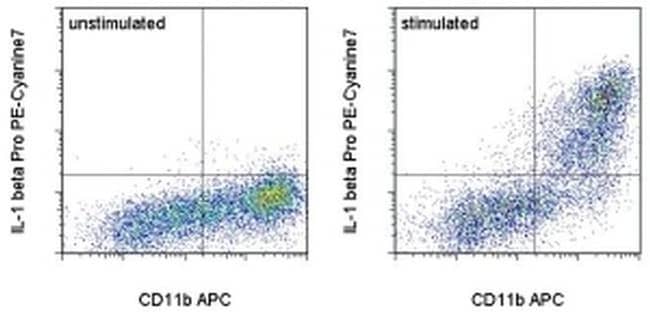
Invitrogen™ IL-1 beta (Pro-form) Monoclonal Antibody (NJTEN3), PE-Cyanine7, eBioscience™, Invitrogen™

Rat Monoclonal Antibody
Brand: Invitrogen™ 25-7114-82
This item is not returnable.
View return policy
Description
Description: This NJTEN3 monoclonal antibody reacts with the pro-form of mouse IL-1 beta, which is a proinflammatory cytokine expressed by monocytes, macrophages, and dendritic cells. It is synthesized in response to inflammatory stimuli as a 31 kDa inactive pro-form that accumulates in the cytosol. Cleavage of pro-IL-1 beta into the active 17 kDa protein requires the activation of inflammasomes, which are multi-protein complexes that respond to pathogens, stress conditions, and other danger signals. Inflammasome activation triggers the processing of the caspase-1 precursor into its active form, which in turn cleaves pro-IL-1 beta. IL-1 beta lacks a signal sequence peptide for classical ER/Golgi pathway and is instead secreted alongside caspase-1 via an alternate and incompletely understood mechanism. IL-1 beta signals via the IL-1RI, which is shared with IL-1 alpha. These cytokines play important roles in innate host defense by triggering the production of other proinflammatory cytokines in target cells and initiating acute-phase responses. Their activity can be moderated by IL-1 Receptor Antagonist (IL-1RA), a protein produced by many cell types that blocks receptor binding through competitive inhibition. Elevated levels of IL-1 beta have been associated with many chronic inflammatory conditions, giving IL-RA or IL-1 beta neutralizing antibodies potential therapeutical value.
Interleukin-1 beta (IL-1 beta) is a proinflammatory cytokine expressed by monocytes, macrophages, and dendritic cells. It is synthesized in response to inflammatory stimuli as a 31 kDa inactive pro-form that accumulates in the cytosol. Cleavage of pro-IL-1 beta into the active 17 kDa protein requires the activation of inflammasomes, which are multi-protein complexes that respond to pathogens, stress conditions, and other danger signals. Inflammasome activation triggers the processing of the caspase-1 precursor into its active form, which in turn cleaves pro-IL-1 beta. IL-1 beta lacks a signal sequence peptide for classical ER/Golgi pathway and is instead secreted alongside caspase-1 via an alternate and incompletely understood mechanism. Although IL-1 beta is most often secreted in its active form, secretion of the uncleaved protein may be detectable under some biological conditions.IL-1 beta signals through two receptors, IL-1RI and IL-1RII, both of which are shared with IL-1 alpha. These cytokines play important roles in innate host defense by triggering the production of other proinflammatory cytokines in target cells and initiating acute-phase responses. Their activity can be moderated by IL-1 Receptor Antagonist (IL-1RA), a protein produced by many cell types that blocks receptor binding through competitive inhibition. Elevated levels of IL-1 beta have been associated with many chronic inflammatory conditions, giving IL-RA or IL-1 beta neutralizing antibodies potential therapeutical value.
Specifications
| IL-1 beta (Pro-form) | |
| Monoclonal | |
| 0.2 mg/mL | |
| PBS with 0.09% sodium azide; pH 7.2 | |
| P10749 | |
| Il1b | |
| Affinity chromatography | |
| RUO | |
| 16176 | |
| 4°C, store in dark, DO NOT FREEZE! | |
| Liquid | |
| Responsibly packaged |
| Flow Cytometry | |
| NJTEN3 | |
| PE-Cyanine7 | |
| Il1b | |
| il 1b; IL 1β; IL-1 beta; Il1b; Il-1b; IL-1beta; IL1β; ILN; Interleukin; interleukin 1 beta; Interleukin1 beta; interleukin-1 beta; Interleukin-1b | |
| Rat | |
| 100 μg | |
| Primary | |
| Mouse | |
| Antibody | |
| IgG1 κ |
Product Content Correction
Your input is important to us. Please complete this form to provide feedback related to the content on this product.
Product Title
For Research Use Only.
Spot an opportunity for improvement?Share a Content Correction