missing translation for 'onlineSavingsMsg'
Learn More
Learn More
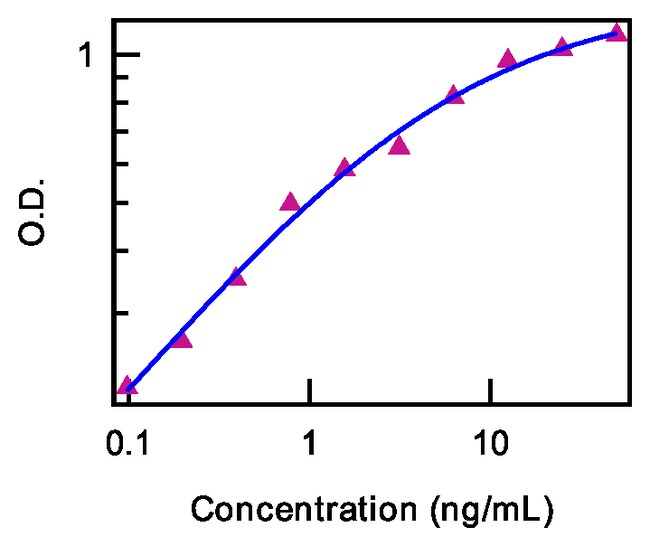
Human IL-23, Invitrogen™
Click to view available options
Quantity:
10 μg
Unit Size:
Each
Description
IL-23 is a heterodimeric cytokine composed of the p40 subunit of IL-12 disulfide-linked with a protein p19. p19, like p35 of IL-12, is biologically inactive by itself. IL-23 interacts with IL-12Rbeta1 and an additional, novel beta2-like receptor subunit with STAT4 binding domain, termed IL-23R. IL-23 is secreted by activated mouse and human dendritic cells. Biological activities of mouse IL-23 are distinct from those of mouse IL-12. Mouse IL-23 was found not to induce significant amounts of IFN-gamma. Mouse IL-23 does induce strong proliferation of memory T cells (but not naive T cells), whereas IL-12 has no effect on memory cells. Additionally, mouse IL-23 (but not IL-12) can activate mouse memory T cells to produce the proinflammatory cytokine IL-17. Human IL-23 has biological properties which are less distinct from human IL-12; human IL-23 induces proliferation of memory T cells and induces moderate levels of IFN-gamma production by naive and memory T cells, as compared to IL-12. eBioscience′s recombinant IL-23 is produced in baculovirus-infected insect cells as an authentic heterodimer of precursor p19 and p40 subunits using a dual promoter expression system. It is distinct from other available forms of the protein in that it is expressed as a true heterodimer, as opposed to a single-chain, pseudo-heterodimer in which the subunits are joined by an artificial linker. Description: IL-23 is a heterodimeric cytokine composed of the p40 subunit of IL-12 disulfide-linked with a protein p19. p19, like p35 of IL-12, is biologically inactive by itself. IL-23 interacts with IL-12Rbeta1 and an additional, novel beta2-like receptor subunit with STAT4 binding domain, termed IL-23R. IL-23 is secreted by activated mouse and human dendritic cells. Biological activities of mouse IL-23 are distinct from those of mouse IL-12. Mouse IL-23 was found not to induce significant amounts of IFN-gamma. Mouse IL-23 does induce strong proliferation of memory T cells (but not naive T cells), whereas IL-12 has no effect on memory cells. Additionally, mouse IL-23 (but not IL-12) can activate mouse memory T cells to produce the proinflammatory cytokine IL-17. Human IL-23 has biological properties which are less distinct from human IL-12; human IL-23 induces proliferation of memory T cells and induces moderate levels of IFN-gamma production by naive and memory T cells, as compared to IL-12. eBioscience′s recombinant IL-23 is produced in baculovirus-infected insect cells as an authentic heterodimer of precursor p19 and p40 subunits using a dual promoter expression system. It is distinct from other available forms of the protein in that it is expressed as a true heterodimer, as opposed to a single-chain, pseudo-heterodimer in which the subunits are joined by an artificial linker. Applications Reported: Recombinant human IL-23 is biologically active. Applications Tested: The ED50 of this protein, as measured by induction of IL-17A in mouse splenocytes, is less than or equal to 3.5ng/mL. This corresponds to a specific activity of greater than or equal to 2.9 x 10e5 Units/mg. Source: Insect cells infected with baculovirus: human p40, amino acids met 1-Ser 328, accession &Num; NM_002187 was co-expressed with human p19, amino acids met 1-pro 189, accession &Num; NM_016584. Bioactivity: The ED50 of this protein, as measured by induction of IL-17A in mouse splenocytes, is less than or equal to 3.5ng/mL. This corresponds to a specific activity of greater than or equal to 2.9 x 10e5 Units/mg. Endotoxin: Less than 0.01ng/ug cytokine as determined by the LAL assay. Purity: >98% as determined by SDS-PAGE. Molecular Weight: The heterodimer of p40, amino acids ile 23-ser 328, cystine linked to p19, amino acids arg 20-pro 189, has a predicted molecular mass of 53,356. On non-reducing SDS-PAGE the heterodimeric cystine-linked protein migrates as a 55 kDa protein. The DTT reduced protein migrates as 43 kDa and 18 kDa polypeptides. Storage and handling: For best recovery, quick-spin vial prior to opening. Use in a sterile environment. Purity: Greater than 90%, as determined by SDS-PAGE. Aggregation: Less than 10%, as determined by HPLC. Filtration: 0.2μm post-manufacturing filtered.

Specifications
Specifications
| Accession Number | Q9NPF7 |
| Concentration | 0.1mg/mL |
| For Use With (Application) | Control, ELISA, Functional Assay |
| Formulation | 20mM phosphate with 0.2M NaCl, 1% BSA and no preservative; pH 6.0 |
| Gene ID (Entrez) | 51561 |
| Molecular Weight (g/mol) | The heterodimer of p40, amino acids ile 23-ser 328, cystine linked to p19, amino acids arg 20-pro 189, has a predicted molecular mass of 53,356. On non-reducing SDS-PAGE the heterodimeric cystine-linked protein migrates as a 55kDa protein. The DTT reduced protein migrates as 43kDa and 18kDa polypeptides. |
| Name | Human IL-23 |
| pH Range | 6.0 |
| Purification Method | SDS-PAGE |
| Quantity | 10 μg |
| Show More |
For Research Use Only.
Product Content Correction
Your input is important to us. Please complete this form to provide feedback related to the content on this product.
Product Title
Spot an opportunity for improvement?Share a Content Correction