missing translation for 'onlineSavingsMsg'
Learn More
Learn More
Invitrogen™ GPNMB Monoclonal Antibody (HOST5DS), PE, eBioscience™

Mouse Monoclonal Antibody
£239.00
Specifications
| Antigen | GPNMB |
|---|---|
| Clone | HOST5DS |
| Concentration | 5 μL/Test |
| Content And Storage | 4°C, store in dark, DO NOT FREEZE! |
| Applications | Flow Cytometry |
Description
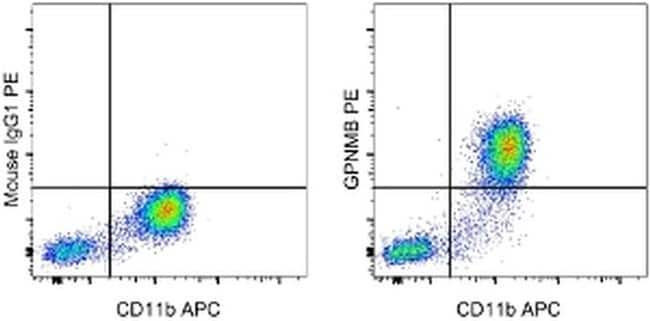
Description: This HOST5DS monoclonal antibody recognizes human GPNMB also known as Osteoactivin, DC-HIL and HGFIN. This type-1 transmembrane glycoprotein was described independently as a bone development factor, tumor related molecule, neurokinin, and immune regulator. Expressed on macrophages and dendritic cells, GPNMB is a ligand for proteoglycan Syndecan-4 (SD-4), which is found on T cells, and is known to inhibit their activation and proliferation. Hence, surface expression of GPNMB by myeloid cells may be indicative of their tolerogenic properties. Various cancers express GPNMB, and it is suspected to help in immune evasion. Treatment with IL-10 and various immunosuppressive drugs (e.g., dexamethasone) upregulate GPNMB on macrophages and dendritic cells. THP-1 and U937 cell lines constitutively express GPNMB. GPNMB may also be secreted. The HOST5DS antibody will work on paraformaldehyde-fixed and permeabilized cells, and can be used for intracellular staining. Please, note that enzymatic tissue dissociation may reduce the amount of surface GPNMB, and thereby negatively impact the brightness of the staining. Applications Reported: This HOST5DS antibody has been reported for use in flow cytometric analysis. Applications Tested: This HOST5DS antibody has been pre-titrated and tested by flow cytometric analysis of human blood monocyte-derived macrophages. This can be used at 5 μL (0.125 μg) per test. A test is defined as the amount (μg) of antibody that will stai...
The protein encoded by this gene is a type I transmembrane glycoprotein which shows homology to the pMEL17 precursor, a melanocyte-specific protein. GPNMB shows expression in the lowly metastatic human melanoma cell lines and xenografts but does not show expression in the highly metastatic cell lines. GPNMB may be involved in growth delay and reduction of metastatic potential. Two transcript variants encoding different isoforms have been found for this gene.Specifications
| GPNMB | |
| 5 μL/Test | |
| Flow Cytometry | |
| PE | |
| Mouse | |
| RUO | |
| PBS with BSA and 0.09% sodium azide; pH 7.2 | |
| Q14956 | |
| 10457 | |
| Fc-tagged full protein expressed in insect cells. | |
| Antibody |
| HOST5DS | |
| 4°C, store in dark, DO NOT FREEZE! | |
| Monoclonal | |
| Liquid | |
| IgG1 κ | |
| Human | |
| GPNMB | |
| Dchil; DC-HIL; dendritic cell-associated heparin sulfate proteoglycan-dependent integrin ligand; dendritic cell-associated transmembrane protein; glycoprotein (transmembrane) nmb; glycoprotein nmb; glycoprotein nmb-like protein; glycoprotein nonmetastatic melanoma protein B; Gpnmb; hematopoietic growth factor inducible neurokinin-1; Hematopoietic growth factor inducible neurokinin-1 type; Hgfin; ipd; iris pigment dispersion; NMB; Osteoactivin; si:ch211-155k24.6; transmembrane glycoprotein HGFIN; transmembrane glycoprotein NMB; Unknown (protein for MGC:133733); UNQ1725/PRO9925 | |
| GPNMB | |
| Primary | |
| Affinity chromatography |
Spot an opportunity for improvement?Share a Content Correction
Product Content Correction
Your input is important to us. Please complete this form to provide feedback related to the content on this product.
Product Title