missing translation for 'onlineSavingsMsg'
Learn More
Learn More
Invitrogen™ EVA1 Monoclonal Antibody (G9P3-1), PE, eBioscience™
Mouse Monoclonal Antibody
£293.00
Specifications
| Antigen | EVA1 |
|---|---|
| Clone | G9P3-1 |
| Concentration | 0.2 mg/mL |
| Content And Storage | 4°C, store in dark, DO NOT FREEZE! |
| Applications | Flow Cytometry |
Description
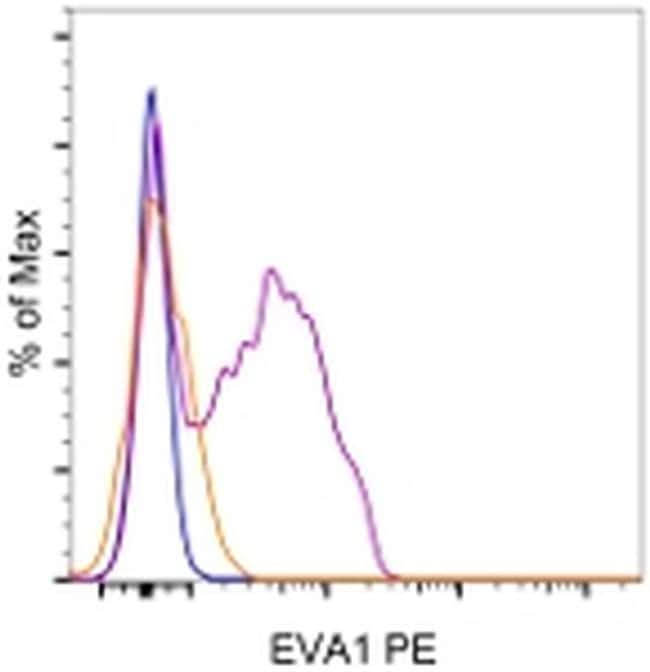
Description: The monoclonal antibody G9P3-1 reacts with human and mouse epithelial V-like antigen 1 (EVA1), also known as myelin protein zero-like 2 (MPZL2). EVA1 is a low affinity adhesion type I transmembrane glycoprotein that bears an immunolobulin V-type domain. This glycoprotein is expressed on some epithelial tissues and also on immature thymocytes in the DN3 stage. The DN3 thymocytes are characterized by CD4 and CD8 double negative cells that are CD25 positive and CD44 negative. EVA1 has a role in immature thymocyte development, and thymic regeneration. Applications Reported: This G9P3-1 antibody has been reported for use in flow cytometric analysis. Applications Tested: This G9P3-1 antibody has been tested by flow cytometric analysis of mouse thymocytes. This can be used at less than or equal to 0.5 μg per test. A test is defined as the amount (μg) of antibody that will stain a cell sample in a final volume of 100 μL. Cell number should be determined empirically but can range from 10^5 to 10^8 cells/test. It is recommended that the antibody be carefully titrated for optimal performance in the assay of interest. Excitation: 488-561 nm; Emission: 578 nm; Laser: Blue Laser, Green Laser, Yellow-Green Laser. Filtration: 0.2 μm post-manufacturing filtered.
Thymus development depends on a complex series of interactions between thymocytes and the stromal component of the organ. Epithelial V-like antigen (EVA) is expressed in thymus epithelium and strongly downregulated by thymocyte developmental progression. This gene is expressed in the thymus and in several epithelial structures early in embryogenesis. It is highly homologous to the myelin protein zero and, in thymus-derived epithelial cell lines, is poorly soluble in nonionic detergents, strongly suggesting an association to the cytoskeleton. Its capacity to mediate cell adhesion through a homophilic interaction and its selective regulation by T cell maturation might imply the participation of EVA in the earliest phases of thymus organogenesis. The protein bears a characteristic V-type domain and two potential N-glycosylation sites in the extracellular domain; a putative serine phosphorylation site for casein kinase 2 is also present in the cytoplasmic tail. Two transcript variants encoding the same protein have been found for this gene.Specifications
| EVA1 | |
| 0.2 mg/mL | |
| Flow Cytometry | |
| PE | |
| Mouse | |
| RUO | |
| PBS with 0.09% sodium azide; pH 7.2 | |
| O60487, O70255 | |
| 10205, 14012 | |
| Primary | |
| Affinity chromatography |
| G9P3-1 | |
| 4°C, store in dark, DO NOT FREEZE! | |
| Monoclonal | |
| Liquid | |
| IgG1 κ | |
| Human, Mouse | |
| Mpzl2 | |
| epithelial V-like antigen 1; EVA; Eva1; MPZL2; myelin protein zero like 2; myelin protein zero-like 2; myelin protein zero-like protein 2; UNQ606/PRO1192 | |
| Mpzl2 | |
| Antibody |
Spot an opportunity for improvement?Share a Content Correction
Product Content Correction
Your input is important to us. Please complete this form to provide feedback related to the content on this product.
Product Title