Learn More


Description
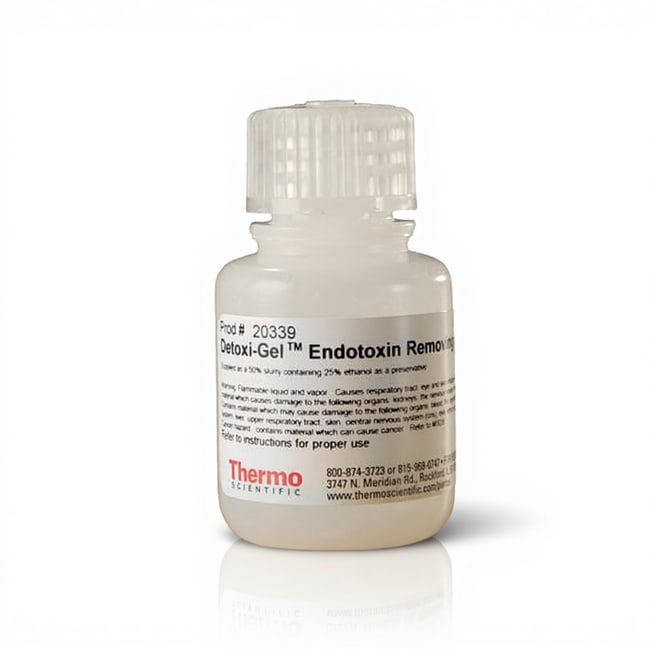
Thermo Scientific™ Detoxi-Gel Endotoxin Removing Gel and Columns provide a quick method to remove endotoxins (lipopolysaccharides or LPS) from samples.
Highlights:
Affinity-based – uses immobilized polymixin B to remove endotoxins by binding to their lipid A domains
High capacity – 1mL of Detoxi-Gel Resin removes at least 9995 endotoxin units from a 5mL sample containing 10,000 EU of lipopolysaccharide (LPS)
Reusable – no loss in binding capacity even after 10 regenerations; requires activation and regeneration with 1% sodium deoxycholate (Part No. 89904)
Testing required – protein recovery is dependent upon protein type and concentration; empirical testing is required to validate the method for particular protein samples
Versatile – remove endotoxin from protein solutions, cell culture media and pharmacological components
Requires:
Sodium deoxycholate (Part No. 89904) for resin activation and regeneration.

Specifications
Specifications
| Capacity (Metric) | 4000 to 6000 EU Binding per mL Gel |
| Content And Storage | Store at 4°C. |
| Form | Liquid |
| Product Line | Detoxi-Gel |
| Quantity | 10 mL |
| Target | Endotoxin Removal |
| Type | Endotoxin Removing Gel |
| Stationary Phase | Polymixin B |
| Sufficient For | 1 mL of gel binds 4000-6000 EU |
| Format | Bottle |
| Show More |
Frequently Asked Questions (FAQs)
It is possible that the column may have been contaminated with endotoxin during storage and handling. Equilibrating the column with 1% sodium deoxycholate followed by pyrogen-free washing ensures that the column is free of endotoxin before the sample is added. The column must be regenerated following endotoxin removal from a sample to make sure the endotoxin that has bound to the column from the sample is washed off.
The Thermo Scientific 1 mL Detoxi-Gel Column has a void volume of 0.3-0.5 mL. This is the volume of solution that must be collected from the column before the sample will begin to come off the column.
1. Equilibrate the column with 5 column volumes of 1% sodium deoxycholate in pyrogen-free water, followed by 3 column volumes of pyrogen-free water or buffer of choice.
2. Apply sample, being sure not to exceed the binding capacity of the gel.
3. Collect sample by gravity flow by applying additional pyrogen-free water or buffer.
4. Regenerate the column with 5 column volumes of 1% sodium deoxycholate in pyrogen-free water, followed by 3 column volumes of pyrogen-free water.
Detoxi-Gel Support has the capacity to bind up to 2µg LPS/mL of gel. Because one endotoxin unit (EU) is approximately 0.1 ng/mL, the gel has the potential for binding up to 20,000 EU/mL of gel.
Detoxi-Gel Support consists of 6% cross-linked beaded agarose that has Polymixin B immobilized onto it. Polymixin B is an antibiotic that contains a cationic cyclopeptide with a fatty acid chain that can neutralize the biological activity of endotoxins by binding to the lipid A portion of the bacterial lipopolysacharide (LPS). After the endotoxin from a sample binds to the immobilized Polymixin B, the sample can be collected and the endotoxin can be eluted using 1% sodium deoxycholate.
Safety and Handling


- Detoxi-Gel Endotoxin Removing Gel
- Danger
- Carcinogenicity Category 2
- Serious eye damage/eye irritation Category 2
- Reproductive toxicity Category 1
- Skin corrosion/irritation Category 2
- H315-Causes skin irritation.
- H319-Causes serious eye irritation.
- H350-May cause cancer.
- H360Df-May damage the unborn child. Suspected of damaging fertility.
- P201-Obtain special instructions before use.
- P202-Do not handle until all safety precautions have been read and understood.
- P260-Do not breathe dust/fume/gas/mist/vapours/spray.
- P280-Wear protective gloves/protective clothing/eye protection/face protection.
- P303+P361+P353-IF ON SKIN (or hair): Take off immediately all contaminated clothing. Rinse skin with water/ shower.
- P305+P351+P338-IF IN EYES: Rinse cautiously with water for several minutes. Remove contact lenses, if present and easy to do. Continue rinsing.
- P405-Store locked up.
- P501b-Dispose of contents/container in accordance with local/regional/national/international regulations.
- MIXTURE LIST-Contain: ethanol
For Research Use Only. Not for use in diagnostic procedures.
By clicking Submit, you acknowledge that you may be contacted by Fisher Scientific in regards to the feedback you have provided in this form. We will not share your information for any other purposes. All contact information provided shall also be maintained in accordance with our Privacy Policy.