missing translation for 'onlineSavingsMsg'
Learn More
Learn More




Invitrogen™ Cytokeratin 8 Monoclonal Antibody (LP3K), eBioscience™
Mouse Monoclonal Antibody
Brand: Invitrogen™ 14-9938-37
This item is not returnable.
View return policy
Description
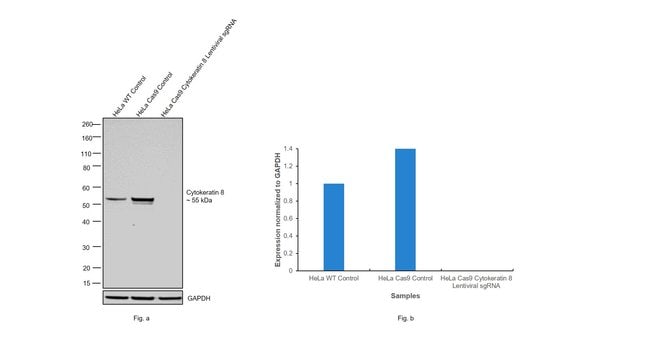
Description: This LP3K monoclonal antibody reacts with human cytokeratin 8 (K8), a 55-kDa member of the family of intermediate filament proteins. Cytokeratin 8 is a type II (or basic) keratin that is expressed in epithelial and carcinoma cells. Cytokeratins form the intracellular cytoskeletal network that maintains the integrity and stability of cells and tissues. More specifically, studies have demonstrated the involvement of cytokeratin 8 in protection against apoptosis, stress, or injury, as well as regulation of the cell cycle. This keratin is frequently co-expressed with cytokeratin 18, a type I (or acidic) keratin as a heterodimer. Although detected primarily in the cytoplasm of normal healthy cells, cytokeratin 8 has been found to localize to the plasma membrane in some tumor cells. Finally, cytokeratin 8 is phosphorylated on serine 73 in dividing cells. Applications Reported: This LP3K antibody has been reported for use in immunoblotting (WB) and immunocytochemistry. Applications Tested: This LP3K antibody has been tested by western blot analysis of reduced A549 cell lysate, as well as by immunocytochemistry of A549 cells. For western blotting, this antibody can be used at 1-10 μg/mL. For immunocytochemistry, LP3K can be used at 1 μg/mL. It is recommended that the antibody be carefully titrated for optimal performance in the assay of interest. Purity: Greater than 90%, as determined by SDS-PAGE. Aggregation: Less than 10%, as determined by HPLC. Filtration: 0...
Cytokeratin 8 is a member of the type II keratin family clustered on the long arm of chromosome 12. Type I and type II keratins heteropolymerize to form intermediate-sized filaments in the cytoplasm of epithelial cells. Cutokeratin 8 typically dimerizes with keratin 18 to form an intermediate filament in simple single-layered epithelial cells. This protein plays a role in maintaining cellular structural integrity and also functions in signal transduction and cellular differentiation. Mutations in this gene cause cryptogenic cirrhosis.
Specifications
| Cytokeratin 8 | |
| Monoclonal | |
| 0.5 mg/mL | |
| PBS with 0.09% sodium azide; pH 7.2 | |
| P05787 | |
| KRT8 | |
| Affinity chromatography | |
| RUO | |
| 3856 | |
| 4°C | |
| Liquid |
| Western Blot, Immunocytochemistry | |
| LP3K | |
| Unconjugated | |
| KRT8 | |
| AA960620; AL022697; AU019895; CARD2; cb186; CK8; CK-8; CYK8; CYKER; cytokeratin 8; cytokeratin 8 (370 AA); cytokeratin endo A; Cytokeratin-8; cytokeratin-A; DreK8; EndoA; etID33550.23; etID43142.23; etID43142.8; K2C8; K8; KERA; keratin 8; keratin 8, type II; keratin complex 2, basic, gene 8; keratin, type 2, gene 8; Keratin, type II cytoskeletal 8; keratin, type II cytoskeletal 8-like protein; keratin-8; KO; Krt-2.8; Krt2-8; krt8; LOW QUALITY PROTEIN: keratin, type II cytoskeletal 8; sb:cb186; type II cytokeratin A (no.8); type-II keratin Kb8; wu:fa20h05; wu:fa95h10; wu:fb96c06; zfk8; zf-K8 | |
| Mouse | |
| 2 mg | |
| Primary | |
| Human | |
| Antibody | |
| IgG1 |
Product Content Correction
Your input is important to us. Please complete this form to provide feedback related to the content on this product.
Product Title
Spot an opportunity for improvement?Share a Content Correction