missing translation for 'onlineSavingsMsg'
Learn More

Invitrogen™ CrkL Polyclonal Antibody
GREENER_CHOICE

Product Code. 16394325 Shop All Thermo Scientific Products
Change view
Click to view available options
Quantity:
100 μg
Unit Size:
100µg
1 product options available for selection
Product selection table with 1 available options. Use arrow keys to navigate and Enter or Space to select.
Product Code. Quantity unitSize
16394325 100 μg 100µg
Use arrow keys to navigate between rows. Press Enter or Space to select a product option. 1 options available.
1 options
This item is not returnable. View return policy
Product Code. 16394325 Supplier Invitrogen™ Supplier No. PA595058

Please to purchase this item. Need a web account? Register with us today!

This item is not returnable. View return policy

Rabbit Polyclonal Antibody

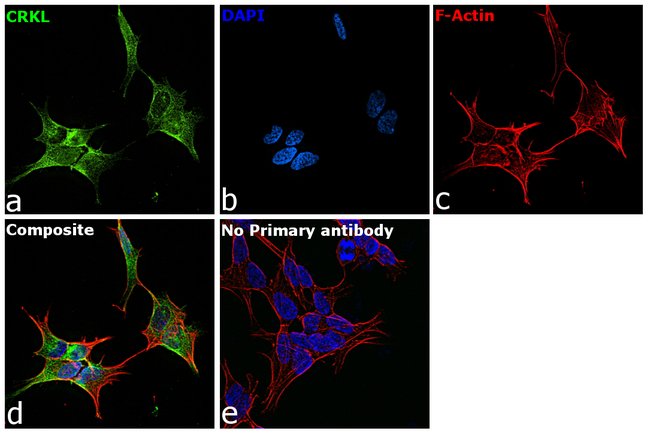
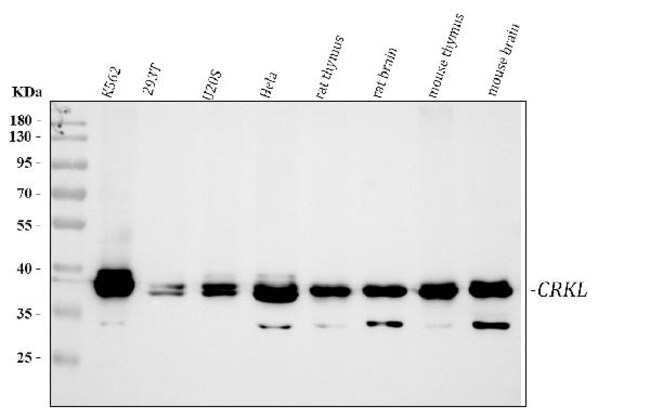
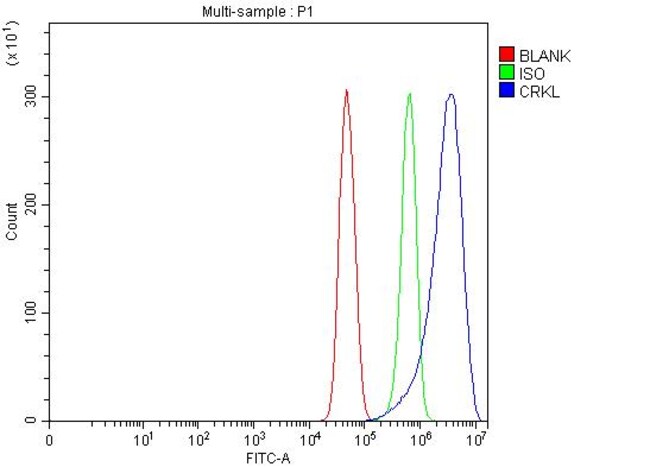
Reconstitute with 0.2 mL of distilled water to yield a concentration of 500 μg/mL. Positive Control - WB: human K562 whole cell, human 293T whole cell, human U20S whole cell, human Hela whole cell, rat thymus tissue, rat brain tissue, mouse thymus tissue, mouse brain tissue. Flow: U251 cell. Store at -20°C for one year from date of receipt. After reconstitution, at 4°C for one month. It can also be aliquotted and stored frozen at -20°C for six months. Avoid repeated freeze-thaw cycles.

The CRKL gene encodes the CRK-like protein, an adaptor protein that plays a crucial role in intracellular signaling pathways related to cell proliferation, differentiation, and migration. CRKL contains SH2 and SH3 domains that facilitate interactions with other signaling molecules, influencing multiple pathways such as the MAPK, PI3K, and STAT pathways. It is involved in processes like cytoskeleton reorganization and immune cell signaling, with significant implications for development and cancer. CRKL is notably associated with Philadelphia chromosome-positive leukemias, where it interacts with the BCR-ABL fusion protein, contributing to leukemogenesis. Additionally, dysregulation of CRKL can affect cardiovascular development, leading to congenital heart defects. Research into CRKL focuses on understanding its role in signal transduction and its potential as a therapeutic target due to its involvement in oncogenic and developmental pathways.
TRUSTED_SUSTAINABILITY

Specifications

Antigen CrkL
Applications Flow Cytometry, Western Blot, Immunocytochemistry
Classification Polyclonal
Concentration 500 μg/mL
Conjugate Unconjugated
Formulation PBS with 5mg BSA and 0.05mg sodium azide, 0.05mg thimerosal
Gene CRKL
Gene Accession No. P46109, P47941, Q5U2U2
Gene Alias 1110025F07Rik; AA589403; AI325100; CRK like proto-oncogene, adaptor protein; CRKL; crkl {ECO:0000312; crk-like protein; crk-like protein {ECO:0000250; Crkol; EMBL:AAH85865.1, ECO:0000312; OTTHUMP00000198539; RGD:1308531}; UniProtKB:P46109}; v-crk avian sarcoma virus CT10 oncogene homolog-like; v-crk sarcoma virus CT10 oncogene homolog (avian)-like; v-crk sarcoma virus CT10 oncogene homolog-like
Gene Symbols CRKL
Host Species Rabbit
Immunogen A synthetic peptide corresponding to a sequence at the C-terminus of human CrkL (286-303aa FPFTHVKIFDPQNPDENE).
Purification Method Affinity chromatography
Quantity 100 μg
Regulatory Status RUO
Primary or Secondary Primary
Gene ID (Entrez) 12929, 1399, 287942
Target Species Human, Mouse, Rat
Content And Storage -20°C
Product Type Antibody
Form Lyophilized
Isotype IgG
Show More Show Less
Product Title
Select an issue

By clicking Submit, you acknowledge that you may be contacted by Fisher Scientific in regards to the feedback you have provided in this form. We will not share your information for any other purposes. All contact information provided shall also be maintained in accordance with our Privacy Policy.