missing translation for 'onlineSavingsMsg'
Learn More
Learn More
Invitrogen™ CD69 Monoclonal Antibody (FN50), Brilliant Ultra Violet™ 737, eBioscience™, Invitrogen™

Mouse Monoclonal Antibody
£176.00 - £353.00
Specifications
| Antigen | CD69 |
|---|---|
| Clone | FN50 |
| Concentration | 5 μL/Test |
| Applications | Flow Cytometry |
| Classification | Monoclonal |
| Product Code | Brand | Quantity | Price | Quantity & Availability | |||||
|---|---|---|---|---|---|---|---|---|---|
| Product Code | Brand | Quantity | Price | Quantity & Availability | |||||
|
17443372
|
Invitrogen™
367-0699-41 |
25 Tests |
£176.00
Pack of 25 |
Please sign in to purchase this item. Need a web account? Register with us today! | |||||
|
17453372
|
Invitrogen™
367-0699-42 |
100 Tests |
£353.00
Pack of 100 |
Please sign in to purchase this item. Need a web account? Register with us today! | |||||
Description
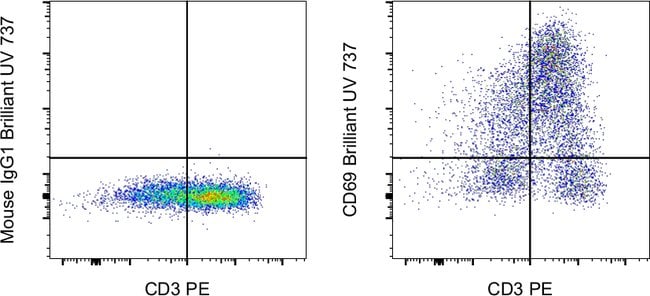
The FN50 monoclonal antibody reacts with human CD69, also known as very early activation antigen (VEA). CD69 is approximately 30 kDa and is expressed on the cell-surface as a disulfide-linked dimer. CD69 is rapidly upregulated upon activation and expressed on lymphocytes, monocytes and platelets. Applications Reported: This FN50 antibody has been reported for use in flow cytometric analysis. Applications Tested: This FN50 antibody has been pre-diluted and tested by flow cytometric analysis of stimulated normal human peripheral blood cells. This may be used at 5 μL (0.06 μg) per test. A test is defined as the amount (μg) of antibody that will stain a cell sample in a final volume of 100 μL. Cell number should be determined empirically but can range from 10^5 to 10^8 cells/test. Brilliant Ultraviolet 737 is a tandem dye that emits at 732 nm and is intended for use on cytometers equipped with an ultraviolet (355 nm) laser.
CD69 (AIM, Active Inducer Molecule) is a gp28/34 disulfide bonded homodimer with a molecular weight of 60 kDa under non-reducing conditions. CD69 contains one or two N linked oligosacaride and the molecule is present on activated platelets. In normal peripheral blood a variable percentage of cells express the CD69 antigen, and it is involved in lymphocyte signal transduction. Expression CD69 is induced upon activation of T lymphocytes, and may play a role in proliferation. Furthermore, the protein may act to transmit signals in natural killer cells and platelets. Alternative splicing results in multiple transcript variants of CD69. Diseases associated with CD69 dysfunction include coccidiodomycosis and asthma.Specifications
| CD69 | |
| 5 μL/Test | |
| Monoclonal | |
| Liquid | |
| RUO | |
| PBS with BSA and 0.09% sodium azide; pH 7.2 | |
| 5830438K24Rik; Activation inducer molecule; activation inducer molecule (AIM/CD69); AI452015; AIM; BL-AC/P26; CD69; CD69 antigen; CD69 antigen (p60, early T-cell activation antigen); CD69 molecule; CLEC2C; C-type lectin domain family 2 member C; C-type lectin domain family 2, member C; EA1; early activation antigen CD69; early lymphocyte activation antigen; early T-cell activation antigen p60; GP32/28; leukocyte surface antigen Leu-23; MLR-3; VEA; Very Early Activation Antigen | |
| CD69 | |
| Primary | |
| 4°C, store in dark, DO NOT FREEZE! | |
| CD69 |
| FN50 | |
| Flow Cytometry | |
| Brilliant Ultraviolet 737 | |
| Mouse | |
| Human | |
| Q07108 | |
| 969 | |
| IgG1 κ | |
| Affinity chromatography | |
| Antibody |
Spot an opportunity for improvement?Share a Content Correction
Product Content Correction
Your input is important to us. Please complete this form to provide feedback related to the content on this product.
Product Title