missing translation for 'onlineSavingsMsg'
Learn More
Learn More
Invitrogen™ CD58 (LFA-3) Monoclonal Antibody (TS2/9), PE, eBioscience™, Invitrogen™

Mouse Monoclonal Antibody
Brand: Invitrogen™ 12-0578-42
This item is not returnable.
View return policy
Description
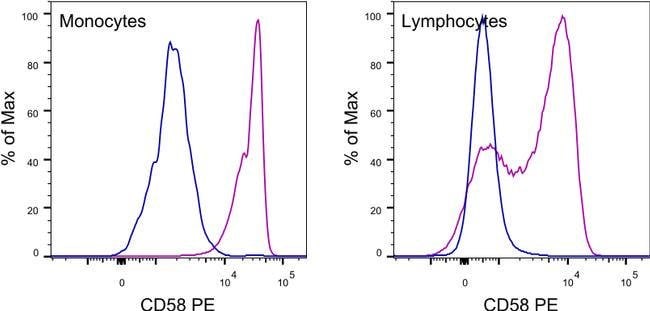
Description: The TS2/9 antibody recognizes human CD58, which is also known as Lymphocyte Associated Antigen-3 (LFA-3). CD58 exists both as a transmembrane protein as well as a GPI-linked extracellular protein. It has been shown that cells can express both forms concurrently. In addition, soluble CD58 has also been observed in serum, urine and synoval fluid of rheumatoid arthritis patients. CD58 is found on non-hematopoietic and most hematopoietic cells. Binding to its ligand CD2, which is present on T cells, initiates a signaling pathway which includes phosphorylation and results in release of cytokines. CD58 has been shown to be important in adhesion to various cell types, T cell activation, cytokine production and cytoxicity. The TS2/9 antibody has been reported to induce signaling events upon crosslinking. The epitope is in domain 1 of the immunoglobulin region. Applications Reported: This TS2/9 antibody has been reported for use in flow cytometric analysis. Applications Tested: This TS2/9 antibody has been pre-diluted and tested by flow cytometric analysis of normal human peripheral blood cells. This may be used at 5 μL (0.5 μg) per test. A test is defined as the amount (μg) of antibody that will stain a cell sample in a final volume of 100 μL. Cell number should be determined empirically but can range from 10^5 to 10^8 cells/test. Excitation: 488-561 nm; Emission: 578 nm; Laser: Blue Laser, Green Laser, Yellow-Green Laser
CD58 is a member of the immunoglobulin superfamily and exists both as a transmembrane protein and a GPI-linked extracellular protein, with cells capable of expressing both forms concurrently. Additionally, soluble CD58 has been detected in serum, urine, and synovial fluid, particularly in patients with rheumatoid arthritis. CD58 is widely expressed on non-hematopoietic and most hematopoietic cells. CD58 serves as a ligand for the CD2 protein on T lymphocytes, playing a crucial role in adhesion and activation of T cells. The interaction between CD58 and CD2 initiates a signaling pathway that includes phosphorylation and leads to cytokine release. This interaction is important for T cell activation, cytokine production, cytotoxicity, and adhesion to various cell types. The protein is localized to the plasma membrane, and alternatively spliced transcript variants have been described, indicating diverse functional roles. CD58's involvement in immune responses highlights its significance in both normal physiological processes and disease states.
Specifications
| CD58 (LFA-3) | |
| Monoclonal | |
| 5 μL/Test | |
| PBS with BSA and 0.09% sodium azide; pH 7.2 | |
| P19256 | |
| CD58 | |
| Affinity chromatography | |
| RUO | |
| 965 | |
| 4°C, store in dark, DO NOT FREEZE! | |
| Liquid |
| Flow Cytometry | |
| TS2/9 | |
| PE | |
| CD58 | |
| Ag3; CD305; CD58; CD58 antigen; CD58 antigen, (lymphocyte function-associated antigen 3); CD58 molecule; FLJ23181; FLJ43722; LAIR1; LAIR-1; LFA3; LFA-3; Lymphocyte function-associated antigen 3; membrane receptor; RP5-1086K13.2; surface glycoprotein LFA-3 | |
| Mouse | |
| 100 Tests | |
| Primary | |
| Human | |
| Antibody | |
| IgG1 κ |
Product Content Correction
Your input is important to us. Please complete this form to provide feedback related to the content on this product.
Product Title
Spot an opportunity for improvement?Share a Content Correction