missing translation for 'onlineSavingsMsg'
Learn More
Learn More
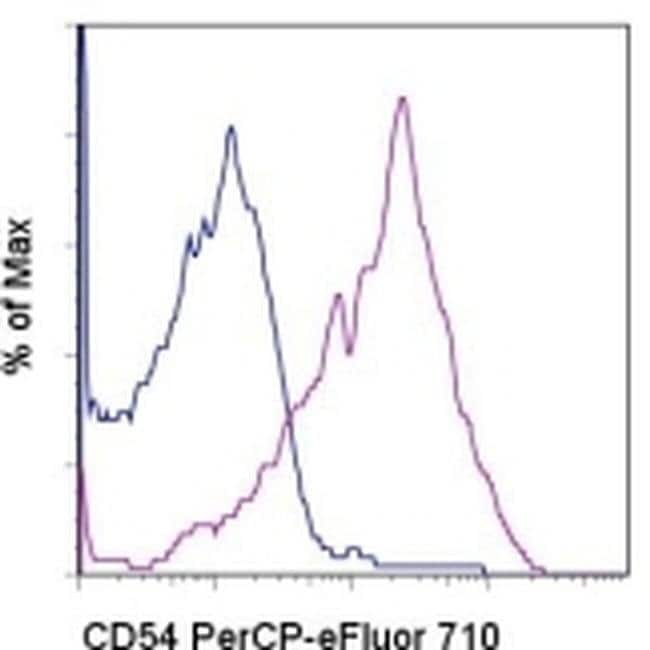
Invitrogen™ CD54 (ICAM-1) Monoclonal Antibody (1A29), PerCP-eFluor™ 710, eBioscience™
Mouse Monoclonal Antibody
Brand: Invitrogen™ 46-0540-80
This item is not returnable.
View return policy
Description
Description: The 1A29 monoclonal antibody reacts with rat CD54, which is also known as intercellular adhesion molecule 1 (ICAM-1). In the immune system, this type I immunoglobulin (Ig)-like transmembrane protein is expressed on lymphocytes, macrophages, dendritic cells, monocytes, granulocytes, and thymic stromal cells. CD54 is also present on endothelial cells and such non-immune cells as hepatocytes, cardiomyocytes, and vascular smooth muscle cells. In addition, reports demonstrate that CD54 expression can be induced in vitro by proinflammatory cytokines, including IFN-gamma, IL-1, CCL2, or TNF-alpha. CD54 plays important roles in transendothelial migration of leukocytes to sites of inflammation and in T cell interactions with antigen presenting cells. Studies indicate that CD54 mediates these functions by binding to lymphocyte function-associated molecule (LFA-1; also known as CD11a/CD18). The 1A29 antibody has been reported to block interactions between CD54 and LFA-1. Applications Reported: This 1A29 antibody has been reported for use in flow cytometric analysis. Applications Tested: This 1A29 antibody has been tested by flow cytometric analysis of rat splenocytes. This can be used at less than or equal to 0.125 μg per test. A test is defined as the amount (μg) of antibody that will stain a cell sample in a final volume of 100 μL. Cell number should be determined empirically but can range from 10^5 to 10^8 cells/test. It is recommended that the antibody be ca...
ICAM-1 (CD54) is an 85-110 kDa single-chain type 1 integral membrane glycoprotein with an extracellular domain of five immunoglobulin superfamily repeats, a transmembrane region and a cytoplasmic domain. ICAM-1 has 7 potential N-linked glycosylation sites and shares considerable amino acid sequence homology with ICAM-3 (CD50) and ICAM-2 (CD102). ICAM-1 binds to integrins of type CD11a/CD18 (leukocyte adhesion molecule, LFA-1), or CD11b/CD18 (Mac-1) and is exploited by Rhinovirus as a receptor. ICAM-1 is expressed by activated endothelial cells and detected on epithelial cells, fibroblasts, chondrocytes, B lymphocytes, T lymphocytes (low), monocytes, macrophages, dendritic cells and neutrophils, with lower levels that increase upon inflammation. ICAM-1 is also detected in some carcinoma and melanoma cells. Soluble ICAM-1 is detectable in the plasma and is elevated in patients with various inflammatory syndromes.
Specifications
| CD54 (ICAM-1) | |
| Monoclonal | |
| 0.2 mg/mL | |
| PBS with 0.09% sodium azide; pH 7.2 | |
| Q00238 | |
| ICAM1 | |
| Affinity chromatography | |
| RUO | |
| 25464 | |
| 4°C, store in dark, DO NOT FREEZE! | |
| Liquid |
| Flow Cytometry | |
| 1A29 | |
| PerCP-eFluor 710 | |
| ICAM1 | |
| BB2; CD54; cell surface glycoprotein P3.58; Human rhinovirus receptor; ICAM; Icam1; ICAM-1; ICAM-1; CD54 homolog; Intercellular adhesion molecule 1; intercellular adhesion molecule 1 (CD54), human rhinovirus receptor; intercellular adhesion molecule-1; intercellular adhesion molecule-1 precursor; Ly 47; Ly-47; major group rhinovirus receptor; MALA2; MALA-2; MyD10; P3.58; sCD54; soluble CD54; Surface antigen of activated B cells | |
| Mouse | |
| 25 μg | |
| Primary | |
| Rat | |
| Antibody | |
| IgG1 κ |
Product Content Correction
Your input is important to us. Please complete this form to provide feedback related to the content on this product.
Product Title
Spot an opportunity for improvement?Share a Content Correction