missing translation for 'onlineSavingsMsg'
Learn More
Learn More
Invitrogen™ CD28 Monoclonal Antibody (CD28.2), PE-eFluor™ 610, eBioscience™
Mouse Monoclonal Antibody
Brand: Invitrogen™ 61-0289-41
This item is not returnable.
View return policy
Description
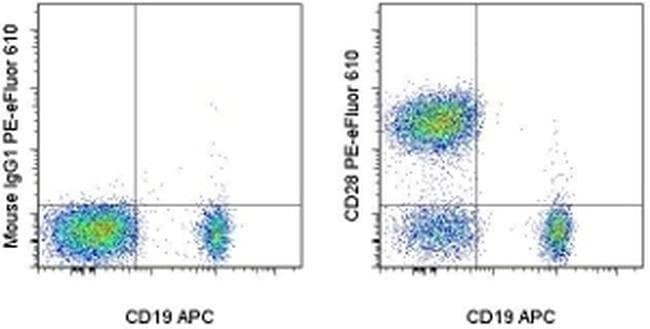
Description: The CD28.2 monoclonal antibody reacts with the human CD28 molecule, a 44 kDa homodimer expressed by thymocytes, mature T cells and plasma cells. CD28 is a ligand for CD80 (B7-1) and CD86 (B7-2) and is a potent co-stimulator of T cells. Signaling through CD28 augments IL-2 and IL-2 receptor expression as well as cytotoxicity of CD3-activated T cells. Applications Reported: This CD28.2 antibody has been reported for use in flow cytometric analysis. Applications Tested: This CD28.2 antibody has been pre-titrated and tested by flow cytometric analysis of normal human peripheral blood cells. This can be used at 5 μL (0.25 μg) per test. A test is defined as the amount (μg) of antibody that will stain a cell sample in a final volume of 100 μL. Cell number should be determined empirically but can range from 10^5 to 10^8 cells/test. PE-eFluor® 610 can be excited with laser lines from 488-561 nm and emits at 607 nm. We recommend using a 610/20 band pass filter (equivalent to PE-Texas Red®). Please make sure that your instrument is capable of detecting this fluorochome. Light sensitivity: This tandem dye is sensitive to photo-induced oxidation. Please protect this vial and stained samples from light. Fixation: Samples can be stored in IC Fixation Buffer (Product # 00-8222) (100 μL of cell sample + 100 μL of IC Fixation Buffer) or 1-step Fix/Lyse Solution (Product # 00-5333) for up to 3 days in the dark at 4°C with minimal impact on brightnes...
CD28 antigen is a 44 kDa disulfide linked homodimeric T cell specific surface glycoprotein. CD28 is a cell adhesion molecule of the immunoglobulin superfamily which is constitutively expressed on most peripheral blood T lymphocytes. Moreover, CD28 is the critical T cell costimulatory receptor that provides the cell the important second activation signal by binding CD80 and CD86 which are expressed by antigen presenting cells. In addition to its co-stimulation role, CD28 functions by preventing T cells from entering an anergic-hyporesponsive state or from undergoing premature apoptotic cell death. In murine peripheral lymphoid organs and in the blood, all CD4+ and CD8+ T cells express CD28. In the thymus, CD28 expression is highest on immature CD3-, CD8+ and CD4+8+ cells, and on CD4-8- cells that express alpha/beta and gamma/delta TCR. The level of CD28 on mature CD4+ and CD8+ alpha/beta TCR+ thymocytes is two- to fourfold lower than on the immature cells. Diseases associated with CD28 dysfunction include mycosis fungiodes and Sezary's Disease.
Specifications
| CD28 | |
| Monoclonal | |
| 5 μL/Test | |
| PBS with BSA and 0.09% sodium azide; pH 7.2 | |
| P10747 | |
| Cd28 | |
| Affinity chromatography | |
| RUO | |
| 940 | |
| 4°C, store in dark, DO NOT FREEZE! | |
| Liquid |
| Flow Cytometry | |
| CD28.2 | |
| PE-eFluor 610 | |
| Cd28 | |
| antigen CD28; CD28; CD28 antigen; CD28 antigen (Tp44); CD28 isoform; CD28 isoform 2; Cd28 molecule; CD28 precursor protein; CD28 protein; CD28 protein precursor; CD28RNA; cell surface protein; CHT28; contains partial extracellular domain; costimulatory molecule B7 receptor CD28; EGK_04709; MGC138290; sCD28; soluble CD28; T44; T-cell costimulatory molecule CD28; T-cell costimulatory molecule Tp44; T-cell-specific surface glycoprotein CD28; T-cell-specific surface glycoprotein CD28 homolog; TP44 | |
| Mouse | |
| 25 Tests | |
| Primary | |
| Human | |
| Antibody | |
| IgG1 κ |
Product Content Correction
Your input is important to us. Please complete this form to provide feedback related to the content on this product.
Product Title
Spot an opportunity for improvement?Share a Content Correction