missing translation for 'onlineSavingsMsg'
Learn More
Learn More
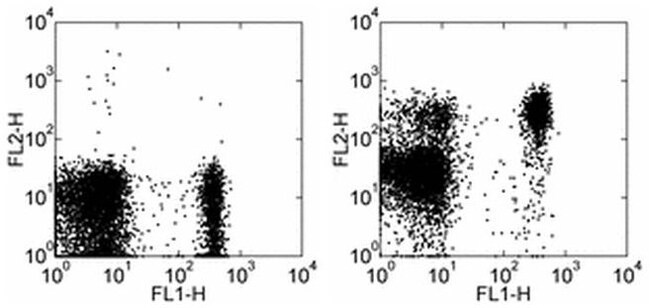
CD197 (CCR7) Monoclonal Antibody (4B12), Biotin, eBioscience™, Invitrogen™

Rat Monoclonal Antibody
£48.56 - £320.00
Specifications
| Antigen | CD197 (CCR7) |
|---|---|
| Clone | 4B12 |
| Concentration | 0.5 mg/mL |
| Applications | Flow Cytometry |
| Classification | Monoclonal |
| Produktkod | Brand | Quantity | Pris | Kvantitet och tillgänglighet | |||||
|---|---|---|---|---|---|---|---|---|---|
| Produktkod | Brand | Quantity | Pris | Kvantitet och tillgänglighet | |||||
|
15289759
|
Invitrogen
13-1971-80 |
25 μg | |||||||
|
15299759
|
Invitrogen™
13-1971-82 |
100 μg |
£216.00
100µg |
Please sign in to purchase this item. Need a web account? Register with us today! | |||||
|
15209769
|
Invitrogen™
13-1971-85 |
500 μg |
£320.00
500µg |
Please sign in to purchase this item. Need a web account? Register with us today! | |||||
Beskrivning
Description: The 4B12 monoclonal antibody reacts with mouse CCR7, also known as EBI-1 and CD197. CCR7 is a chemokine receptor for the chemokines CCL19 (CKβ11, ELC, MIP3β, Scya19, Exodus-3) and CCL21 (CKβ9, SLC, MIP2β, Scya21, Exodus-2). In recent years, the role of chemokines in directing the migration of lymphocytes has been well-characterized. One of the most important mediators of homeostatic trafficking of naive T cells to secondary lymphoid organs (SLO) is the chemokine receptor CCR7. Binding of its ligands, CCL19 and CCL21, mediates the trans endothelial migration of T cells across high endothelial venules into SLO. It has also been demonstrated that CCR7 plays a role in the localization of dendritic cells and B cells during an immune response. CCR7 is a chemokine receptor for the chemokines CCL19 (CKβ11, ELC, MIP3β, Scya19, Exodus-3) and CCL21 (CKβ9, SLC, MIP2β, Scya21, Exodus-2). In addition to its significant role in the chemotaxis of lymphocytes, human CCR7 has also been recognized as a marker for a distinct subset of memory T cells, the central memory (TCM) population. These cells are characterized by the expression of CCR7 and CD62L and reside within peripheral lymphoid organs. CCR7 also plays a role in thymocyte development and its deficiency leads to disturbed thymic architecture, aberrant T cell development, and limited thymocyte expansion.
CCR7 is a member of the G protein coupled receptor family, which is a subfamily of chemokines. CCR7 was identified to be induced by the Epstein Barr virus (EBV), and is thought to be a mediator of EBV effects on B lymphocytes. CCR7 has been reported to be expressed in blood, bone marrow, lymph node, and intestine. CCR7 is particularly expressed in lymphoid tissues and in activated B and T lymphocytes and has been shown to control the migration of memory T cells to inflamed tissues, as well as stimulate dendritic cell maturation. The chemokine (C-C motif) ligand 19 (CCL19/ECL) has been reported to be a specific ligand of this receptor. ESTs have been isolated from blood, embryo, lymph node, and thymus libraries. Receptors for the C - C chemokine family include CCR 1, CCR 2A, CCR 3, CCR 4, CCR 5 and the Duffy blood group antigen. The C-C receptors are important in the function of T cell chemotaxis and migration of phagocytic cells to sites of inflammation.Specifikationer
| CD197 (CCR7) | |
| 0.5 mg/mL | |
| Monoclonal | |
| Liquid | |
| RUO | |
| P47774 | |
| Ccr7 | |
| Primary | |
| 4° C, store in dark, DO NOT FREEZE! | |
| Ccr7 |
| 4B12 | |
| Flow Cytometry | |
| Biotin | |
| Rat | |
| Mouse | |
| 12775 | |
| IgG2a κ | |
| Affinity chromatography | |
| Antibody |
For Research Use Only.
Hittar du en möjlighet till förbättring?Dela en innehållskorrigering
Korrigering av produktinnehåll
Din input är viktig för oss. Fyll i det här formuläret för att ge feedback relaterad till innehållet på denna produkt.
Produkttitel