Learn More
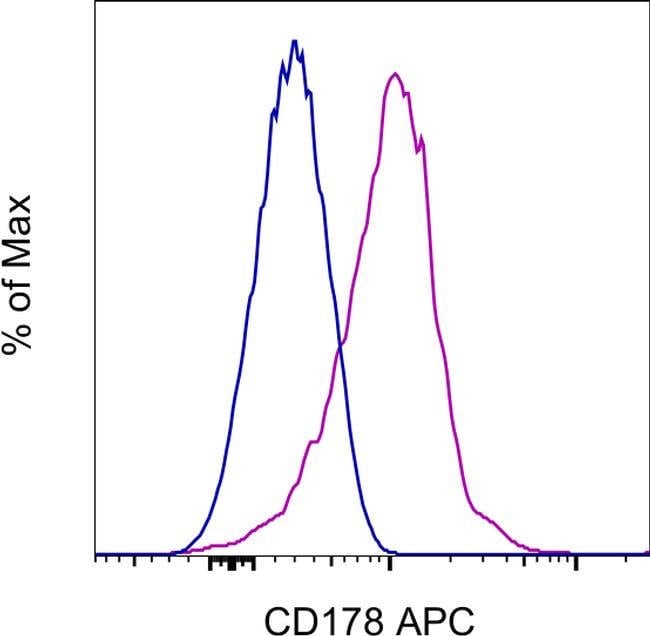
Invitrogen™ CD178 (Fas Ligand) Monoclonal Antibody (NOK-1), APC, eBioscience™

Description
Description: The NOK-1 monoclonal antibody reacts with human Fas (CD95) Ligand, a 40 kDa type II transmembrane glycoprotein. FasL is a member of the TNF family and is expressed by neutrophils, monocytes, and activated T cells and NK cells. The interaction of FasL with its receptor (CD95, Fas) induces Fas-mediated killing of lymphocytes. Human FasL is cleaved from the surface by matrix metalloproteinases (MMPs), resulting in a 26 kDa soluble form. Therefore for optimal detection of surface FasL on activated peripheral blood cells, incubation of cells with an MMP inhibitor is recommended. Applications Reported: This NOK-1 antibody has been reported for use in flow cytometric analysis. Applications Tested: This NOK-1 antibody has been pre-diluted and tested by flow cytometric analysis of CD178 transfected cells. This may be used at 5 μL (1.0 μg) per test. A test is defined as the amount (μg) of antibody that will stain a cell sample in a final volume of 100 μL. Cell number should be determined empirically but can range from 10^5 to 10^8 cells/test. Excitation: 633-647 nm; Emission: 660 nm; Laser: Red Laser.

Specifications
Specifications
| Antigen | CD178 (Fas Ligand) |
| Applications | Flow Cytometry |
| Classification | Monoclonal |
| Clone | NOK-1 |
| Concentration | 5 μL/Test |
| Conjugate | APC |
| Formulation | PBS with BSA and 0.09% sodium azide; pH 7.2 |
| Gene | Faslg |
| Gene Accession No. | P48023 |
| Gene Alias | ADAM10-processed FasL form; ALPS1B; APL; Apoptosis (APO 1) antigen ligand 1; apoptosis (APO-1) antigen ligand 1; Apoptosis (APO-1) antigen ligand 1 (Fas antigen ligand); apoptosis antigen ligand; APT1LG1; APTL; CD178; CD178 antigen; CD95 ligand; CD95 ligand protein;Generalized lymphoproliferative disease (Gld); Cd95l; CD95-L; CD95L protein; fas antigen ligand; Fas ligand; Fas ligand (TNF superfamily, member 6); Fasl; Fas-L; FasL ICD; FasL intracellular domain; Faslg; Fas-LG; generalized lymphoproliferative disease; gld; mutant tumor necrosis factor family member 6; Receptor-binding FasL ectodomain; sFasL; Soluble Fas ligand; soluble form; SPA; SPPL2A-processed FasL form; TNFL; Tnfsf6; TNLG1A; Tumor necrosis factor (ligand) superfamily member 6; Tumor necrosis factor (ligand) superfamily member 6 (apoptosis (APO-1) antigen ligand 1) (Fas antigen ligand); Tumor necrosis factor (ligand) superfamily, member 6 (apoptosis (APO-1) antigen ligand 1) (Fas antigen ligand); Tumor necrosis factor ligand; tumor necrosis factor ligand 1A; tumor necrosis factor ligand superfamily member 6; Tumor necrosis factor ligand superfamily member 6 (TNFL6 / TNFSF6); Tumor necrosis factor ligand superfamily member 6, membrane form; Tumor necrosis factor ligand superfamily member 6, soluble form |
| Show More |
By clicking Submit, you acknowledge that you may be contacted by Fisher Scientific in regards to the feedback you have provided in this form. We will not share your information for any other purposes. All contact information provided shall also be maintained in accordance with our Privacy Policy.