missing translation for 'onlineSavingsMsg'
Learn More
Learn More
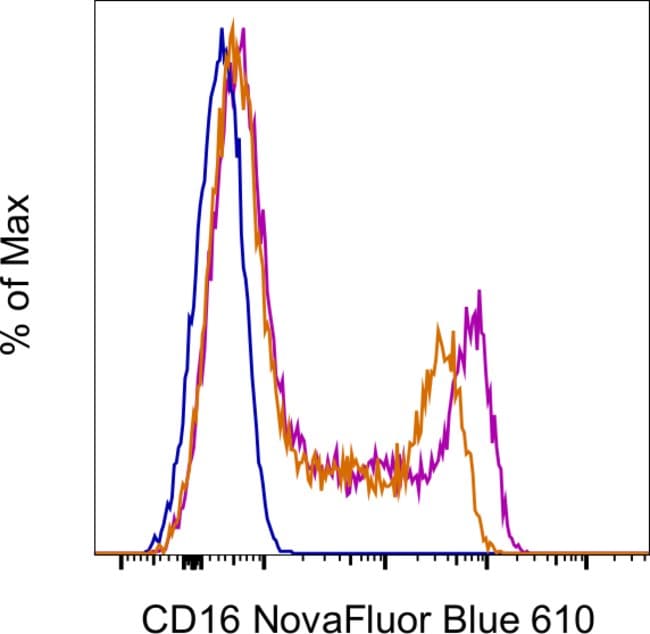

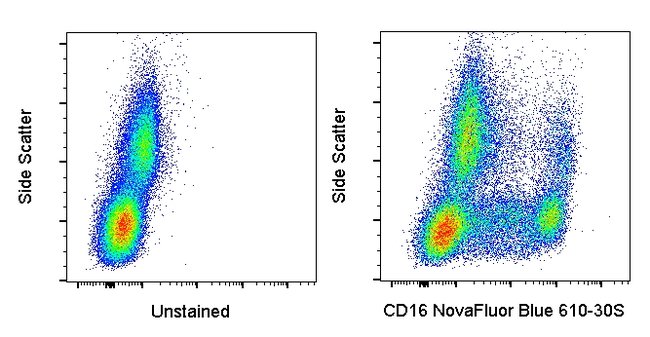
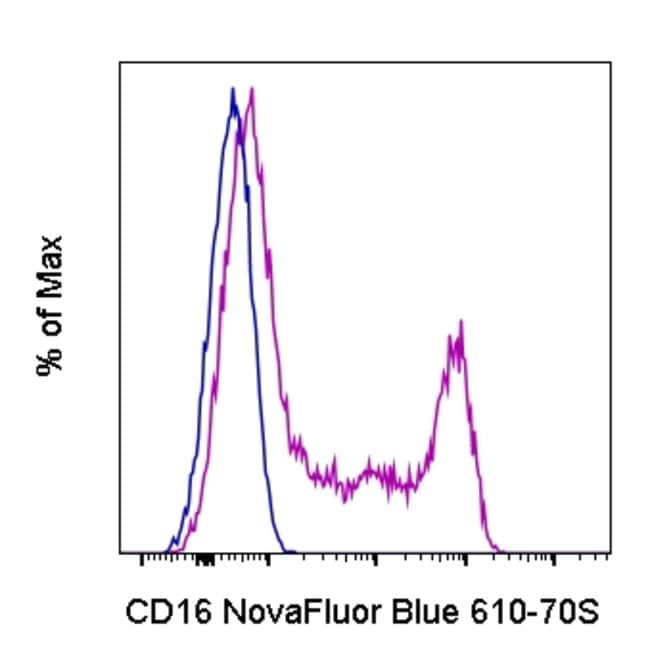
CD16 Monoclonal Antibody (3G8), NovaFluor™ Blue 610-70S, eBioscience™, Invitrogen™
Mouse Monoclonal Antibody
£156.00 - £343.00
Specifications
| Antigen | CD16 |
|---|---|
| Clone | 3G8 |
| Concentration | 4 μL/Test |
| Applications | Flow Cytometry |
| Classification | Monoclonal |
| Product Code | Brand | Quantity | Price | Quantity & Availability | |||||
|---|---|---|---|---|---|---|---|---|---|
| Product Code | Brand | Quantity | Price | Quantity & Availability | |||||
|
17236516
|
Invitrogen
H006T02B06 |
25 Tests |
£156.00
Pack of 25 |
Please sign in to purchase this item. Need a web account? Register with us today! | |||||
|
17286526
|
Invitrogen
H006T03B06 |
100 Tests |
£343.00
Pack of 100 |
Please sign in to purchase this item. Need a web account? Register with us today! | |||||
Description
This 3G8 monoclonal ab reacts with human and Non-human Primate CD16,also known aslow-affinity Fc gamma RIII. CD16 exists as two distinct isoforms, Fc gamma RIIIA and Fc gamma RIIIB. In humans, Fc gamma RIIIA is expressed as a polypeptide-anchored form on monocytes, macrophages, and lymphocytes such as NK cells. T and B cells do not express this Fc receptor. Fc gamma RIIIB is also detected on neutrophils as a GPI-anchored form. Expression of CD16 on lymphocytes and monocytes is similar in Non-human Primates. However, while CD16 is not found on neutrophils in macaques and baboons, this receptor is detected on these cells in sooty mangabeys. Binding of IgG leads to activation of signal transduction pathways, resulting in ab-dependent cell-mediated cytotoxicity(ADCC), phagocytosis, cytokine release, and antigen presentation. Based on cross-blocking studies 3G8 recognizes the same epitope as CB16. However, 3G8 and B73.1 ab clones bind distinct epitopes.
Applications Reported: This 3G8 ab has been reported for use in flow cytometric analysis.
Applications Tested: This 3G8 ab has been pre-diluted and tested by flow cytometric analysis of normal human peripheral blood cells. This may be used at 4uL(0.6ug) per test. A test is defined as the amount(ug) of ab that will stain a cell sample in a final volume of 100uL. Cell number should be determined empirically but can range from 10^5 to 10^8 cells/test. Excitation: 509 nm; Emission: 614 nm; Laser: 488 nm(Blue) Laser
CD16 encodes a receptor that recognizes the Fc portion of immunoglobulin G and is involved in the clearance of immune complexes from the circulation, as well as other functions such as cellular mediated cytotoxicity and enhancement of virus infections. This gene, FCGR3A, shares a high degree of similarity with another nearby gene, FCGR3B, located on chromosome 1. The receptor encoded by this gene is expressed on natural killer (NK) cells as an integral membrane glycoprotein anchored through a transmembrane peptide, while FCGR3B is expressed on polymorphonuclear neutrophils (PMN) where the receptor is anchored through a phosphatidylinositol (PI) linkage. Mutations in this gene have been associated with immunodeficiency 20 and have been linked to susceptibility to recurrent viral infections, susceptibility to systemic lupus erythematosus, and alloimmune neonatal neutropenia. Alternatively spliced transcript variants encoding different isoforms have been found for this gene. Diseases associated with FCGR3A include Immunodeficiency 20 and Herpes Zoster.Specifications
| CD16 | |
| 4 μL/Test | |
| Monoclonal | |
| Liquid | |
| RUO | |
| PBS with 0.09% sodium azide; pH 7.2 | |
| 4833442P21Rik; CD16; CD16-2; CD16A; CD16a antigen; CD16b; CD32; CD32 receptor 2; CDw32; cytolytic trigger molecule G7; Fc fragment of IgG intermediate affinity IV receptor; Fc fragment of IgG low affinity IIIa receptor; Fc fragment of IgG receptor IIIa; Fc fragment of IgG receptor IIIb; Fc fragment of IgG, low affinity III, receptor for (CD16); Fc fragment of IgG, low affinity IIIa, receptor; Fc fragment of IgG, low affinity IIIa, receptor (CD16a); Fc fragment of IgG, low affinity IIIa, receptor for (CD16); Fc fragment of IgG, low affinity IIIa, receptor for (CD16); Fc fragment of IgG, low affinity III, receptor for (CD16); Fc fragment of IgG, low affinity IIIb, receptor (CD16b); Fc gamma receptor III; Fc gamma receptor IIIa; Fc gamma receptor III-A; Fc gamma receptor IIIb; Fc gamma RIIIa; Fc gammaRIV; Fc receptor, IgG, low affinity III; Fc receptor, IgG, low affinity IV; Fc receptor-like 3; Fcg receptor III; FCG2; FCG3; Fc-gamma receptor III-2 (CD 16); Fc-gamma receptor IIIb (CD 16); Fc-gamma receptor IIIb (CD16); Fc-gamma RII-b; Fc-gamma RII-c; fc-gamma RIII; Fc-gamma RIIIa; Fc-gamma RIII-alpha; fc-gamma RIIIb; fc-gamma RIII-beta; Fc-gamma-RIIb; Fc-gamma-RIIc; FcgammaRIII; FcgammaRIII a.1; FcgammaRIII a.2; FcgammaRIII a.3; FcgammaRIIIA; FcgammaRIV; FCGR2; FCGR2A; FCGR2B; FCGR2C; FCGR3; Fcgr3a; FCGR3B; Fcgr4; FCGRIII; FcgRIV; FcR-10; FcRII-b; FcRII-c; FcRIII; FCRIIIA; FCRIIIb; Fcrl3; IGFR3; IgG Fc gamma receptor III; igG Fc receptor III; IgG Fc receptor III-1; igG Fc receptor III-2; IMD20; immunoglobulin G Fc receptor III; LOC100911825; Low affinity immunoglobulin gamma Fc region receptor III; low affinity immunoglobulin gamma Fc region receptor III-A; Low affinity immunoglobulin gamma Fc region receptor III-B; low affinity immunoglobulin gamma Fc region receptor III-like; Low affinity immunoglobulin gamma Fc region receptor IV; neutrophil-specific antigen NA; RP11-5K23.1; transmembrane receptor FcgammaRIII-X | |
| Fcgr3, FCGR3A, FCGR3B | |
| Primary | |
| 4° C, store in dark, DO NOT FREEZE! | |
| FCGR3A |
| 3G8 | |
| Flow Cytometry | |
| NovaFluor Blue 610-70S | |
| Mouse | |
| Baboon, Chimpanzee, Cynomolgus Monkey, Human, Non-human Primate, Rhesus Monkey | |
| A3RFZ7, O75015, P08637 | |
| 2214, 2215, 720006 | |
| IgG1 | |
| Affinity chromatography | |
| Antibody |
Spot an opportunity for improvement?Share a Content Correction
Product Content Correction
Your input is important to us. Please complete this form to provide feedback related to the content on this product.
Product Title