missing translation for 'onlineSavingsMsg'
Learn More
Learn More
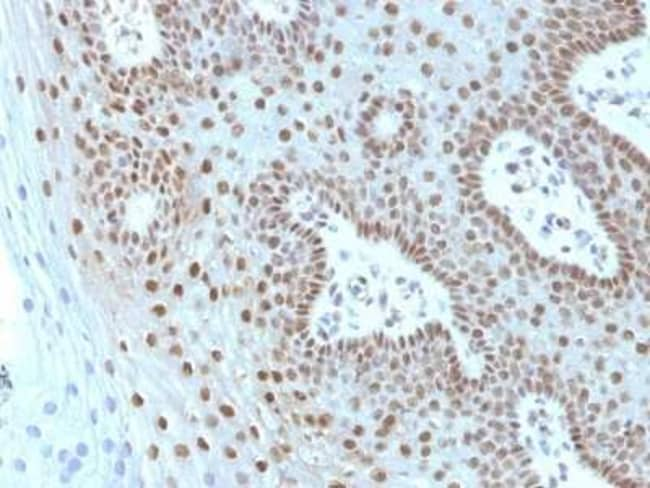
c-Myc Antibody (MYC275 + MYC909), Novus Biologicals™
Mouse Monoclonal Antibody
Brand: Novus Biologicals NBP2-45147-0.1MG
This item is not returnable.
View return policy
Description
Ensure accurate, reproducible results in Flow Cytometry, Immunohistochemistry (Paraffin), Immunofluorescence
c-Myc Monoclonal specifically detects c-Myc in Human samples. It is validated for Flow Cytometry, Immunohistochemistry, Immunocytochemistry/Immunofluorescence, Immunohistochemistry-Paraffin, Immunofluorescence.
Specifications
| c-Myc | |
| Monoclonal | |
| 0.2 mg/mL | |
| Flow Cytometry 0.5 - 1 ug/million cells, Immunohistochemistry-Paraffin 1 - 2 ug/ml, Immunofluorescence 1 - 2 ug/ml | |
| P01106 | |
| MYC | |
| Recombinant human c-myc protein | |
| 0.1 mg | |
| Autophagy, Cancer, Cancer Stem Cells, Cell Cycle and Replication, Chromatin Research, Core ESC Like Genes, Epitope Tags, Myc Epitope Tags, Stem Cell Markers, Transcription Factors and Regulators, Tumor Suppressors | |
| 4609 | |
| Human | |
| Purified |
| Flow Cytometry, Immunohistochemistry (Paraffin), Immunofluorescence | |
| MYC275 + MYC909 | |
| Unconjugated | |
| 10mM PBS and 0.05% BSA with 0.05% Sodium Azide | |
| avian myelocytomatosis viral oncogene homolog, BHLHE39, bHLHe39MRTL, Class E basic helix-loop-helix protein 39, c-Myc, MYC, myc proto-oncogene protein, MYCC, myc-related translation/localization regulatory factor, Proto-oncogene c-Myc, Transcription factor p64, v-myc avian myelocytomatosis viral oncogene homolog, v-myc myelocytomatosis viral oncogene homolog (avian) | |
| Mouse | |
| Protein A or G purified | |
| RUO | |
| Primary | |
| It recognizes a transcription factor of 64-67kDa, identified as c-myc. This MAb shows no cross-reaction with v-myc. c-myc is involved in the control of cell proliferation and differentiation and is amplified and/or over-expressed in a variety of tumors. Over-expression of c-myc protein occurs frequently in luminal cells of prostate intraepithelial neoplasia as well as in most primary carcinomas and metastatic disease. Rearrangement of the MYC gene is found in 3% to 16% of diffuse large B-cell lymphoma (DLBCL s) and in nearly 100% of Burkitt lymphomas (BL). Identifying MYC status is important in establishing final diagnosis of DLBCL, BL, or B-cell lymphoma, with features intermediate between DLBCL and BL as well as in differential diagnoses of the lymphomas. | |
| Store at 4C. | |
| IgG1 κ |
Product Content Correction
Your input is important to us. Please complete this form to provide feedback related to the content on this product.
Product Title
For Research Use Only
Spot an opportunity for improvement?Share a Content Correction