missing translation for 'onlineSavingsMsg'
Learn More
Learn More

Invitrogen™ BAK Polyclonal Antibody

Description
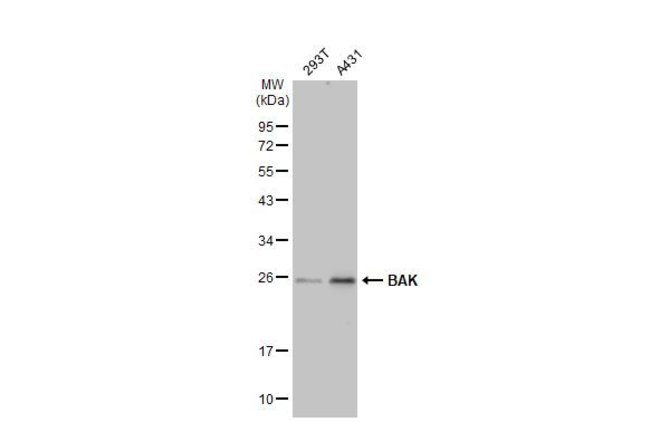
Recommended positive controls: 293T, A431, H1299, HeLa, HepG2, Molt-4, Raji. Predicted reactivity: Rhesus Monkey (100%). Store product as a concentrated solution. Centrifuge briefly prior to opening the vial.
The protein encoded by this gene belongs to the BCL2 protein family. BCL2 family members form oligomers or heterodimers and act as anti- or pro-apoptotic regulators that are involved in a wide variety of cellular activities. This protein localizes to mitochondria, and functions to induce apoptosis. It interacts with and accelerates the opening of the mitochondrial voltage-dependent anion channel, which leads to a loss in membrane potential and the release of cytochrome c. This protein also interacts with the tumor suppressor P53 after exposure to cell stress.

Specifications
Specifications
| Antigen | BAK |
| Applications | Immunohistochemistry (Paraffin), Western Blot |
| Classification | Polyclonal |
| Concentration | 1 mg/mL |
| Conjugate | Unconjugated |
| Formulation | PBS with 20% glycerol and 0.01% thimerosal; pH 7 |
| Gene | BAK1 |
| Gene Accession No. | Q16611 |
| Gene Alias | Apoptosis regulator BAK; BAK; Bak1; BAK-LIKE; BCL2 antagonist/killer 1; Bcl2 homologous antagonist/killer; Bcl-2 homologous antagonist/killer; BCL2-antagonist/killer 1; BCL2L7; bcl2-L-7; BCL2-like 7 protein; BCL2-like 7protein; bcl-2-like protein 7; Bcl-2-likeous antagonist/killer; CDN1; MGC117255; MGC3887; N-Bak; N-BAK1; pro-apoptotic protein BAK |
| Gene Symbols | BAK1 |
| Show More |
Product Title
By clicking Submit, you acknowledge that you may be contacted by Fisher Scientific in regards to the feedback you have provided in this form. We will not share your information for any other purposes. All contact information provided shall also be maintained in accordance with our Privacy Policy.
Spot an opportunity for improvement?