missing translation for 'onlineSavingsMsg'
Learn More
Learn More
Invitrogen™ ATG10 Polyclonal Antibody

Description
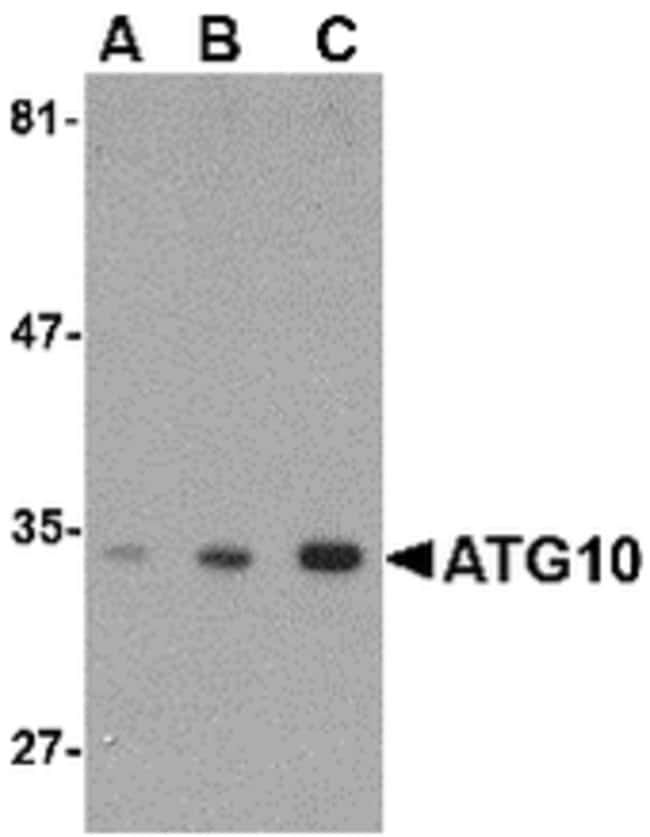
A suggested positive control is SK-N-SH cell lysate. PA5-20454 can be used with blocking peptide PEP-0571. Antibodies should not be exposed to prolonged high temperatures.
ATG10 is involved in autophagy which is a process for the bulk degradation of cytosolic compartments by lysosomes/vacuoles. The formation of autophagosomes involves a dynamic rearrangement of the membrane for which two ubiquitin-like modifications (the conjugation of APG12p and the modification of a soluble form of MAP-LC3 to a membrane-bound form) are essential. APG10 is an E2-like enzyme involved in two ubiquitin-like modifications essential for autophagosome formation, ATG12 -ATG5 conjugation and modification of a soluble form of MAP-LC3 (MAP1LC3A), a homolog of yeast Apg8, to a membrane-bound form. The protein ATG10 is ubiquitously expressed and the human APG10L gene is localized on chromosome 5q14.2.

Specifications
Specifications
| Antigen | ATG10 |
| Applications | Western Blot |
| Classification | Polyclonal |
| Concentration | 1 mg/mL |
| Conjugate | Unconjugated |
| Formulation | PBS with 0.02% sodium azide |
| Gene | ATG10 |
| Gene Accession No. | Q8R1P4, Q9H0Y0 |
| Gene Alias | 5330424L23Rik; 5430428K15Rik; Agp10; AI852123; APG10; APG10L; APG10-like; Apg10p; ATG10; ATG10 autophagy related 10 homolog; Atg10l; autophagy related 10; autophagy related 10 homolog; autophagy-related 10; autophagy-related protein 10; DKFZp586I0418; FLJ13954; mAPG10; pp12616; Ubiquitin-like-conjugating enzyme ATG10 |
| Gene Symbols | ATG10 |
| Show More |
Product Title
By clicking Submit, you acknowledge that you may be contacted by Fisher Scientific in regards to the feedback you have provided in this form. We will not share your information for any other purposes. All contact information provided shall also be maintained in accordance with our Privacy Policy.
Spot an opportunity for improvement?