missing translation for 'onlineSavingsMsg'
Learn More
Learn More
PeproTech APRIL Polyclonal Antibody, PeproTech®, Invitrogen™

Rabbit Polyclonal Antibody
£177.00 - £1468.00
Specifications
| Antigen | APRIL |
|---|---|
| Concentration | 0.1-1.0 mg/mL |
| Applications | ELISA, Western Blot |
| Classification | Polyclonal |
| Conjugate | Unconjugated |
| Product Code | Brand | Quantity | Price | Quantity & Availability | |||||
|---|---|---|---|---|---|---|---|---|---|
| Product Code | Brand | Quantity | Price | Quantity & Availability | |||||
|
17855763
|
PeproTech
500-P192-50UG |
50 μg |
£177.00
50µg |
Please sign in to purchase this item. Need a web account? Register with us today! | |||||
|
17825243
|
PeproTech
500-P192-100UG |
100 μg |
£228.00
100µg |
Please sign in to purchase this item. Need a web account? Register with us today! | |||||
|
17865583
|
PeproTech
500-P192-1MG |
1 mg |
£1468.00
1mg |
Please sign in to purchase this item. Need a web account? Register with us today! | |||||
Description
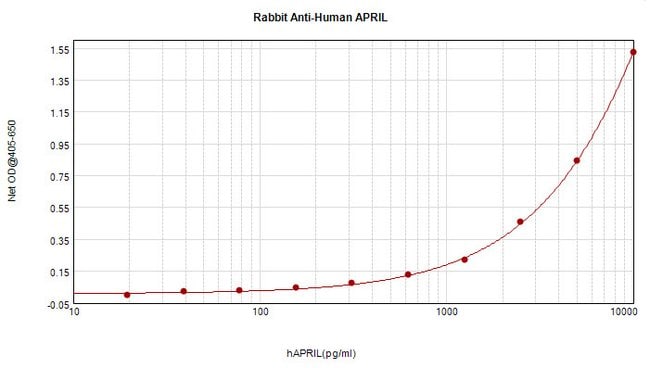
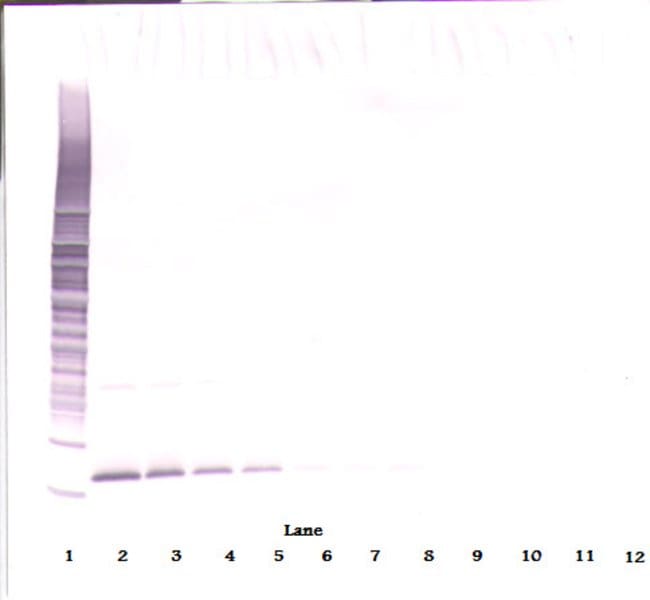
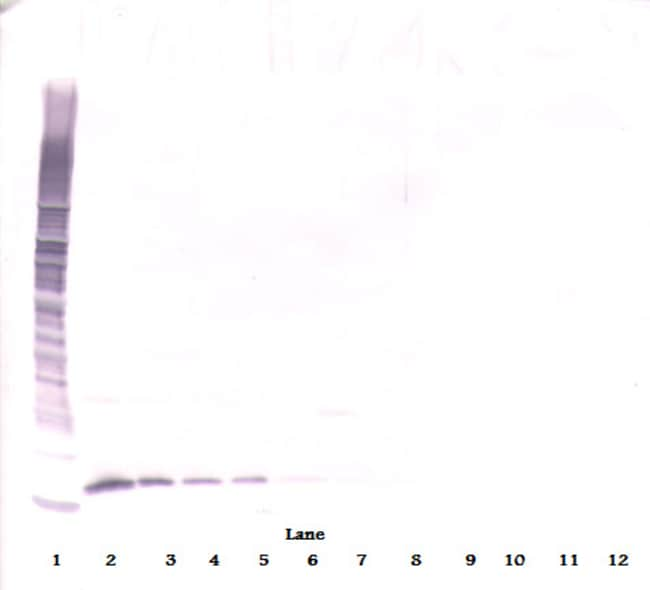
AA Sequence of recombinant protein: AVLTQKQKKQ HSVLHLVPIN ATSKDDSDVT EVMWQPALRR GRGLQAQGYG VRIQDAGVYL LYSQVLFQDV TFTMGQVVSR EGQGRQETLF RCIRSMPSHP DRAYNSCYSA GVFHLHQGDI LSVIIPRARA KLNLSPHGTF LGFVKL. Preparation: Produced from sera of rabbits immunized with highly pure Recombinant Human APRIL. Anti-Human APRIL-specific antibody was purified by affinity chromatography employing an immobilized Human APRIL matrix. Sandwich ELISA: To detect Human APRIL by sandwich ELISA (using 100 μL/well antibody solution) a concentration of 0.5-2.0 μg/mL of this antibody is required. This antigen affinity purified antibody, in conjunction with PeproTech Biotinylated Anti-Human APRIL (500-P192Bt) as a detection antibody, allows the detection of at least 0.2-0.4 ng/well of Recombinant Human APRIL. Western Blot: To detect Human APRIL by Western Blot analysis this antibody can be used at a concentration of 0.1-0.2 μg/mL. Used in conjunction with compatible secondary reagents the detection limit for Recombinant Human APRIL is 1.5-3.0 ng/lane, under either reducing or non-reducing conditions.
Members in the TNF superfamily regulate immune responses and induce apoptosis. A novel member in the TNF family was recently identified by several groups and designated APRIL (for A PRoliferation-Inducing Ligand), TALL2 (for TNF and ApoL-related Leukocyte-expressed Ligand 2), and TRDL 1a (for TNF related death ligand 1a) in human and mouse. Two receptors for APRIL were recently identified and designated TACI and BCMA. APRIL stimulates B and T cell proliferation, triggers humoral immune responses, activates NF-kB, and induces cell death. APRIL and its close relative of BlyS and their receptors BCMA and TACI are involved in diseases of autoimmunity and cancer.Specifications
| APRIL | |
| ELISA, Western Blot | |
| Unconjugated | |
| Rabbit | |
| Human | |
| O75888 | |
| 8741 | |
| Insect cells-derived Recombinant Human APRIL. | |
| Antigen affinity chromatography | |
| TNFSF13 |
| 0.1-1.0 mg/mL | |
| Polyclonal | |
| Lyophilized | |
| RUO | |
| PBS with no preservative | |
| 2310026N09Rik; A proliferation-inducing ligand; APRIL; CD256; TALL2; TALL-2; TNF- and APOL-related leukocyte expressed ligand 2; TNF-related death ligand 1; Tnfsf13; TNLG7B; Trdl1; TRDL-1; tumor necrosis factor (ligand) superfamily, member 13; tumor necrosis factor ligand 7B; tumor necrosis factor ligand superfamily member 13; tumor necrosis factor superfamily member 13; tumor necrosis factor-like protein ZTNF2; tumor necrosis factor-related death ligand-1; UNQ383/PRO715; ZTNF2 | |
| TNFSF13 | |
| Primary | |
| -20°C |
Spot an opportunity for improvement?Share a Content Correction
Product Content Correction
Your input is important to us. Please complete this form to provide feedback related to the content on this product.
Product Title