missing translation for 'onlineSavingsMsg'
Learn More
Learn More
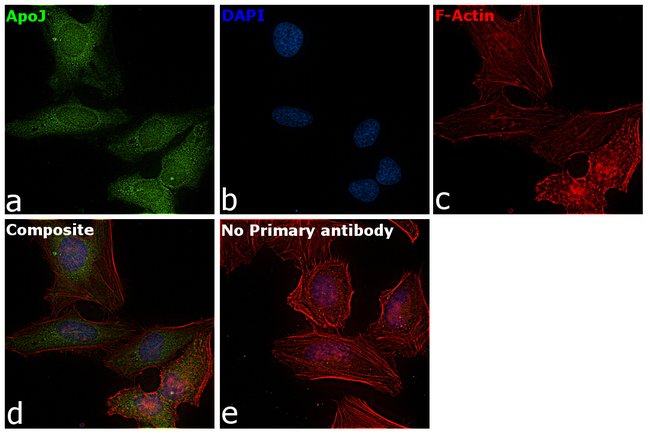


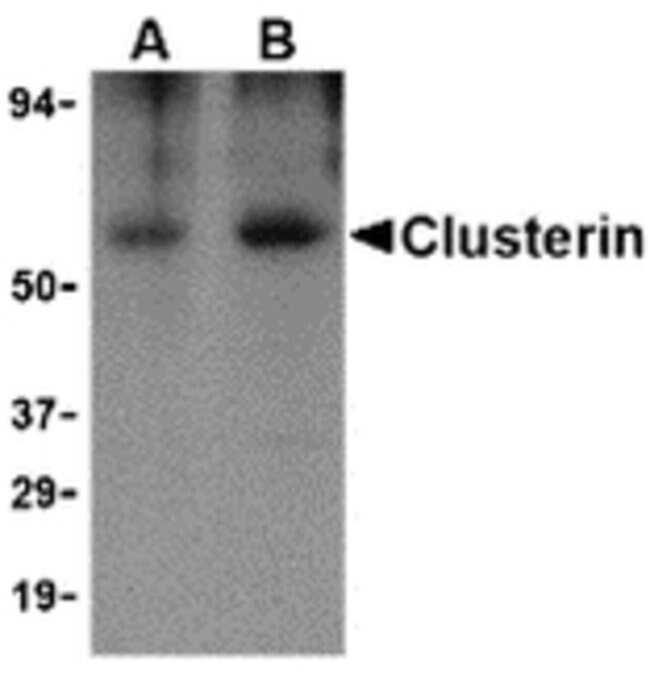
Invitrogen™ Apolipoprotein J Polyclonal Antibody

Description
This antibody reacts with Clusterin isoform 1. A suggested positive control is human brain tissue lysate.
Isoform 1 functions as extracellular chaperone that prevents aggregation of nonnative proteins. Prevents stress-induced aggregation of blood plasma proteins. Inhibits formation of amyloid fibrils by APP, APOC2, B2M, CALCA, CSN3, SNCA and aggregation-prone LYZ variants (in vitro). Does not require ATP. Maintains partially unfolded proteins in a state appropriate for subsequent refolding by other chaperones, such as HSPA8/HSC70. Does not refold proteins by itself. Binding to cell surface receptors triggers internalization of the chaperone-client complex and subsequent lysosomal or proteasomal degradation. Secreted isoform 1 protects cells against apoptosis and against cytolysis by complement. Intracellular isoforms interact with ubiquitin and SCF (SKP1-CUL1-F-box protein) E3 ubiquitin-protein ligase complexes and promote the ubiquitination and subsequent proteasomal degradation of target proteins. Promotes proteasomal degradation of COMMD1 and IKBKB. Modulates NF-kappa-B transcriptional activity. Nuclear isoforms promote apoptosis. Mitochondrial isoforms suppress BAX-dependent release of cytochrome c into the cytoplasm and inhibit apoptosis. Plays a role in the regulation of cell proliferation.

Specifications
Specifications
| Antigen | Apolipoprotein J |
| Applications | Immunohistochemistry, Western Blot, Immunocytochemistry |
| Classification | Polyclonal |
| Concentration | 1 mg/mL |
| Conjugate | Unconjugated |
| Formulation | PBS with 0.02% sodium azide |
| Gene | Clu |
| Gene Accession No. | P10909 |
| Gene Alias | AAG4; Aging associated protein 4; Aging-associated gene 4 protein; aging-associated protein 4; AI893575; apo j; Apo J a; Apo J alpha; Apo J b; Apo J beta; Apo J α; Apo J β; Apo Ja; Apo Jb; ApoJ; Apo-J; ApoJ a; ApoJ alpha; ApoJ b; ApoJ beta; ApoJ α; ApoJ β; ApoJa; ApoJalpha; ApoJb; ApoJbeta; Apolipoprotein J; CLI; Clu; CLU1; CLU2; clusterin; Clusterin alpha / beta chain; Clusterin alpha chain; Clusterin beta chain; Clustrin; Complement associated protein SP40; complement cytolysis inhibitor; Complement cytolysis inhibitor a chain; Complement cytolysis inhibitor b chain; complement lysis inhibitor; complement-associated protein SP-40,40; D14Ucla3; DAG; Dimeric acid glycoprotein; GP80; HGNC:2095; ku70-binding protein 1; Ku70-binding protein 1 (KUB1); KUB1; MGC24903; Msgp-2; NA1/NA2; RATTRPM2B; SGP2; Sgp-2; SP40; SP-40; Sugp-2; sulfated glycoprotein 2; Sulfated glycoprotein 2 (SGP2); testosterone repressed prostate message; testosterone repressed prostate message 2; Testosterone repressed prostate message 2 (TPRM2B); testosterone repressed prostate message-2; testosterone-repressed prostate message; testosterone-repressed prostate message 2; testostrone-repressed prostate message 2; Trpm2; TRPM-2; TRPM2B; Trpmb |
| Gene Symbols | Clu |
| Show More |
Product Title
By clicking Submit, you acknowledge that you may be contacted by Fisher Scientific in regards to the feedback you have provided in this form. We will not share your information for any other purposes. All contact information provided shall also be maintained in accordance with our Privacy Policy.
Spot an opportunity for improvement?