missing translation for 'onlineSavingsMsg'
Learn More
Learn More
PKCα (pT497) Mouse, PE, Clone: K14-984, BD
Mouse Monoclonal Antibody
Brand: BD Biosciences 560141
This item is not returnable.
View return policy
Description
The Protein Kinase C (PKC) family of serine/threonine protein kinases is involved in a number of processes such as growth, differentiation, and cytokine secretion. Three categories exist, conventional PKC (cPKC), novel PKC (nPKC), and atypical PKC (aPKC). All have C-terminal kinase domains, which are closely related to those of protein kinases A and B (Akt), and variable N-terminal regulatory domains that give them different modes of activation. For example, cPKC (α, βI, βII, and γ isoforms) are calcium-activated, phospholipid-dependent serine/threonine-specific enzymes that can also be activated by phorbol esters. However, nPKC (δ, ε, η, and θ isoforms) and aPKC (ζ, ι, and λ isoforms) are Ca2+-independent. aPKC are unique in that their activity is independent of diacylglycerols and phorbol esters. Phosphorylation at three conserved sites in the kinase domain is required for catalytic activity. Specifically, the threonine 497 (T497) of PKCα is in the activation loop of the kinase domain and is phosphorylated by the constitutively active phosphoinositide-dependent kinase-1 (PDK-1). The K14-984 monoclonal antibody recognizes the phosphorylated T497 in the kinase domain of human PKCα.
Host Species: Mouse
Clone: K14-984
Isotype: IgG1 κ
Species Reactivity: Human, Mouse
Immunogen: Phosphorylated Human PKCα Peptide
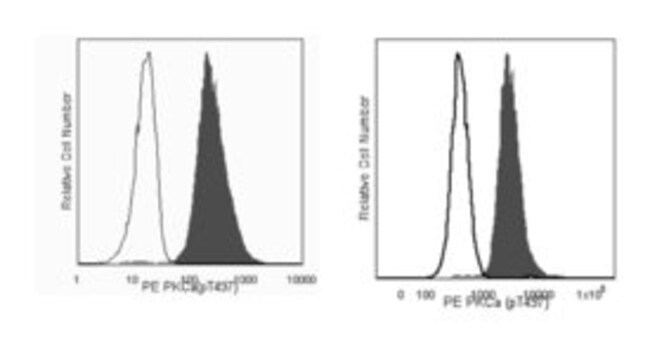
Intracellular Staining

Specifications
| PKCα (pT497) | |
| Monoclonal | |
| PE | |
| Mouse | |
| Affinity Purified | |
| RUO | |
| Primary | |
| Store undiluted at 4°C and protected from prolonged exposure to light. Do not freeze. |
| Flow Cytometry | |
| K14-984 | |
| Aqueous buffered solution containing BSA and ≤0.09% sodium azide. | |
| Phosphorylated Human PKCα Peptide | |
| 50 Tests | |
| Cell Biology | |
| Human, Mouse | |
| IgG1 κ |
Product Content Correction
Your input is important to us. Please complete this form to provide feedback related to the content on this product.
Product Title
Spot an opportunity for improvement?Share a Content Correction