missing translation for 'onlineSavingsMsg'
Learn More
Learn More
Phospho-Tau (Ser422) Rabbit anti-Human, Mouse, Rat, Polyclonal, Invitrogen™
Rabbit Polyclonal Antibody
Brand: Invitrogen OPA103151
This item is not returnable.
View return policy
Description
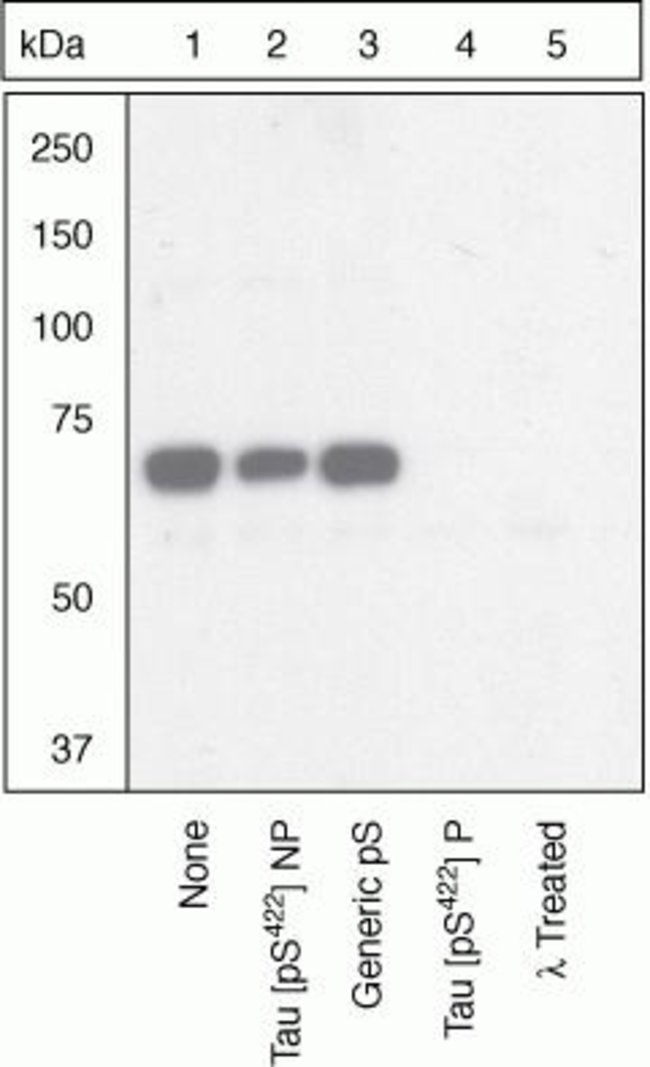
OPA1-03151 detects human p-Tau (pSer422) from human samples. Mouse and rat share 100% homology with the immunizing peptide but have not yet been tested. OPA1-03151 has been successfully used in Western blot procedures. By Western blot, this antibody detects an ∽63 kDa protein representing p-Tau (pSer422). OPA1-03151 immunizing phosphopeptide was derived from a region of human tau that contains serine 422. For up to 1 week, store at 4°C. For long-term storage, store -20°C.
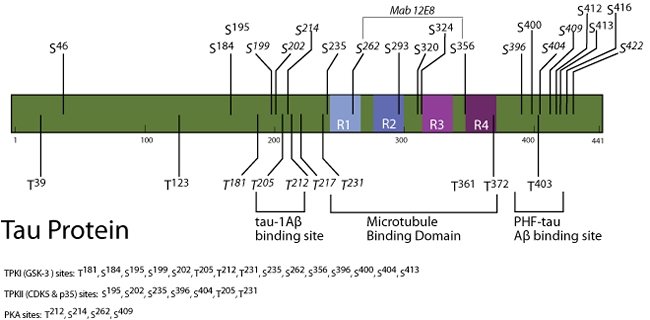
Tau is a neuronal microtubule-associated protein found predomitly on axons. The function of Tau is to promote tubulin polymerization and stabilize microtubules. The C-terminus binds axonal microtubules while the N- terminus binds neural plasma membrane components, suggesting that tau functions as a linker protein between both. Axonal polarity is predetermined by TAU/MAPT localization (in the neuronal cell) in the domain of the cell body defined by the centrosome. The short isoforms allow plasticity of the cytoskeleton while the longer isoforms may preferentially play a role in its stabilization. In its hyper-phosphorylated form, Tau is the major component of paired helical filaments (PHF), the building block of neurofibrillary lesions in Alzheimer′s diseases (AD) brain. Hyper-phosphorylation impairs the microtubule binding function of Tau, resulting in the destabilization of microtubules in AD brains, ultimately leading to the degeneration of the affected neurons. Numerous serine/threonine kinases phosphorylate Tau, including GSK-3beta, protein kinase A (PKA), cyclindependent kinase 5 (cdk5) and casein kinase II. Hyper-phosphorylated Tau is found in neurofibrillary lesions in a range and other central nervous system disorders such as Pick′s disease, frontotemporal dementia, cortico-basal degeneration and progressive supranuclear palsy.Abbreviations: AP=Affinity Purification, ChIP=Chromatin IP, CM=Confocal Microscopy, DB=Dot Blot, EIA=ELISA, EM=Electron Microscopy, FC=Flow Cytometry, GS=Gel Supershift, IC=Immunocytochemistry, IF=Immunofluorescence, IH=Immunohistology/Immunohistochemistry, IP=Immunoprecipitation, IPK=IP Kinase Assay, KA=Kinase Assay, NEUT=Neutralization, PIA=Peptide Inhibition Assay, RIA=Radioimmunossay, TCA=T Cell Activation, WB=Western Blotting, Species: Am=Amphibian, Av=Avian, B=Bovine, Ca=Cat ,Ck=Chicken, D=Dog, Dr=Deer, Ds=Drosophila, El=Elk, Fg=Frog, Fs=Fish, Ft=Ferret, G=Goat, Gp=Guinea Pig, H=Horse, Hm=Hamster, Hu=Human, K=Kangaroo, Ms=Mouse, Nhp=Non-Human Primate, O=Ovine, P=Porcine, Rb=Rabbit, Rp=Reptile, Rt=Rat, Ys=Yeast, Xn=Xenopus, (wk)=cross reacts weakly

Specifications
| Phospho-Tau (Ser422) | |
| Polyclonal | |
| Dulbecco′s PBS with 1mg/mL BSA, 50% glycerol and 0.05% sodium azide; pH 7.3 | |
| P10636, P10637, P19332 | |
| MAPT | |
| Synthetic phosphopeptide derived from a region of human Tau that contains serine 422. | |
| 100 μL | |
| Primary | |
| Human, Mouse, Rat | |
| Antibody | |
| IgG |
| Western Blot | |
| Unconjugated | |
| MAPT | |
| DDPAC, Disinhibition Dementia Parkinsonism Amyotrophy Complex, FLJ31424, FTDP17, MAPTL, Microtubule Associated Protein Tau, MSTD, Neurofibrillary Tang | |
| Rabbit | |
| Affinity chromatography | |
| RUO | |
| 17762, 29477, 4137 | |
| -20° C, Avoid Freeze/Thaw Cycles | |
| Liquid |
Product Content Correction
Your input is important to us. Please complete this form to provide feedback related to the content on this product.
Product Title
Spot an opportunity for improvement?Share a Content Correction