missing translation for 'onlineSavingsMsg'
Learn More
Learn More
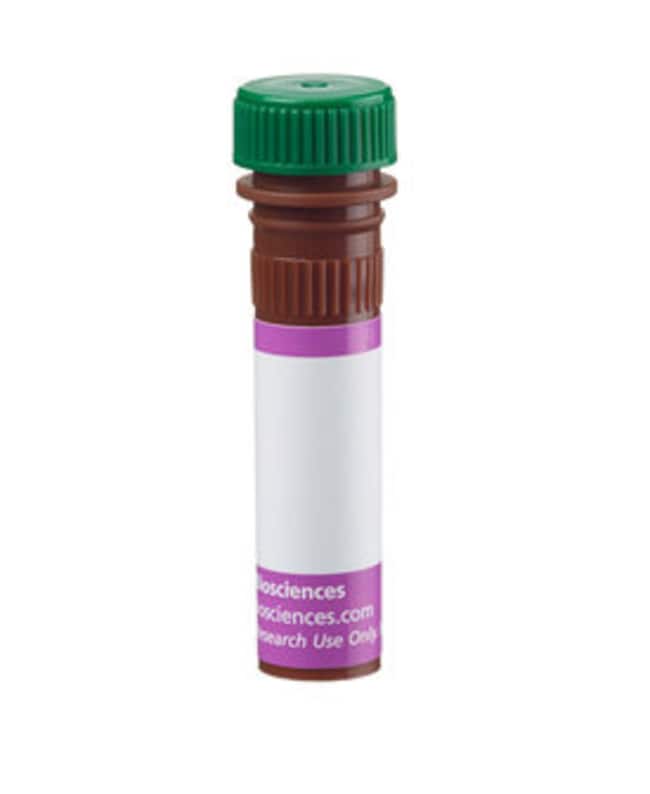

This item is not returnable.
View return policy
Description
The 1H9 monoclonal antibody clone specifically binds to human and mouse Paired box protein Pax-5. Pax-5 is a ∽50 kDa protein that is also known as B-cell-specific transcription factor and B cell specific activator protein (BSAP). Pax-5 is a member of the paired box (Pax) family of transcription factors. It is expressed in pro-B, pre-B and mature B cells. Through the Groucho family of co-repressors, Pax-5 likely functions as a transcriptional repressor of non-B-lymphoid genes during the B cell commitment process. In the early stages of B cell development, Pax-5 influences the expression of several B-cell-specific genes, such as CD19 and CD20 and maintains B cell identity. Pax-5 suppression is involved in the upregulation of Blimp-1 leading to the development of Pax-5-negative plasma cells. Pax-5 mRNA is transiently detected in the mesencephalon and spinal cord during embryogenesis. Expression then shifts to the fetal liver and correlates with the onset of B lymphopoiesis. Altered forms and expression patterns of Pax-5 have been associated with some lymphoid and nonlymphoid cancers.
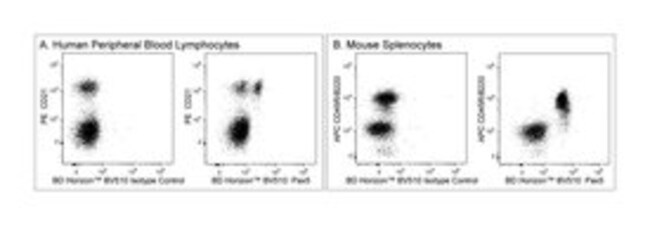
The antibody was conjugated to BD Horizon™ BV510 which is part of the BD Horizon™ Brilliant Violet™ family of dyes. With an Ex Max of 405-nm and Em Max at 510-nm, BD Horizon™ BV510 can be excited by the violet laser and detected in the BD Horizon™ V500 (525/50-nm) filter set. BD Horizon™ BV510 conjugates are useful for the detection of dim markers off the violet laser.

Specifications
| PAX-5 | |
| Monoclonal | |
| Brilliant Violet 510 | |
| Aqueous buffered solution containing BSA and ≤0.09% sodium azide. | |
| Recombinant Mouse Pax-5 protein containing aa 154-284 | |
| 50 Tests | |
| Primary | |
| Store undiluted at 4°C and protected from prolonged exposure to light. Do not freeze. |
| Flow Cytometry | |
| 1H9 | |
| Pax5, PAX5, KLP, BSAP, EBB-1; B-cell-specific transcription factor | |
| Rat | |
| Affinity Purified | |
| RUO | |
| Human, Mouse | |
| IgG2a κ |
Product Content Correction
Your input is important to us. Please complete this form to provide feedback related to the content on this product.
Product Title
Spot an opportunity for improvement?Share a Content Correction