missing translation for 'onlineSavingsMsg'
Learn More
Learn More
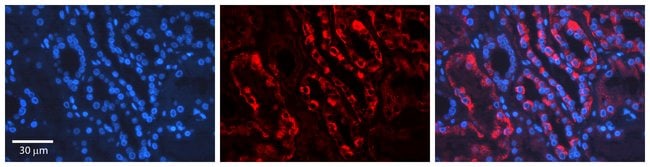
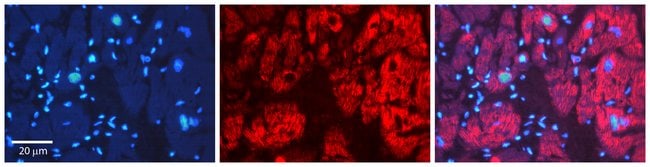
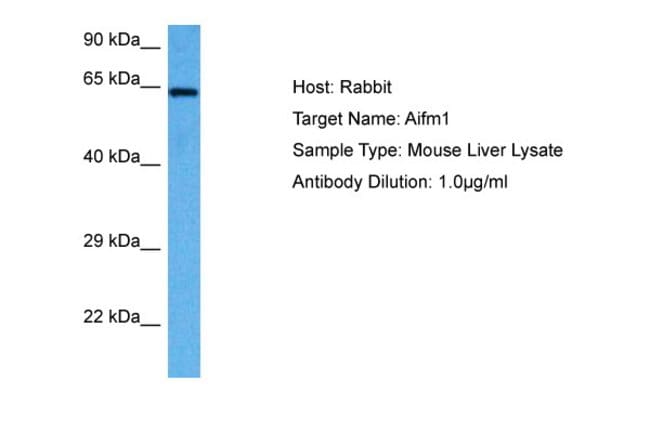
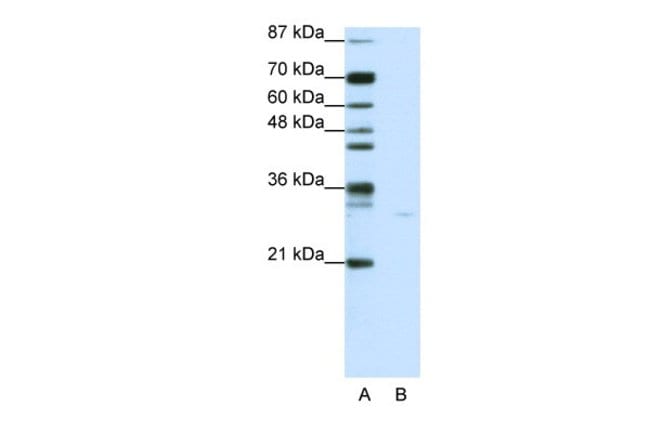
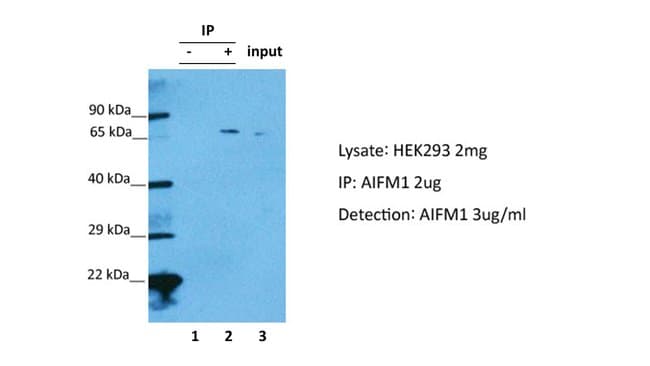
Invitrogen™ AIF Polyclonal Antibody

Rabbit Polyclonal Antibody
Brand: Invitrogen™ PA5113680
This item is not returnable.
View return policy
Description
Immunogen sequence: VDSSLPTVGV FAKATAQDNP KSATEQSGTG IRSESETESE ASEITIPPST For short term use, store at 2-8°C up to 1 week. For long term storage, store at -20°C in small aliquots to prevent freeze-thaw cycles. Predicted homology: Cow: 100%; Dog: 100%; Guinea Pig: 93%; Horse: 100%; Human: 100%; Mouse: 100%; Pig: 100%; Rabbit: 93%; Rat: 100%; Sheep: 100%; Zebrafish: 79%.
Apoptosis Inducing Factor (AIF) causes chromatin condensation and DNA fragmentation. AIF was recently identified, and cloned. Apoptosis is characterized by several morphological nuclear changes including chromatin condensation and nuclear fragmentation. These changes are triggered by the activation of members of caspase family, caspase activated DNase, and several novel proteins. Like the critical molecules, cytochrome c and caspase-9, in apoptosis, AIF localizes in mitochondria. AIF translocates to the nucleus when apoptosis is induced and induces mitochondria to release the apoptogenic proteins cytochrome c and caspase-9. AIF induces chromatin condensation and large scale DNA fragmentation, which are the hallmarks of apoptosis, of the isolated nucleus and the nucleus in live cells by microinjection and apoptosis stimuli. AIF is highly conserved between human and mouse and widely expressed. Mutations in the AIF gene cause combined oxidative phosphorylation deficiency 6, which results in a severe mitochondrial encephalomyopathy. Alternative splicing results in multiple transcript variants of AIF and a related pseudogene has been identified on chromosome 10.
Specifications
| AIF | |
| Polyclonal | |
| Unconjugated | |
| AIFM1 | |
| AG1; AGR1; Aif; AIFM1; AIFsh2; apoptosis inducing factor mitochondria associated 1; apoptosis inducing factor, mitochondria associated 1; apoptosis-inducing factor 1, mitochondrial; apoptosis-inducing factor, mitochondrion-associated 1; apoptosis-inducing factor, mitochondrion-associated, 1; CMT2D; CMTX4; COWCK; COXPD6; DFNX5; ER protein 18; ER protein 19; ERP18; ERP19; hAG-1; harlequin; Hq; hTLP19; MGC111425; mitochondrial apoptosis-inducing factor 1; NADMR; NAMSD; pcd8; PDCD8; PDIA16; programmed cell death 8 (apoptosis-inducing factor); programmed cell death protein 8; RP3-438D16.2; striatal apoptosis-inducing factor; testicular secretory protein Li 4; TLP19; UNQ713/PRO1376 | |
| Rabbit | |
| Affinity chromatography | |
| RUO | |
| 26926, 9131 | |
| -20°C, Avoid Freeze/Thaw Cycles | |
| Liquid |
| Immunohistochemistry (Paraffin), Immunoprecipitation, Western Blot | |
| 0.5 mg/mL | |
| PBS with 2% sucrose and 0.09% sodium azide | |
| O95831, Q9Z0X1 | |
| AIFM1 | |
| Synthetic peptide directed towards the C terminal region of human PDCD8 (aa 498-547). | |
| 100 μL | |
| Primary | |
| Human, Mouse | |
| Antibody | |
| IgG |
Product Content Correction
Your input is important to us. Please complete this form to provide feedback related to the content on this product.
Product Title
Spot an opportunity for improvement?Share a Content Correction