missing translation for 'onlineSavingsMsg'
Learn More
Learn More
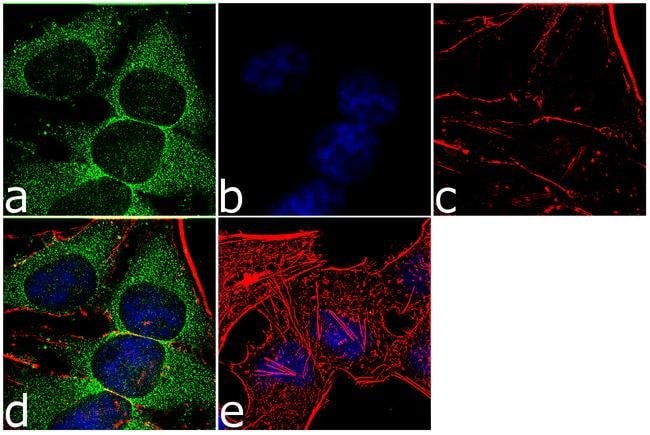
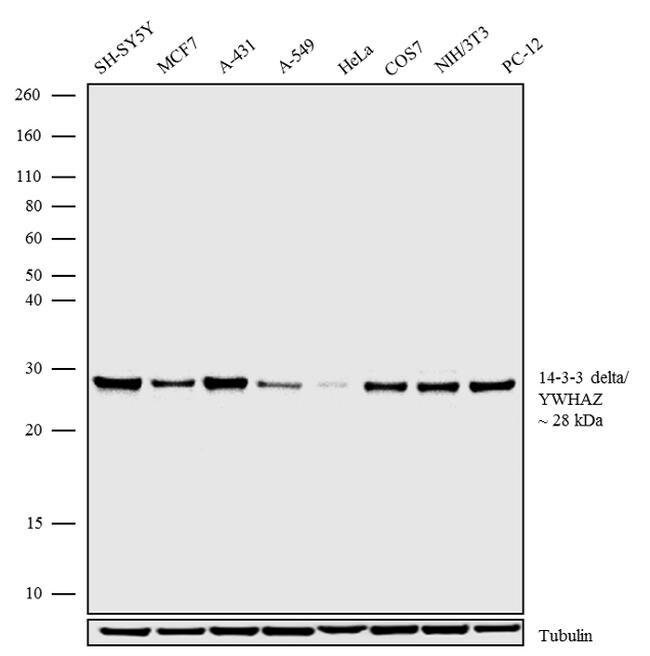
Invitrogen™ 14-3-3 zeta Recombinant Superclonal™ Antibody (1HCLC)
Rabbit Recombinant Superclonal Antibody
Brand: Invitrogen™ 711507
This item is not returnable.
View return policy
Description
This antibody is predicted to react with Monkey, Horse, Goat Recombinant rabbit Superclonal™ antibodies are unique offerings from Thermo Fisher Scientific. They are comprised of a selection of multiple different recombinant monoclonal antibodies, providing the best of both worlds - the sensitivity of polyclonal antibodies with the specificity of monoclonal antibodies - all delivered with the consistency only found in a recombinant antibody. While functionally the same as a polyclonal antibody - recognizing multiple epitope sites on the target and producing higher detection sensitivity for low abundance targets - a recombinant rabbit Superclonal™ antibody has a known mixture of light and heavy chains. The exact population can be produced in every lot, circumventing the biological variability typically associated with polyclonal antibody production. Note: Formerly called Recombinant polyclonal antibody, this product is now rebranded as Recombinant Superclonal™ antibody. The physical product and the performance remain unchanged.
At least seven isoforms comprise the highly conserved 14-3-3 family of homo- and heterodimeric proteins that are abundantly expressed in all eukaryotic cells. Although more than seven isoforms of 14-3-3 have been described, some redundancies have appeared upon sequencing. The 14-3-3s are thought to be key regulators of signal transduction events mediated through their binding to serine-phosphorylated proteins. By interacting with Cdc25C, 14-3-3 regulates entry into the cell cycle and through interaction with Bad, prevents apoptosis. Other proteins that have been shown to bind to 14-3-3s include members of the protein kinase C family, Cbl, IRS-1, polyoma middle-T antigen, nitrate reductase, S-raf and the IGF-1 receptor. Detection of 14-3-3 proteins in cerebrospinal fluid has been shown to be useful in the differential diagnosis of Creutzfeldt-Jakob disease and other prion diseases.
Specifications
| 14-3-3 zeta | |
| Recombinant Superclonal | |
| 0.5 mg/mL | |
| PBS with 0.09% sodium azide; pH 7.4 | |
| P63101, P63102, P63104 | |
| Ywhaz | |
| Peptides corresponding to human 14-3-3 delta/zeta (aa68-86, aa131-149). | |
| 100 μg | |
| Primary | |
| Human, Mouse, Rat | |
| Antibody | |
| IgG |
| Western Blot, Immunocytochemistry | |
| 1HCLC | |
| Unconjugated | |
| Ywhaz | |
| 1110013I11Rik; 14-3-3 delta; 14-3-3 protein zeta/delta; 14-3-3 protein/cytosolic phospholipase A2; 14-3-3 zeta; 1433Z; 14-3-3z; 14-3-3zeta; 14-3-3-zeta; 143Z; AI596267; AL022924; AU020854; epididymis luminal protein 4; epididymis secretory protein Li 3; epididymis secretory protein Li 93; factor activating exoenzyme S; FAS; HEL4; HEL-S-3; HEL-S-93; KCIP-1; mitochondrial import stimulation factor S1 subunit; Msfs1; phospholipase A2; protein kinase C inhibitor protein 1; protein kinase C inhibitor protein-1; SEZ-2; tyrosine 3/tryptophan 5 -monooxygenase activation protein, zeta polypeptide; tyrosine 3/tryptophan 5-monooxygenase activation protein zeta polypeptide; tyrosine 3-monooxygenase tryptophan 5-monooxygenase activation protein; tyrosine 3-monooxygenase/tryptophan 5-monooxygenase activation protein zeta; tyrosine 3-monooxygenase/tryptophan 5-monooxygenase activation protein, delta polypeptide; tyrosine 3-monooxygenase/tryptophan 5-monooxygenase activation protein, zeta; tyrosine 3-monooxygenase/tryptophan 5-monooxygenase activation protein, zeta polypeptide; YWHAD; YWHAZ | |
| Rabbit | |
| Protein A | |
| RUO | |
| 22631, 25578, 7534 | |
| Store at 4°C short term. For long term storage, store at -20°C, avoiding freeze/thaw cycles. | |
| Liquid |
Product Content Correction
Your input is important to us. Please complete this form to provide feedback related to the content on this product.
Product Title
Spot an opportunity for improvement?Share a Content Correction