Learn More


Invitrogen™ Ubiquitin Monoclonal Antibody (Ubi-1)

Description
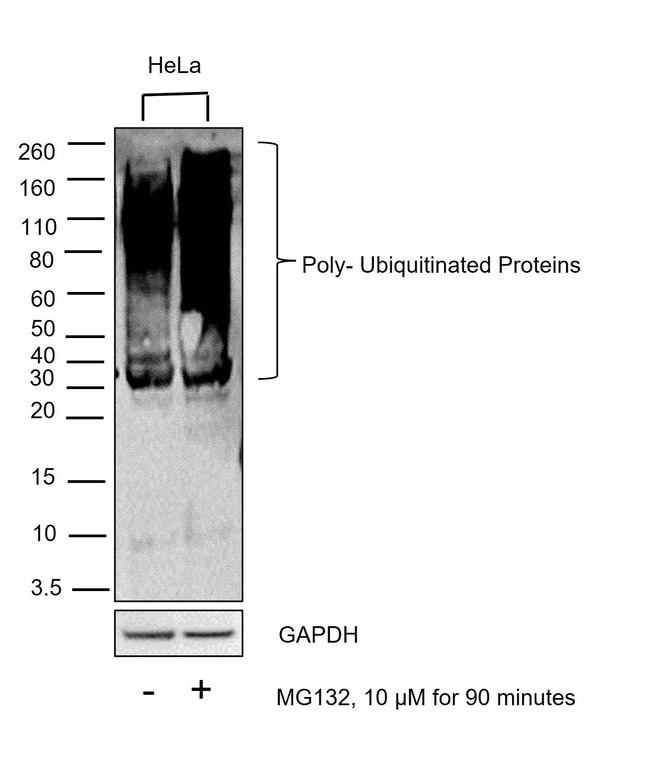
13-1600 recognizes ubiquitin, both conjugated and unconjugated. It reacts with a single chain 8.5 kDa protein. The ubiquitin molecule appears to be present in all eukaryotic cells and has an identical primary structure in all animals. Ubiquitin is present in the nucleus, cytoplasm, and on cell surface membranes. This antibody is suitable for immunohistochemical staining of alcohol- or paraformaldehyde-fixed, paraffin-embedded or frozen tissue sections. Heat-induced epitope retrieval with citrate buffer, pH 6.0, is required for specific staining of formalin-fixed, paraffin-embedded tissue sections. To stain, incubate 30-60 minutes at room temperature or overnight at 4°C. This antibody may also be used in ELISA and has been successfully used in western blot analysis of ubiquitinated proteins in mouse thymocytes. To perform western blotting, prepare lysis buffer in 10 mM N-Ethylmaleimide to inhibit ubiquitin-conjugating enzymes. N-Ethylmaleimide inactivates certain enzymes by blocking free sulfhydryls. After electrophoresis and transfer, pre-incubate transferred membranes in denaturing buffer (6 M guanidine-HCl, 20 mM Tris-HCl, pH 7.5, 5 mM betamercaptoethanol, 1 mM PMSF) for 30-60 minutes at 4°C, followed by extensive PBS washing.

Specifications
Specifications
| Antigen | Ubiquitin |
| Applications | ELISA, Immunohistochemistry, Immunoprecipitation, Western Blot |
| Classification | Monoclonal |
| Clone | Ubi-1 |
| Concentration | 0.5 mg/mL |
| Conjugate | Unconjugated |
| Formulation | PBS with 0.1% sodium azide; pH 7.4 |
| Gene | UBB |
| Gene Accession No. | P0CG47, P0CG48, P0CG49, P0CG50, P0CG53, P0CG62, P0CH28, P62979, P62983, P62984, P62985, P62987, P62992, P63048, P79781, Q3T0B7, Q6ZWY3, Q71UM5 |
| Gene Alias | 0610006J14Rik; 1810034D23Rik; 2700054O04Rik; 40S ribosomal protein S27a; 40S ribosomal protein S27-like; 40S ribosomal protein S27-like protein; AI194771; AL033289; CEP80; CG5271; CG5271-PA; Chap1; Dmel\CG5271; Dmel_CG5271; Dub80; epididymis luminal protein 112; epididymis secretory protein Li 50; HEL112; HEL-S-50; hm:zeh0386; HMG20; hPLIC-2; HRIHFB2157; HUBCEP52; ik:tdsubc_1f2; l(2)04820; l(2)31Ei; LOC100912032; LOC101747587; male female sterile 31; mfs(2)31; mfs(2)48; mfs48; OTTHUMP00000200786; OTTHUMP00000201692; PLIC-2; polyubiquitin; polyubiquitin B; polyubiquitin C; poly-ubiquitin precursor; polyubiquitin-B; Polyubiquitin-C; polyubiquitin-C-like; RE44350p; ribosomal protein S27; ribosomal protein S27 like; ribosomal protein S27A; ribosomal protein S27a L homeolog; ribosomal protein S27a S homeolog; ribosomal protein S27-like; ribosomal protein S27-like protein; RPL40; RpS27; Rps27a; rps27a.L; rps27a.S; RpS27A-PA; RPS27L; S27A; similar to polyubiquitin; similar to ubiquitin-S27a fusion protein; Small ribosomal subunit protein eS27-like; Small ribosomal subunit protein eS31; tdsubc_1f2; TI-225; UB3-D; Uba52; UBA80; UBB; Ubb2; UBC; UBCEP1; UBCEP80; Ubi-f80; Ubi-m; Ubiq; Ubiquilin 2; ubiquitin; ubiquitin (34 AA) (1 is 2nd base in codon); ubiquitin and ribosomal protein S27a; ubiquitin B; ubiquitin C; ubiquitin carboxyl extension protein 80; ubiquitin copy 4; ubiquitin fusion 80; ubiquitin polyprotein (heat shock related); ubiquitin/ribosomal protein; ubiquitin-40S ribosomal protein S27a; ubiquitin-40S ribosomal protein S27a-like; ubiquitin-CEP80; ubiquitin-hybrid protein precursor; Ubiquitin-monomeric; Ubiquitin-related; Ubiquitin-related 1; Ubiquitin-related 2; ubiquitin-S27a fusion protein; Unknown (protein for MGC:127652); unnamed protein product; XELAEV_18028796mg; xx:tdsubc_1f2; zgc:66168; zgc:66168 protein |
| Show More |
By clicking Submit, you acknowledge that you may be contacted by Fisher Scientific in regards to the feedback you have provided in this form. We will not share your information for any other purposes. All contact information provided shall also be maintained in accordance with our Privacy Policy.