Learn More

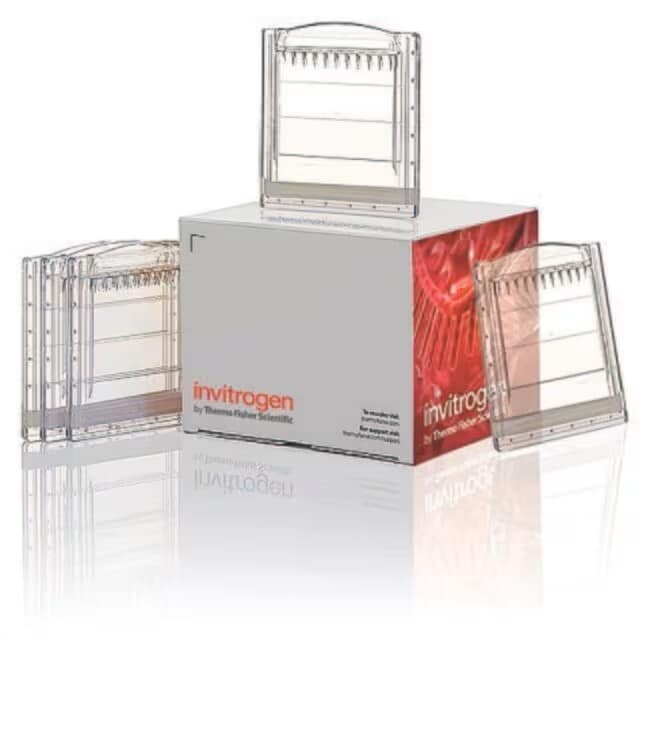
Invitrogen™ NativePAGE™ Bis-Tris Mini Protein Gels, 3 to 12%, 1.0 mm
-

£190.00
£180.65 / Pack of 10
Save £9.35
4% Off
Log in to see stock.

Description
Invitrogen NativePAGE Bis-Tris Protein gels are precast polyacrylamide mini-gels that provides sensitive, high-resolution analysis of native proteins and protein complexes for molecular mass estimations and assessment of purity. They are based on the blue native polyacrylamide gel electrophoresis (BN PAGE) technique developed by Schägger and von Jagow, which overcomes the limitations of traditional native electrophoresis by providing a near-neutral operating pH and detergent compatibility.
Invitrogen NativePAGE Bis-Tris Protein gels are precast polyacrylamide mini-gels that provides sensitive, high-resolution analysis of native proteins and protein complexes for molecular mass estimations and assessment of purity. They are based on the blue native polyacrylamide gel electrophoresis (BN PAGE) technique developed by Schägger and von Jagow, which overcomes the limitations of traditional native electrophoresis by providing a near-neutral operating pH and detergent compatibility.
Features of the NativePAGE Bis-Tris Protein gels include:
- Wide molecular weight resolving range of 15–10,000 kDa
- Neutral-pH separation, which better preserves the native state of protein complexes
- Resolution of all proteins regardless of their isoelectric point (pI)
- Ability to analyze membrane-protein complexes in their native conformations
- Ability to obtain better resolution than with traditional tris-glycine native electrophoresis
How NativePAGE Bis-Tris Protein gels work
In SDS-PAGE, SDS functions as a charge-shift molecule that denatures proteins by conferring on them a net negative charge and enables proteins to migrate towards the anode. BN PAGE uses Coomassie G-250 as the charge-shift molecule, which binds to proteins and confers a net negative charge while maintaining the proteins in their nondenatured, native state. The near-neutral pH of the NativePAGE Bis-Tris Protein gels provides maximum stability of both the proteins and the gel matrix, resulting in a highly sensitive method for analysis of native membrane-protein complexes and offering superior band resolution over traditional Tris-glycine gel systems.
For transferring proteins to a membrane, we recommend using NuPAGE transfer buffers for traditional wet transfer and PVDF membranes. NuPAGE transfer buffers maintain the neutral pH environment established during electrophoresis. Nitrocellulose membranes are not compatible for blotting since the membrane will bind the Coomassie G-250 dye very tightly. Alternatively, rapid semi-dry transfer can be done using the Power Blotter (Cat. No. PB0013) or rapid dry transfer using the iBlot 3 Gel Transfer Device (IB31001) using PVDF membranes.

Specifications
Specifications
| Content And Storage | Store at 2°C to 8°C. Do not freeze. |
| Gel Percentage | 3 to 12% |
| Gel Size | Mini |
| Gel Thickness | 1.0 mm |
| Gel Type | Bis-Tris |
| Sample Loading Volume | Up to 15 μL |
| Separation Range | 30 to 10,000 kDa |
| Separation Type | Native |
| Wells | 15-well |
| Mode of Separation | Molecular Weight |
| Show More |
For Research Use Only.
By clicking Submit, you acknowledge that you may be contacted by Fisher Scientific in regards to the feedback you have provided in this form. We will not share your information for any other purposes. All contact information provided shall also be maintained in accordance with our Privacy Policy.