Learn More
Invitrogen™ CD4 Monoclonal Antibody (RM4-5), Qdot™ 605

Description
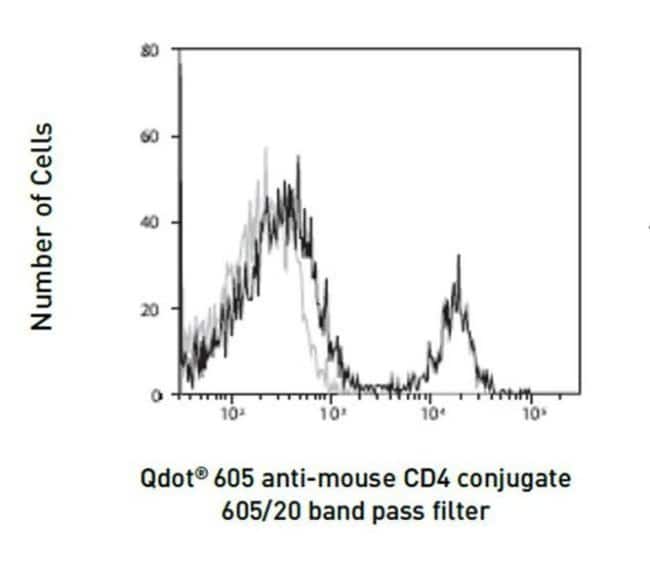
Qdot™ Antibody (Ab) conjugates possess a bright fluorescence emission that makes them well suited for the detection of low-abundance extracellular proteins. Approximately the same size as R-phycoerythrin (R-PE) and compatible with existing organic fluorophore conjugates, Qdot™ Ab conjugates can be excited with any wavelength below their emission maximum, but are best excited by UV or violet light. The narrow, symmetric emission profiles of Qdot Ab conjugates allow for minimal compensation when using a single excitation source, and the very long stoke shifts enable better, more efficient multicolor assays using the 405 nm violet laser. Available in multiple colors for use in flow cytometry, these advantages make Qdot Ab conjugates powerful tools for antibody labeling and staining. Staining: Stain cells in any standard staining buffer, such as phosphate buffered saline (PBS) with 1% bovine serum albumin (BSA). We recommend analysis of cells within 18 hours of staining. If dilute reagent is used, dilute only the quantity of reagent to be used within one day. Qdot Ab conjugates may be mixed with other antibodies, but use the diluted conjugates on the day of dilution. Qdot Ab conjugates can be used for surface staining applications with most conventional sample preparation reagents, such as Cal-Lyse™ Lysing Solution and FIX & PERM™ reagents, with minimal effect on fluorescence. We have observed some batches of BD FACS™ Lysing Solution to interf...

Specifications
Specifications
| Antigen | CD4 |
| Applications | Flow Cytometry |
| Classification | Monoclonal |
| Clone | RM4-5 |
| Conjugate | Qdot 605 |
| Formulation | 0.05M borate with 1M betaine and 0.05% sodium azide; pH 8.3 |
| Gene | CD4 |
| Gene Accession No. | P06332 |
| Gene Alias | Activation B7-1 antigen; B7; B7.1; B7-1; BB1; B-lymphocyte activation antigen B7; CD28LG; CD28LG1; CD4; CD4 antigen; CD4 antigen (p55); CD4 antigen p55; Cd4 molecule; CD4 precursor; CD4 receptor; CD4, allele 1; cd4a; CD4mut; CD80; CD80 antigen (CD28 antigen ligand 1, B7-1 antigen); CD80 molecule; cell surface glycoprotein CD4; costimulatory factor CD80; costimulatory molecule variant IgV-CD80; CTLA-4 counter-receptor B7.1; fCD4; L3T4; LAB7; Leu-3; Ly-4; lymphocyte antigen CD4; lymphocyte antigen CD4 precursor; membrane protein; p55; T-cell differentiation antigen L3T4; T-cell surface antigen T4/Leu-3; T-cell surface glycoprotein CD4; T-cell surface glycoprotein CD4 precursor (T-cell surface antigen T4/Leu-3) (T-cell differentiation antigen L3T4); T-lymphocyte activation antigen CD80; W3/25; W3/25 antigen |
| Gene Symbols | CD4 |
| Show More |
By clicking Submit, you acknowledge that you may be contacted by Fisher Scientific in regards to the feedback you have provided in this form. We will not share your information for any other purposes. All contact information provided shall also be maintained in accordance with our Privacy Policy.